Home
Class 12
PHYSICS
A uniform wire of resistance per unit le...

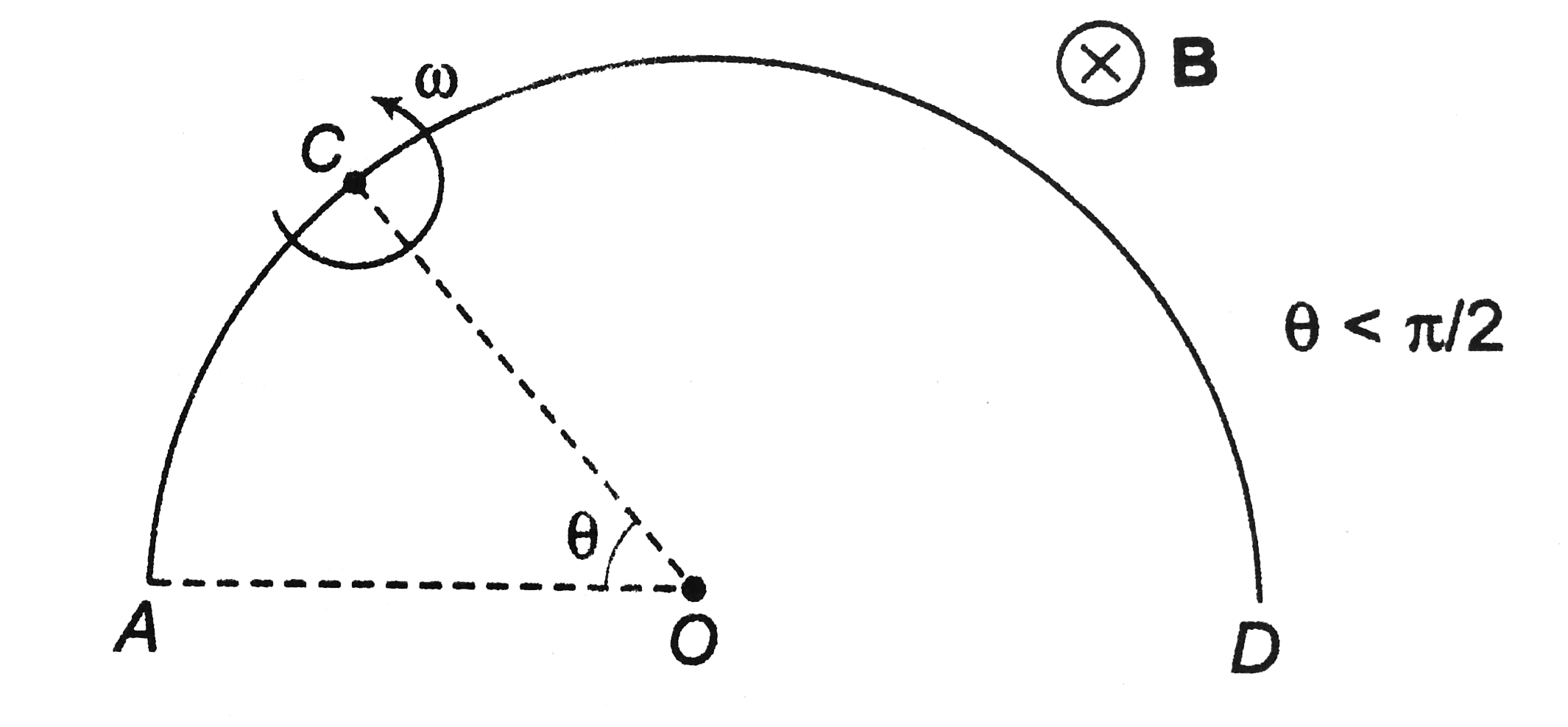
A uniform wire of resistance per unit length `lambda` is bent into semicircle of radius `a`. The wire rotates with angular velocity `omega` in a vertical plane about a orizontal is passing through `C`. A uniform magnetic field `B` exists in space in a direction perpendicular to paper inwards.

a. Calculate potential difference between points `A` and `D`. which point is at higher potential?
b. If points `A` and `D` are connected by a conducting wire of zero resistance, find the potential difference between `A` and `C`.

Text Solution

Verified by Experts
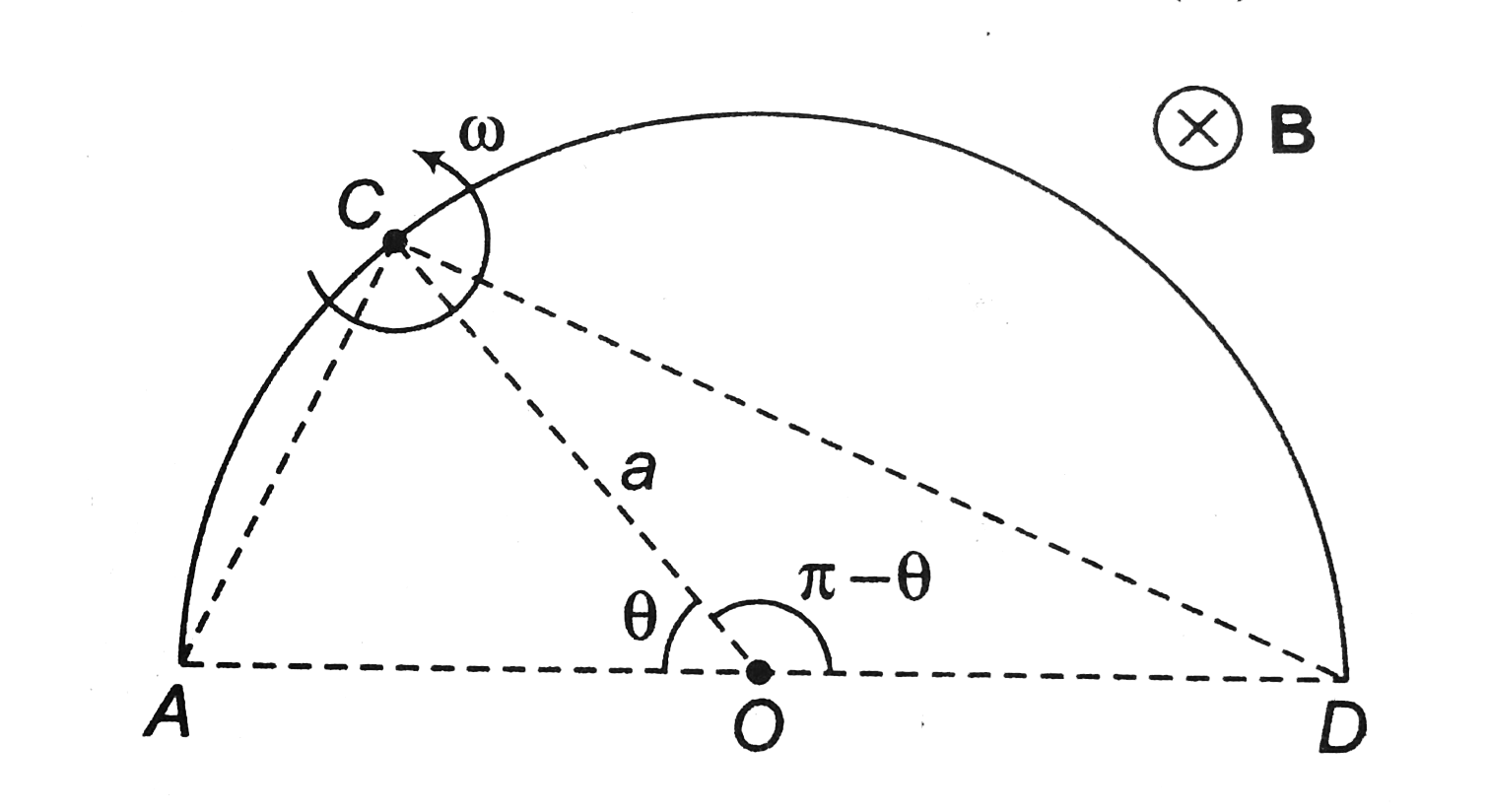
a. Length of straight wire `AC` is `l_1=2asin(theta/2)`

Therefore, the motional emf (or potential difference) between points `C` and `A` is
`V_(CA)=V_C-V_A=1/2Bomegal_1^2=2a^2Bomegasin^2(theta/2)` ..(i)
From right hand rule, we can see that `V_Cgt V_A`
Similarly length of straight wire `CD` is
`l_2=2asin(pi/2-theta/2)=2cos(theta/2)`
Therefore the `PD` between points `C` and `D` is
`V_(CD)=V_C-V_D=1/2 B omegal_(2)^(2) = 2alpha^(2) B omega cos^(2) ((theta)/(2))` ...(ii)
with `V_(C) gt V_(D)`
Eq. (ii) -Eq.(i) gives
`V_(A) -V_(D) = 2a^(2)B omega (cos^(2)(theta)/(2)-sin^(2)(theta)/(2))`
`= 2a^(2) B omega cos theta`

`A` is at higher potential.
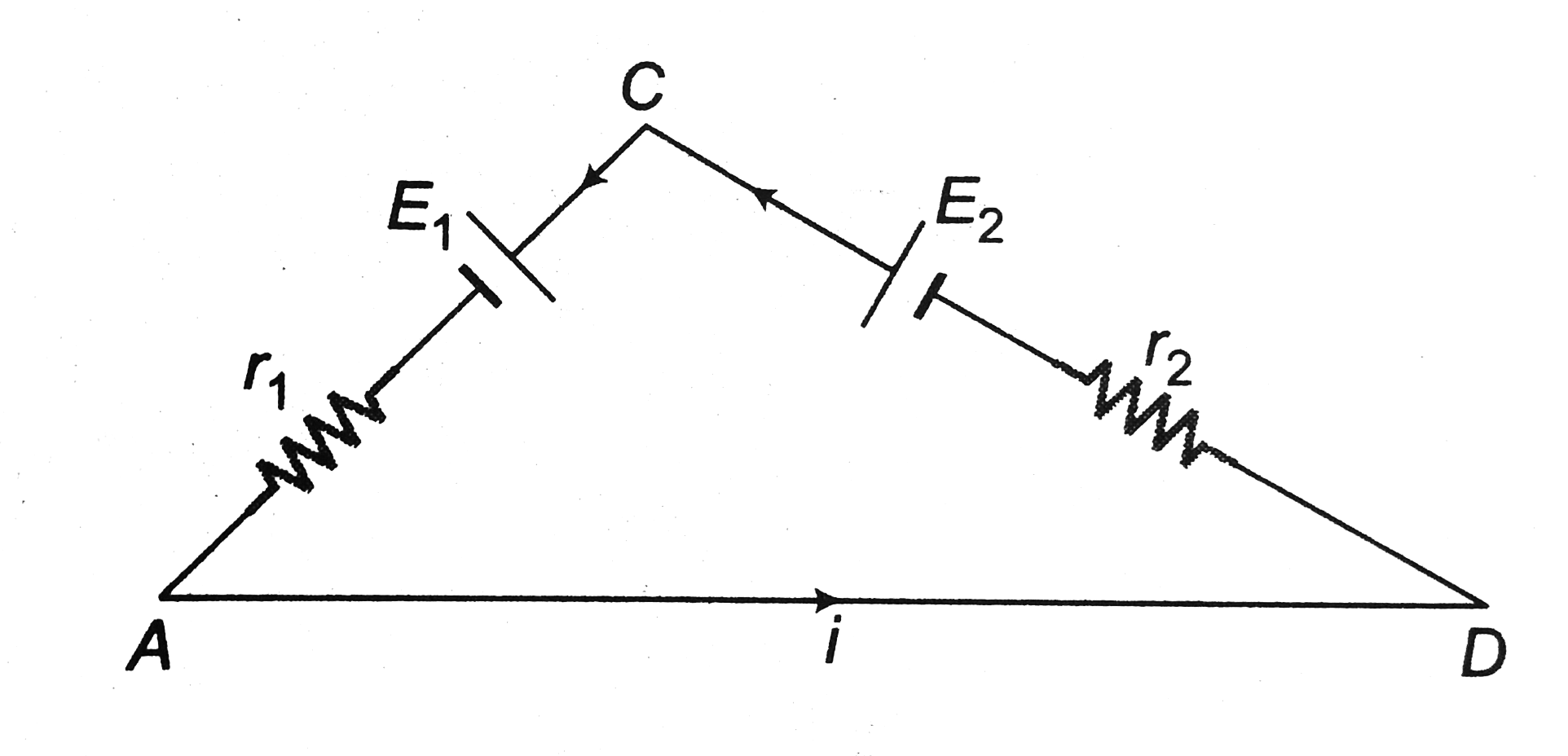
(b) When `A` and `D` are connected from a wire current starts flowing in the circuit as shown in figure:
Resistance between `A` and `C` is `r_1=`(length of are `AC` ) `lambda=atheta lambda`
and between `C` and `D` is `r_2=`(length of are `CD`) lambda=(pi-theta)alambda`

In the figure `E_1=2^2Bomegasin(theta/2)` and `E_2=2a^2Bomgacos^2(theta/2)`
with `E_2gtE_1`
`:.` Current in the circuit is
`i=(E_2-E_1)/(r_1+r_2)=(2a^2Bomegacostheta)/(pi a lambda)=(2aBomegacostheta)/(pi lambda)`
and potential difference between points `C` and `A` is
`V'_(CA) =E_1+ir_1=2a^2Bomegasin^2(theta/2)+((2aBomegacostheta)/(pi lambda))(athetalambda)`
`=2a^2Bomega(sin^2theta/2+theta/picostheta)`
Promotional Banner

Topper's Solved these Questions

  • ELECTROMAGNETIC INDUCTION

    DC PANDEY ENGLISH|Exercise Exercise 27.1|8 Videos
  • ELECTROMAGNETIC INDUCTION

    DC PANDEY ENGLISH|Exercise Exercise 27.2|4 Videos
  • ELECTROMAGNETIC INDUCTION

    DC PANDEY ENGLISH|Exercise Example Type 6|3 Videos
  • CURRENT ELECTRICITY

    DC PANDEY ENGLISH|Exercise Medical entrances gallery|97 Videos
  • ELECTROMAGNETIC WAVES

    DC PANDEY ENGLISH|Exercise Sec C|22 Videos

Similar Questions

Explore conceptually related problems

A vertical disc of diameter 10 cm makes 20 revolutions per second about a horizontal axis passing through its centre. A uniform magnetic field 10^(-1) T acts perpendicular to the plane of the disc. Calculate the potential difference between its centre and rim in volts.

The potential difference points a and B in the given uniform electric field is :

A uniform wire of resistance 18 Omega is bent in the form of a circle. The effective resistance across the points a and b is

A uniform wire of resistance 36 Omega is bent in the form of a circle. The effective resistance across the points A and B is

A square loop of edge a having n turns Is rotated with a uniform angular velocity omega about one of its diagonals which is kept fixed in a horizontal position . A uniform magnetic field B exists in the vertical direction. Find the emf induced in the coil.

A wire shaped as a semicircle of radius a, is rotating about an acis PQ with a constant angular velocity omega = 1/sqrt(LC) , with the help of an external agent. A uniform magnetic field B exists in space and is directed into the plane of the figure. (circuit part remains at rest) (left part is at rest)

Find the potential difference between the points a and b. If the points a and b are joined by a resistance of 5 Omega , calculate the current through this resistance.

A wire is bent to form a semi-circle of radius a. the wire rotates about its one end with angular velocity omega .Axis of rotation being perpendicular to plane of the semicircle . In the space , a uniform magnetic field of induction B exists along the axis of rotation as shown . The correct statement is :

A rod of length l rotates with a small but uniform angular velocity omega about its perpendicular bisector. A uniform magnetic field B exists parallel to the axis of rotation. The potential difference between the centre of the rod and an end is

A wire is bent to form a semi-circle of radius a. The wire rotates about its one end with angular velocity omega . Axis of rotation being perpendicular to plane of the semicircle. In the space, a uniform magnetic field of induction exists along the axis of rotation as shown. The correct statement is