Home
Class 12
PHYSICS
Monochramatic light is incident on the p...

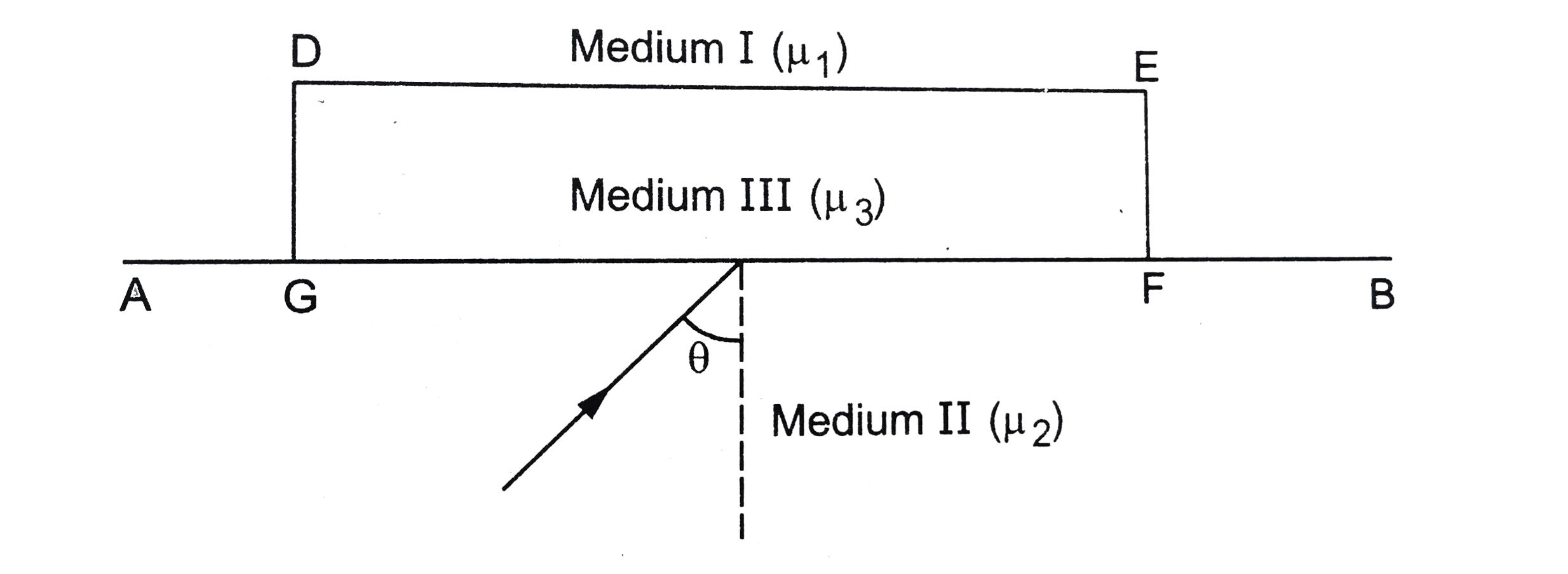
Monochramatic light is incident on the pLane interface AB between two media of refractive indices `mu_1` and `mu_2(mu_2gtmu_1)` at an angle of incidence theta as shown in figure. The angle theta is infinitesimally greater thannte critical angle for the two media so thast total internal reflection takes place. Now, if a transparent slab DEFG of uniform thickness and of refractive inde `mu_2` is introduced on theinterface (as shown in figure ) , show that for any value of `mu_2` all light will ultimately be reflected back into medium II.

Text Solution

Verified by Experts

Given, `theta` is slightly greater than `sin^-1(mu_1/mu_2)`
When `mu_3ltmu_1`
i.e. `mu_3ltmu_1ltmu_2`
or `mu_3/mu_2ltmu_1/mu_2` or `sin^-1(mu_3/mu_2)ltsin^-1(mu_1/mu_2)`
Hence, critical angle for `III` and `II` will be less than the critical angle for `II` and `I`. So, if TIR
is taking place between `I` and `II`, Then TIR will definitely take place between `I` and `III`.
When `mu_3gtmu_1` two cases may arise: Case1 `mu_1ltmu_3ltmu_2`
In this case, there will be no TIR between `II` and `III`
but TIR will take place between `III` and `I`.
This is becuase
Ray of light first enters from `II` to `III`. i.e. from
denser to rarer.
`:. igttheta`
Applying Snell's law at P,
`mu_2sin theta=mu_3sini` or `sini=((mu_(2))/(mu_(3))sin theta`
Since, `sin theta` is slightly greater than `mu_1/mu_2`.
`:. sini` is slightly greater than `mu_2/mu_3xxmu_1/mu_2` or `mu_1/mu_3`
but `mu_1/mu_3` is nothing but `sin (theta_C)_(I,III)`
`:. sin(i)` is slightly greater than sin(theta_C)_(I,III)`
or TIR will now take place on I and III and the ray of light will be reflected back.

Case2 `mu_1ltmu_2ltmu_3`
This time while moving from `II` and `III`, ray of light will
bend towards normal. Again applying Snell's law at P,
`mu_2 sin theta =mu_3 sini`
`sini=mu_2/mu_3 sin theta`
Since, `sin theta` is slightly greater than `mu_1/mu_2`.
Therefore, `sin i` will be slightly than `(mu_2/mu_3xxmu_1/mu_2)` or `(mu_1/mu_3)`
But, `mu_1/mu_3` is `sin (theta_C)_(I,III)`
i.e. `sinigtsin(theta_C)_(I,III)`
`sinigtsin(theta_C)_(I,III)`
`igt(theta_C)_(I,III)`
Therefore, TIR will again take place between I and III and the ray light will be reflected back.
Promotional Banner

Topper's Solved these Questions

  • REFRACTION OF LIGHT

    DC PANDEY ENGLISH|Exercise Example Type 10|1 Videos
  • REFRACTION OF LIGHT

    DC PANDEY ENGLISH|Exercise Example Type 11|3 Videos
  • REFLECTION OF LIGHT

    DC PANDEY ENGLISH|Exercise Subjective|9 Videos
  • SEMICONDUCTORS

    DC PANDEY ENGLISH|Exercise Subjective|12 Videos

Similar Questions

Explore conceptually related problems

What is the relation between the refractive indices mu,mu_(1) and mu_(2) if the behaviour of light rays is shown in Figure.

Two refracting media are separated by a spherical interface as shown in the figure.

A light ray is incident on a glass sphere of reflective index mu = sqrt3 at an angle of incidence 60^(@) as shown in Fig. Find the angles r, r^(') e and the total deviation after two refractions.

For total internal reflection to take place, the angle of incidence i and the refractive index mu of the medium must satisfy the inequality

Two light rays initially in same phase travel through two media of equal length L having refraction index mu_1 and mu_2(mu_1 gt mu_2) as shown in figure. If the wavelength of light rays in air is lamda , the phase difference of the emerging rays is given by

The diagram shows a spherical surface which separates two media of refractive index, mu_(1) and mu_(2) . Respectively. Now, a point object is placed on the principal axis as shown in the figure. Then

When a monochromatic light ray is incident on a medium of refracive index mu with angle of incidence theta_(1) ,the angle of refraction is theta_(r). if theta_(i) is changed slightly by Deltatheta_(i) ,then the corresponding change in theta_(r) will be-

A ray is incident on interface of two media at critical angle as shown in the figure.

A spherical surface of radius R ssparates two media of refractive indices mu_(1) and mu_(1) as shown in figure., Where should an object be placed in medium 1 so that a real image is formed in medium 2 at the same distance?

Light ray is incident on a prism of angle A=60^(@) are refractive index mu=sqrt(2) . The angle of incidence which the emergent rays grazes the surface is given

DC PANDEY ENGLISH-REFRACTION OF LIGHT-Level 2 Subjective
  1. Monochramatic light is incident on the pLane interface AB between two ...

    Text Solution

    |

  2. a. Figure (a) shows the optical axis of a lens, the point source of ...

    Text Solution

    |

  3. a. Figure (a) shows the optical axis of a lens, the point source of ...

    Text Solution

    |

  4. In Figure, a fish watcher watches a fish through a 3.0 cm thick glass ...

    Text Solution

    |

  5. A concave spherical mirror with a radius of curvature of 0.2 m is fill...

    Text Solution

    |

  6. A lens with a focal length of f=30 cm produces on a screen a sharp ima...

    Text Solution

    |

  7. One side of radius of curvature R2=120 cm of a convexo-convex lens of ...

    Text Solution

    |

  8. A small object is placed on the principal axis of concave spherical mi...

    Text Solution

    |

  9. A thin glass lens of refractive index mu2=1.5 behaves as an interface ...

    Text Solution

    |

  10. A glass hemisphere of radius 10 cm and mu=1.5 is silvered over its cur...

    Text Solution

    |

  11. A equilateral prism of flint glass (mug=3//2) is placed water (muw=4//...

    Text Solution

    |

  12. Rays of light fall on the plane surface of a half cylinder at an angle...

    Text Solution

    |

  13. The figure shows an arrangement of an equi-convex lens and a concave m...

    Text Solution

    |

  14. A convex lens is held 45 cm above the bottom of an empty tank. The ima...

    Text Solution

    |

  15. A parallel beam of light falls normally on the first face of a prism o...

    Text Solution

    |

  16. Two converging lenses of the same focal length f are separated by a di...

    Text Solution

    |

  17. A cubical vessel with non-transparent walls is so located that the eye...

    Text Solution

    |

  18. A spherical ball of transparent material has index of refractionmu. A ...

    Text Solution

    |

  19. A ray incident on the droplet of water at an angle of incidence i unde...

    Text Solution

    |

  20. A transparent solid sphere of radius 2 cm and density rho floats in a ...

    Text Solution

    |

  21. A hollow sphere of glass of inner and outer radii R and 2R respectivel...

    Text Solution

    |

