Home
Class 12
PHYSICS
A right angled prism is to be made by se...

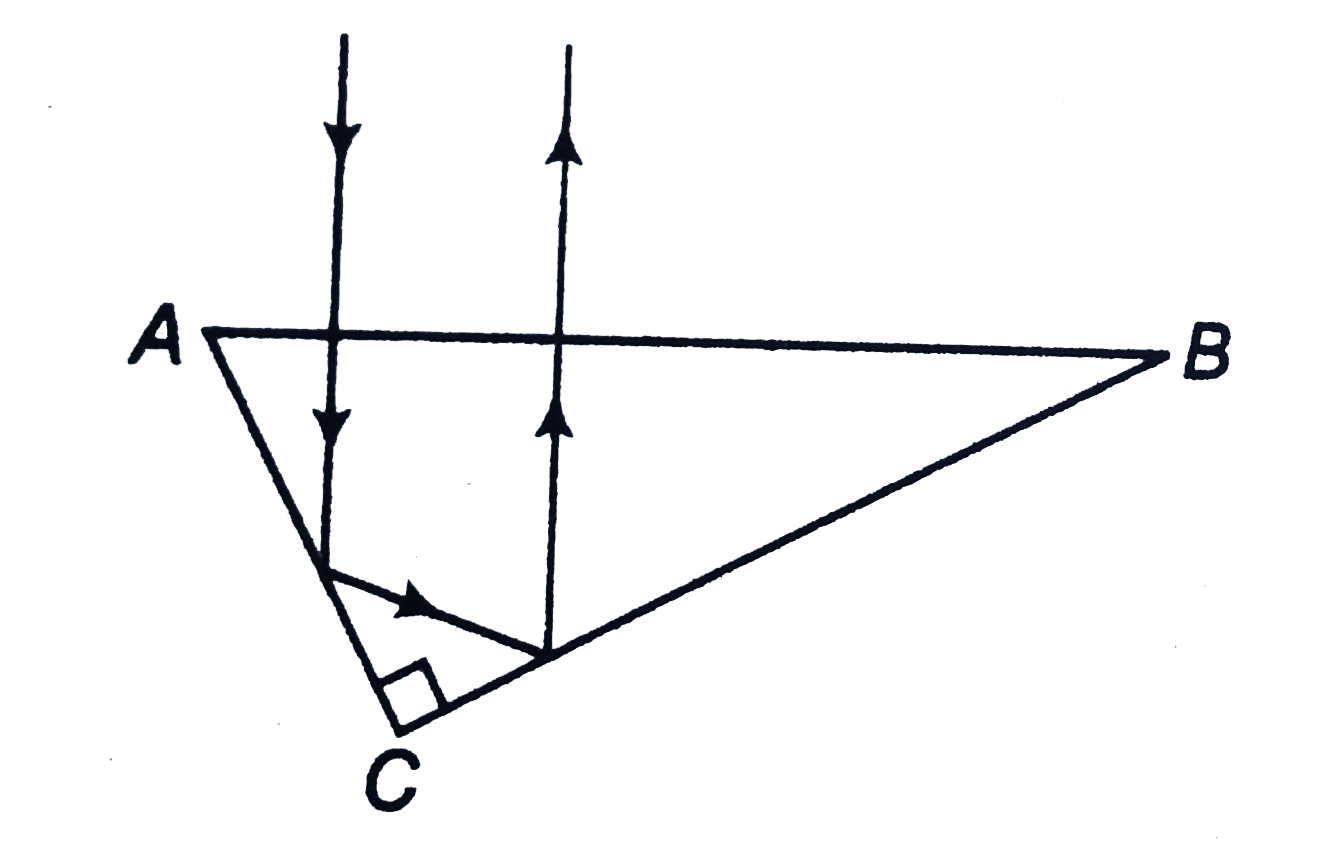
A right angled prism is to be made by selecting a proper material and the angles A and B (BleA), as shown in figure. It is desired that a ray of light incident on the face AB emerges parallel to the incident direction after two internal reflections.

(a) What should be the minimum refractive index n for this to be possible?
(b) For `n=5/3` is it possible to achieve this with the angle B equal to `30` degrees?

Text Solution

Verified by Experts

At P, angle of incidence `i_A=A` and at Q, angle of incidence `i_B=B`

if TIR satisfies for the smaller angle of incidence than for larger angle of incidence is
automatically satisfied.
`BleA`
`:. i_Blei_A`
Maximum value of B can be `45^@`. Therefore, if condition of TIR is satisfied for `45^@,` then
condition of TIR will be satisfied for all value of `i_A and i_B.`
Thus, `45^@getheta_C or sin 45^@gesin theta_C`
or `1/sqrt2ge1/mu or mugesqrt2`
`:.` Minimum value of `mu` is `sqrt2`.
(b) For `mu=5/3, sin theta_C=1/mu=sin^-1((3)/(5))~~37^@`
If `B=30^@` and `A=60^@` or `i_A=60^@, i_Agttheta_C` but `i_Blttheta_C`
i.e. TIR will take place at A but not at B.
Promotional Banner

Topper's Solved these Questions

  • REFRACTION OF LIGHT

    DC PANDEY ENGLISH|Exercise Example Type 10|1 Videos
  • REFRACTION OF LIGHT

    DC PANDEY ENGLISH|Exercise Example Type 11|3 Videos
  • REFLECTION OF LIGHT

    DC PANDEY ENGLISH|Exercise Subjective|9 Videos
  • SEMICONDUCTORS

    DC PANDEY ENGLISH|Exercise Subjective|12 Videos

Similar Questions

Explore conceptually related problems

A right-angled prism is made up of a material of refractive index mu . It is desired that a light ray incident normally on PQ emerges parallel to the incident direction after suffering two total internal reflections . In which of the following conditions is this possible ?

At what angle should a ray of light be incident on the face of a prism of refracting angle 60^(@) so that it just suffers total internal reflection at the other face ? The refractive index of the prism is 1.524.

A prism ABC of angle 30^(@) has its face AC silvered. A ray of light incident at an angle of 45^(@) at the face AB retraces its path after refraction at face AB and reflection at face AC . The refractive index of the material of the prism is

What should be the minimum value of refractive index of a prism, refracting angle A, so that there is no emergent ray irrespective of the angle of incidence?

The angle of incidance for an equilateral prism is 60^(@) . What should be the refractive index of prism so that the ray is parallel to the base inside the prism ?

A glass prism is immeresed in water as shown in the figure. When a beam of light incident is incident normally on the face ab, it is internally reflected at the face ad. If the refractive index of glass is 1.5 and that of water is 4//3 , then

In the figure shown , for an angle of incidence 45^(@) , at the top surface , what is the minimum refractive index needed for the internal reflection at vertical face ?

In the figure shown , for an angle of incidence 45^(@) , at the top surface , what is the minimum refractive index needed for the internal reflection at vertical face ?

The path of a ray of light passing through an equilateral glass prism ABC is shown in figure. The ray of light is incident on face BC at the critical angle for just total internal reflection. The total internal reflection. The total angle of deviation after the refraction at face AC is 108^@ . Calculate the refractive index of the glass.

One face of a prism with a refrective angle of 30^@ is coated with silver. A ray of light incident on another face at an angle of 45^@ is refracted and reflected from the silver coated face and retraces its path. What is the refractive index of the prism?

DC PANDEY ENGLISH-REFRACTION OF LIGHT-Level 2 Subjective
  1. A right angled prism is to be made by selecting a proper material and ...

    Text Solution

    |

  2. a. Figure (a) shows the optical axis of a lens, the point source of ...

    Text Solution

    |

  3. a. Figure (a) shows the optical axis of a lens, the point source of ...

    Text Solution

    |

  4. In Figure, a fish watcher watches a fish through a 3.0 cm thick glass ...

    Text Solution

    |

  5. A concave spherical mirror with a radius of curvature of 0.2 m is fill...

    Text Solution

    |

  6. A lens with a focal length of f=30 cm produces on a screen a sharp ima...

    Text Solution

    |

  7. One side of radius of curvature R2=120 cm of a convexo-convex lens of ...

    Text Solution

    |

  8. A small object is placed on the principal axis of concave spherical mi...

    Text Solution

    |

  9. A thin glass lens of refractive index mu2=1.5 behaves as an interface ...

    Text Solution

    |

  10. A glass hemisphere of radius 10 cm and mu=1.5 is silvered over its cur...

    Text Solution

    |

  11. A equilateral prism of flint glass (mug=3//2) is placed water (muw=4//...

    Text Solution

    |

  12. Rays of light fall on the plane surface of a half cylinder at an angle...

    Text Solution

    |

  13. The figure shows an arrangement of an equi-convex lens and a concave m...

    Text Solution

    |

  14. A convex lens is held 45 cm above the bottom of an empty tank. The ima...

    Text Solution

    |

  15. A parallel beam of light falls normally on the first face of a prism o...

    Text Solution

    |

  16. Two converging lenses of the same focal length f are separated by a di...

    Text Solution

    |

  17. A cubical vessel with non-transparent walls is so located that the eye...

    Text Solution

    |

  18. A spherical ball of transparent material has index of refractionmu. A ...

    Text Solution

    |

  19. A ray incident on the droplet of water at an angle of incidence i unde...

    Text Solution

    |

  20. A transparent solid sphere of radius 2 cm and density rho floats in a ...

    Text Solution

    |

  21. A hollow sphere of glass of inner and outer radii R and 2R respectivel...

    Text Solution

    |

