Home
Class 12
PHYSICS
At what distance eye E will observe the ...

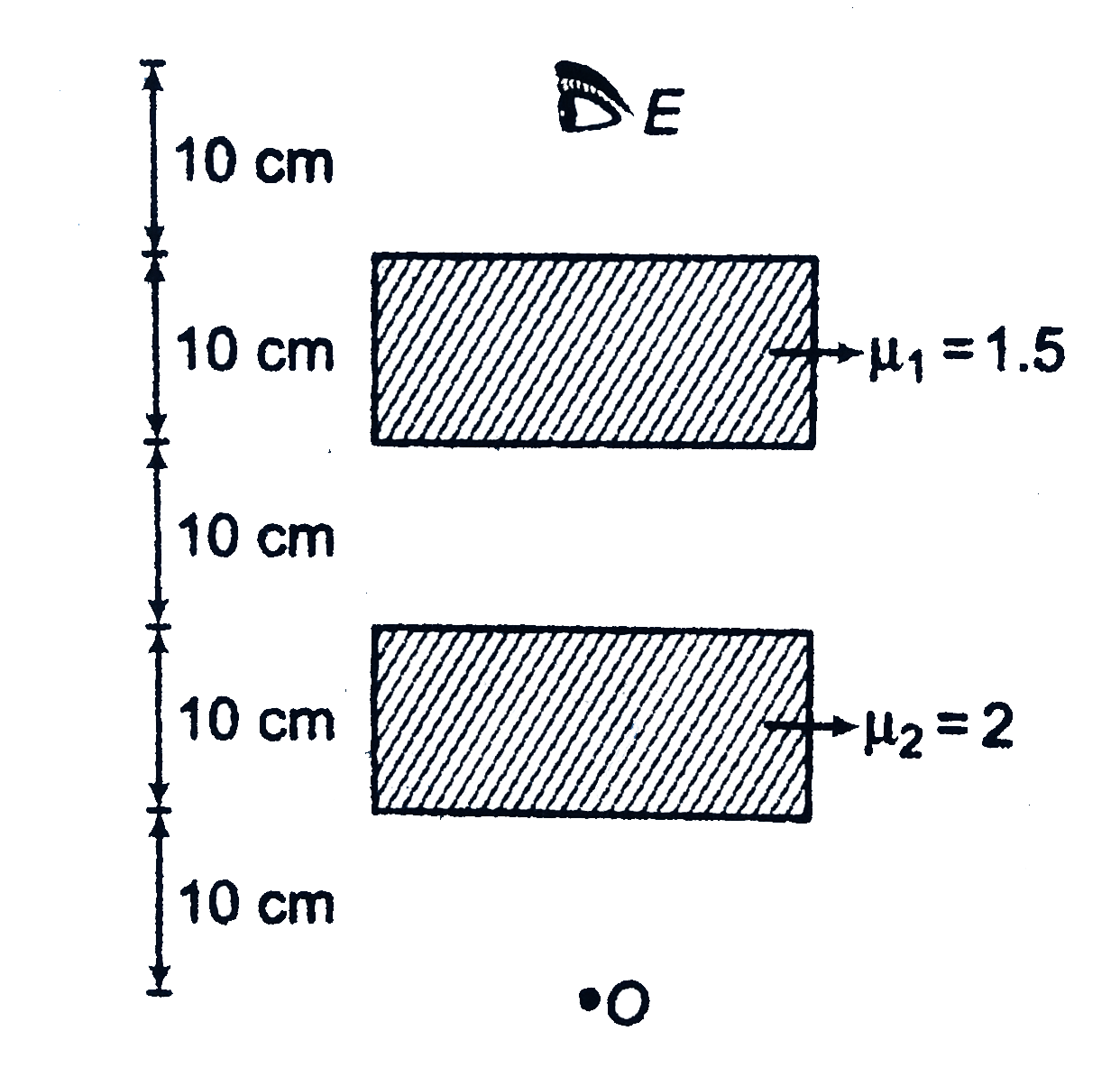
At what distance eye E will observe the fourth image (after four refractions from plane surfaces) of object O from itself.

Text Solution

Verified by Experts

The correct Answer is:

A, B, C

Total shift `=(1-1/mu_1)t_1+(1-1/mu_2)t_2`
`=(1-2/3)10+(1-1/2)10`
`=25/3 cm`
`:.` Image distance `=50-25/3=125/3 cm`
Promotional Banner

Topper's Solved these Questions

  • REFRACTION OF LIGHT

    DC PANDEY ENGLISH|Exercise Exercise 31.5|5 Videos
  • REFRACTION OF LIGHT

    DC PANDEY ENGLISH|Exercise Exercise 31.6|12 Videos
  • REFRACTION OF LIGHT

    DC PANDEY ENGLISH|Exercise Introductory exercise|4 Videos
  • REFLECTION OF LIGHT

    DC PANDEY ENGLISH|Exercise Subjective|9 Videos
  • SEMICONDUCTORS

    DC PANDEY ENGLISH|Exercise Subjective|12 Videos

Similar Questions

Explore conceptually related problems

A parallel beam falls on solid glass sphere of radius R and refractive index mu . What is the distance of final image after refractioin from two surfaces of sphere? What is the condition for the image to be real?

A plano-convex lens P and a concavo-convex lens Q are in contact as shown in figure. The refractive index o fthe material of the lens P and Q is 1.8 and 1.2 respectively. The radius of curvature of the concave surface of the lens Q is double the radius of curvature of the convex surface. The convex surface of Q is silvered. An object is placed on the placed on the principal axis at a distance 10 cm form the plane surface. The image is formed at a distance 40 cm from the plane surfaces on the same side. The focal length of the system is

In Fig, find position of second image I_2 formed after two times refraction from two plane surfaces AB and CD.

A point object lies 30 cm above water on the axis of a convex mirror of focal length 40 cm lying 20 cm below water surface. Consider two images. (i) Image formed by the partial reflection from water surface. (ii) Image formed by refraction from water surface followed by reflection from mirror and again refraction out of the water surface. find the distance between these two images.

Consider the situation in Fig. The bottom of the pot is a reflecting plane mirror, S is a small fish, and T is a human eye. Refractive index of water is mu . a. At what distance(s) from itself will the fish see the image(s) of the eye? b. At what distance(s) from itself will the eye see the image(s) of the fish?

Plane surface of a thin planoconvex lens reflects 50% of light, while the curved surface is completely transparent, if final image of O after refraction through lens coinsides with the image formed due to partial reflection from plane surface. if distance (in m) between O and lens is x then find x//4

The image image of an object placed at a distance of 30 cm on the principal axis of a concave mirror from its pole is formed on the object itself. Find (a) the focal length and (b) linear magnification of mirror:

Consider the situation shown in figure. Water (mu_(w) = (4)/(3)) is filled in a breaker upto a height of 10 cm. A plane mirror is fixed at a height of 5 cm from the surface of water. Distance of image from the mirror after reflection from it if an object O at the bottom of the beaker is

A fish in a lake (refractive index 4//3 for water ) is viewed through a convex lens. From water surface, the lens is placed in air at half of the distance of the fish from the water surface, so that the image is formed at the fish itself. The focal length of the lens is how many times the depth of fish in water?

An object is kept at a distance of 16 cm from a thin lens and the image formed is real. If the object is kept at a distance of 6 cm from the lens, the image formed is virtual. If the sizes of the images formed are equal, the focal length of the lens will be
