Home
Class 12
PHYSICS
If a symmetrical bi-concave thin lens is...

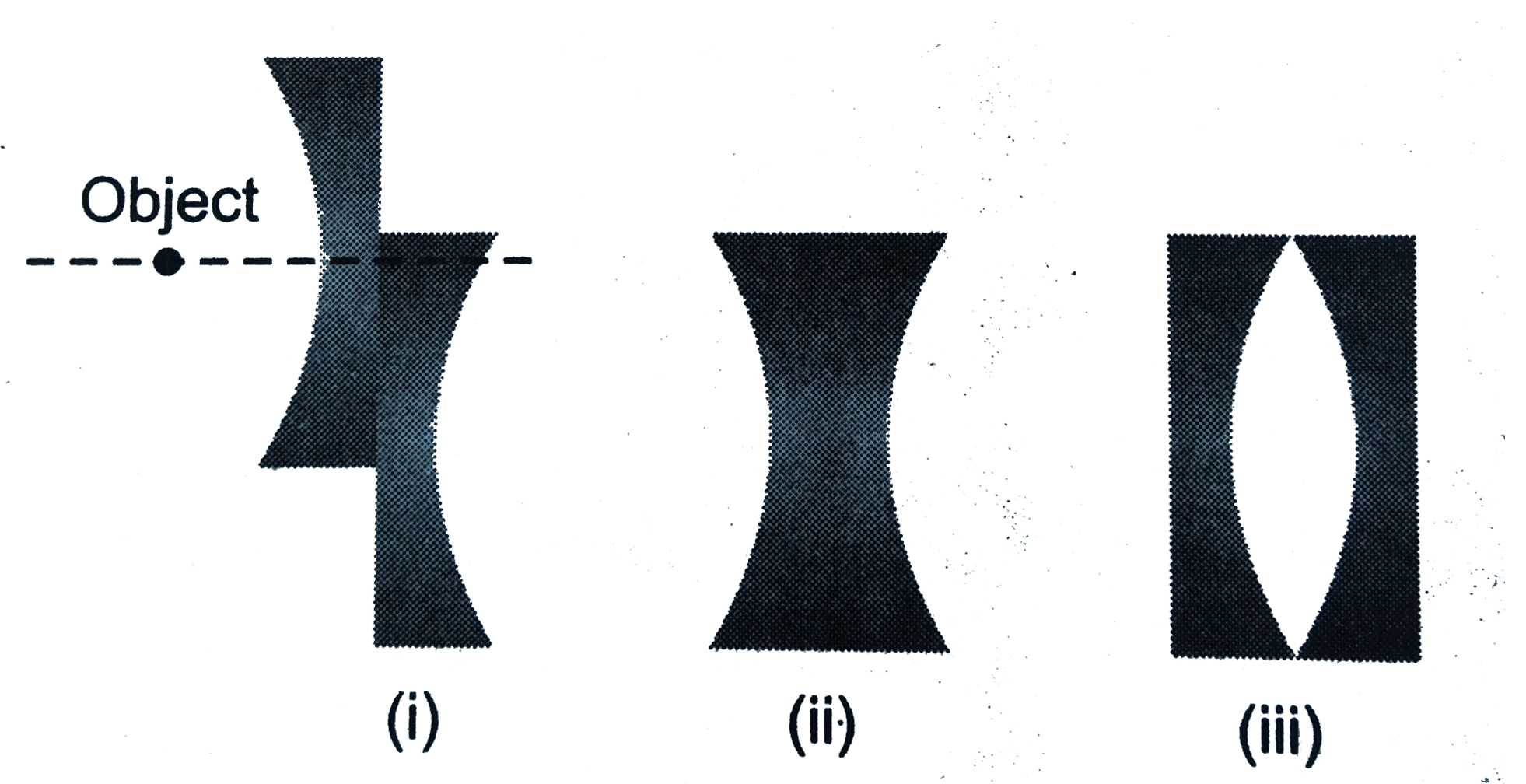
If a symmetrical bi-concave thin lens is cut into two identical halves, and they are placed in different ways as shown, then

A

three images will be formed in case (ii)

B

three images will be formed in case (i)

C

the ratio of focal lengths in (ii) and (iii) is 1

D

the ratio of focal lengths in (ii) and (iii) is 2

Text Solution

Verified by Experts

The correct Answer is:

C

(a) Two images are formed in case(i).
(b) One image is formed in case (ii).
(c) `1/(f_2)=(mu-1)(1/(-R)-1/R)=-2/R(mu-1)….(i)`
`1/(f_3)=1/(F_1)+1/(F_2)`
`=(mu-1)(1/oo-1/R)+(mu-1)(1/(-R)-1/oo)…..(ii)`
From Eqs. (i) and (ii), we can see that `f_2=f_3.`
Promotional Banner

Topper's Solved these Questions

  • REFRACTION OF LIGHT

    DC PANDEY ENGLISH|Exercise Single Correct Option|3 Videos
  • REFRACTION OF LIGHT

    DC PANDEY ENGLISH|Exercise more than one correct option|1 Videos
  • REFRACTION OF LIGHT

    DC PANDEY ENGLISH|Exercise Subjective Questions|8 Videos
  • REFLECTION OF LIGHT

    DC PANDEY ENGLISH|Exercise Subjective|9 Videos
  • SEMICONDUCTORS

    DC PANDEY ENGLISH|Exercise Subjective|12 Videos

Similar Questions

Explore conceptually related problems

A symmetric double convex lens is cut in two equal parts by a plane perpendicular to the principal axis. If the power of the original lens was 4D, the power of a cut lens will be

In the figure (i) a thin lens of focal length 10cm is shown. The lens is cut into two equal parts, and the parts are arranged as shown in the figure (ii). An object AB of height 1cm is placed at distance of 7.5cm from the arrangement. The height of the final image will be:

A symmetric double convex lens is cut in two equal parts by a plane perpendiculr to the pricipal axis. If the power of the original lens was 4D, the power of a cut lens will be a.2D b.3D c.4D d.5D

In a system of two dipoles placed in the way as shown in figure :

A lens of focal length f is cut along the diameter into two identical halevs. In this process, a layer of the lens t in thickness is lost, then the halves are put together to form a composite lens. In between the focal plane and the composite lens, a narrow slit is placed near the focal plane. The slit is emitting monochromatic lambda . Behind the lens, a screen is located at a distance L front it. The expression for the number of visible maxima which are obtained through above said arrangement will turn out to be

A lens of focal length f is cut along the diameter into two identical halevs. In this process, a layer of the lens t in thickness is lost, then the halves are put together to form a composite lens. In between the focal plane and the composite lens, a narrow slit is placed near the focal plane. The slit is emitting monochromatic lambda . Behind the lens, a screen is located at a distance L front it. Find the fringe width for the pattern obtained under given arrangement on the screen.

A thin spherical shell of radius R is cut into two equal halves and then each of its halves is charged to the same uniform surface charge density sigma. If F is the force exerted on each half to keep them at equilibrium, then F is proportional to

A convex lens is cut into two parts in different ways that are arranged in four manners, as shown. Which arrangement will give maximum optical power?

An object suspended from a spring exhibits oscillations of period T. Now the spring is cut in two halves and the same object is suspended with two halves as shown in figure. The new time period of oscillation will become

A symmetrical bioconcave lens having radius of curvature R is made up to two different materials as shown in figure. A parallel beam of light passing through the lens appear to diverge from two different points. Find the distance between them.

DC PANDEY ENGLISH-REFRACTION OF LIGHT-Level 2 Single Correct
  1. There is a small black dot at the centre C of a solid glass sphere of ...

    Text Solution

    |

  2. In the figure ABC is the cross-section of a right angled prism and BCD...

    Text Solution

    |

  3. If a symmetrical bi-concave thin lens is cut into two identical halves...

    Text Solution

    |

  4. If an object is placed at A(OAgtf), where f is the focal length of the...

    Text Solution

    |

  5. An object is seen through a glass slab of thickness 36 cm and refracti...

    Text Solution

    |

  6. How much water should be filled in a container of height 21 cm, so tha...

    Text Solution

    |

  7. Optic axis of a thin equi-convex lens is the x-axis. The co-ordinates ...

    Text Solution

    |

  8. A thin plano-convex lens acts like a concave mirror of radius of curva...

    Text Solution

    |

  9. A thin lens, made of glass of refractive index 3//2, produces a real a...

    Text Solution

    |

  10. The maximum value of refractive index of a prism which permits the tra...

    Text Solution

    |

  11. A glass slab of thickness 4 cm contains the same number of waves as 5 ...

    Text Solution

    |

  12. If the optic axis of convex and concave lenses are separated by a dist...

    Text Solution

    |

  13. A light source S is placed at the centre of a glass sphere of radius R...

    Text Solution

    |

  14. A sphere (mu=4/3) of radius 1 m has a small cavity of diameter 1 cm at...

    Text Solution

    |

  15. An equi-convex lens of mu=1.5 and R=20 cm is cut into two equal parts ...

    Text Solution

    |

  16. As shown in the figure, region BCDEF and ABFG are of refractive index ...

    Text Solution

    |

  17. A point object O is placed at a distance of 20 cm from a convex lens o...

    Text Solution

    |

  18. A point object is placed at a distance of 20 cm from a thin plano-con...

    Text Solution

    |

  19. A flat glass slab of thickness 6 cm and index 1.5 is placed in front o...

    Text Solution

    |

  20. When an object is placed 40cm from a diverging lens, its virtual image...

    Text Solution

    |
