Home
Class 12
PHYSICS
Two refracting media are separated by a ...

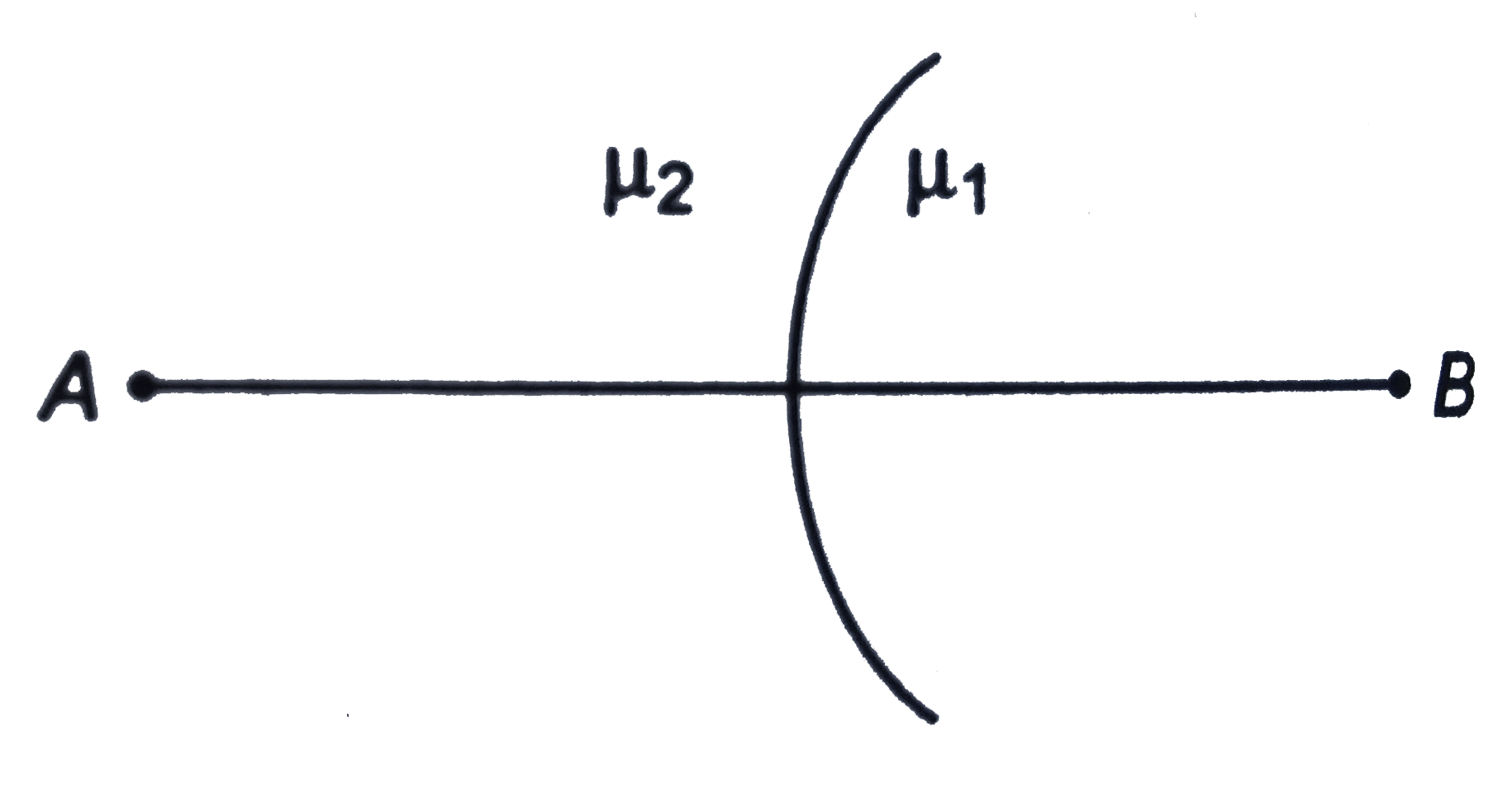
Two refracting media are separated by a spherical interfaces as shown in the figure. AB is the principal axis, `mu_1 and mu_2` are the refractive indices of medium of incidence and medium of refraction respectively. Then,

A

If `mu_2gtmu_1,` then there cannot be a real image of real object

B

If `mu_2gtmu_1,` then there cannot be a real image of virtual object

C

If `mu_1gtmu_2,` then there cannot be a real image of virtual object

D

If `mu_1gtmu_2,` then there cannot be a virtual image of virtual object

Text Solution

Verified by Experts

The correct Answer is:
D


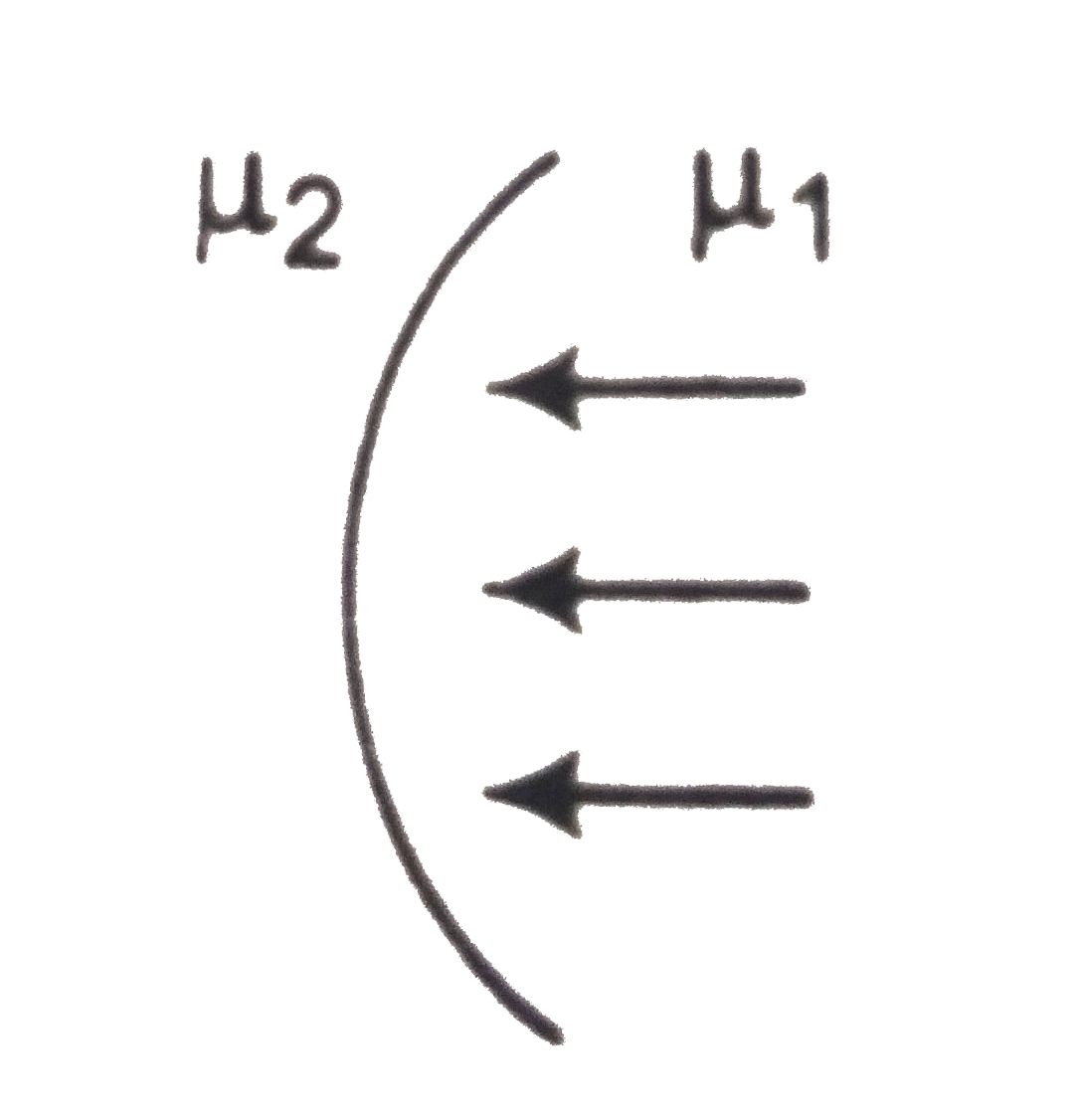
`mu_2/v-mu_1/u=(mu_2-mu_1)/(-R)`
`:. mu_2/v=(mu_1-mu_2)/R+mu_1/u`
If `mu_1gtmu_2`and u is positive (i.e. virtual object),
then v is always positve or image is always real.
Promotional Banner

Topper's Solved these Questions

  • REFRACTION OF LIGHT

    DC PANDEY ENGLISH|Exercise Single Correct Option|3 Videos
  • REFRACTION OF LIGHT

    DC PANDEY ENGLISH|Exercise more than one correct option|1 Videos
  • REFRACTION OF LIGHT

    DC PANDEY ENGLISH|Exercise Subjective Questions|8 Videos
  • REFLECTION OF LIGHT

    DC PANDEY ENGLISH|Exercise Subjective|9 Videos
  • SEMICONDUCTORS

    DC PANDEY ENGLISH|Exercise Subjective|12 Videos

Similar Questions

Explore conceptually related problems

Two refracting media are separated by a spherical interface as shown in the figure.

If mu_(1) and mu_(2) are the refractive indices of the material of core and cladding respectively of an optical fiber, then

A double refracting crystal plate gives two refracted rays A and B for a single incident ray as shown. If mu_(A) and mu_(B) are the refractive indices of the crystal for the two rays

In Figure, a point object O is placed in air. A spherical boundary separates two media. Ab is the principall axis. The refractive index above AB is 1.6 and below AB is 2.0. The separation between the images formed due to refraction at a the spherical surface is (assume the radius of curvature (R) to be 1 unit)

Two prisms placed in contact as shown in figure. The condition for net angular dispersion is zero, is (where mu_f and mu_v refractive indices of red and voilet light in crown glass respectively and mu_f' and mu_v' are refractive indices of red and voilet light in flint glass respectively).

There are three optical media 1,2 and 3 with the refractive indices mu_(1) gt mu_(2) gt mu_(3) . (TIR rarr total internal reflection)

A light ray enters from medium A to medium B as shown in Figure. The refractive index of medium A relative to B will be

Obtain an expression for refraction at a single convex spherical surface separating the two media having refractive indices mu_(1) (rarer medium) and mu_(2) (denser medium) i.e., a relation between u, v, mu_(1),mu_(2) and R.

What is the relation between the refractive indices mu,mu_(1) and mu_(2) if the behaviour of light rays is shown in Figure.

In the figure, a point object O is placed in air. A spherical boundry separates two media of radius of curvature 1.0 m. AB is principal axis. The separation between the images formed due to refraction at spherical surface is

DC PANDEY ENGLISH-REFRACTION OF LIGHT-Level 2 Single Correct
  1. The maximum value of refractive index of a prism which permits the tra...

    Text Solution

    |

  2. A glass slab of thickness 4 cm contains the same number of waves as 5 ...

    Text Solution

    |

  3. If the optic axis of convex and concave lenses are separated by a dist...

    Text Solution

    |

  4. A light source S is placed at the centre of a glass sphere of radius R...

    Text Solution

    |

  5. A sphere (mu=4/3) of radius 1 m has a small cavity of diameter 1 cm at...

    Text Solution

    |

  6. An equi-convex lens of mu=1.5 and R=20 cm is cut into two equal parts ...

    Text Solution

    |

  7. As shown in the figure, region BCDEF and ABFG are of refractive index ...

    Text Solution

    |

  8. A point object O is placed at a distance of 20 cm from a convex lens o...

    Text Solution

    |

  9. A point object is placed at a distance of 20 cm from a thin plano-con...

    Text Solution

    |

  10. A flat glass slab of thickness 6 cm and index 1.5 is placed in front o...

    Text Solution

    |

  11. When an object is placed 40cm from a diverging lens, its virtual image...

    Text Solution

    |

  12. A cubical block of glass of refractive index n1 is in contact with the...

    Text Solution

    |

  13. A concave mirror of focal length 2 cm is placed on a glass slab as sho...

    Text Solution

    |

  14. Two refracting media are separated by a spherical interfaces as shown ...

    Text Solution

    |

  15. A concavo-convex lens has refractive index 1.5 and the radii of curvat...

    Text Solution

    |

  16. A convex spherical refracting surfaces separates two media glass and ...

    Text Solution

    |

  17. An object is moving towards a converging lens on its axis. The image i...

    Text Solution

    |

  18. Two diverging lenses are kept as shown in figure. The final image form...

    Text Solution

    |

  19. In the figure shown , a point object O is placed in air on the princip...

    Text Solution

    |

  20. In the figure, a point object O is placed in air. A spherical boundry ...

    Text Solution

    |

