
Home
Class 12
PHYSICS
A cylinderical glass rod of radius 0.1 m...

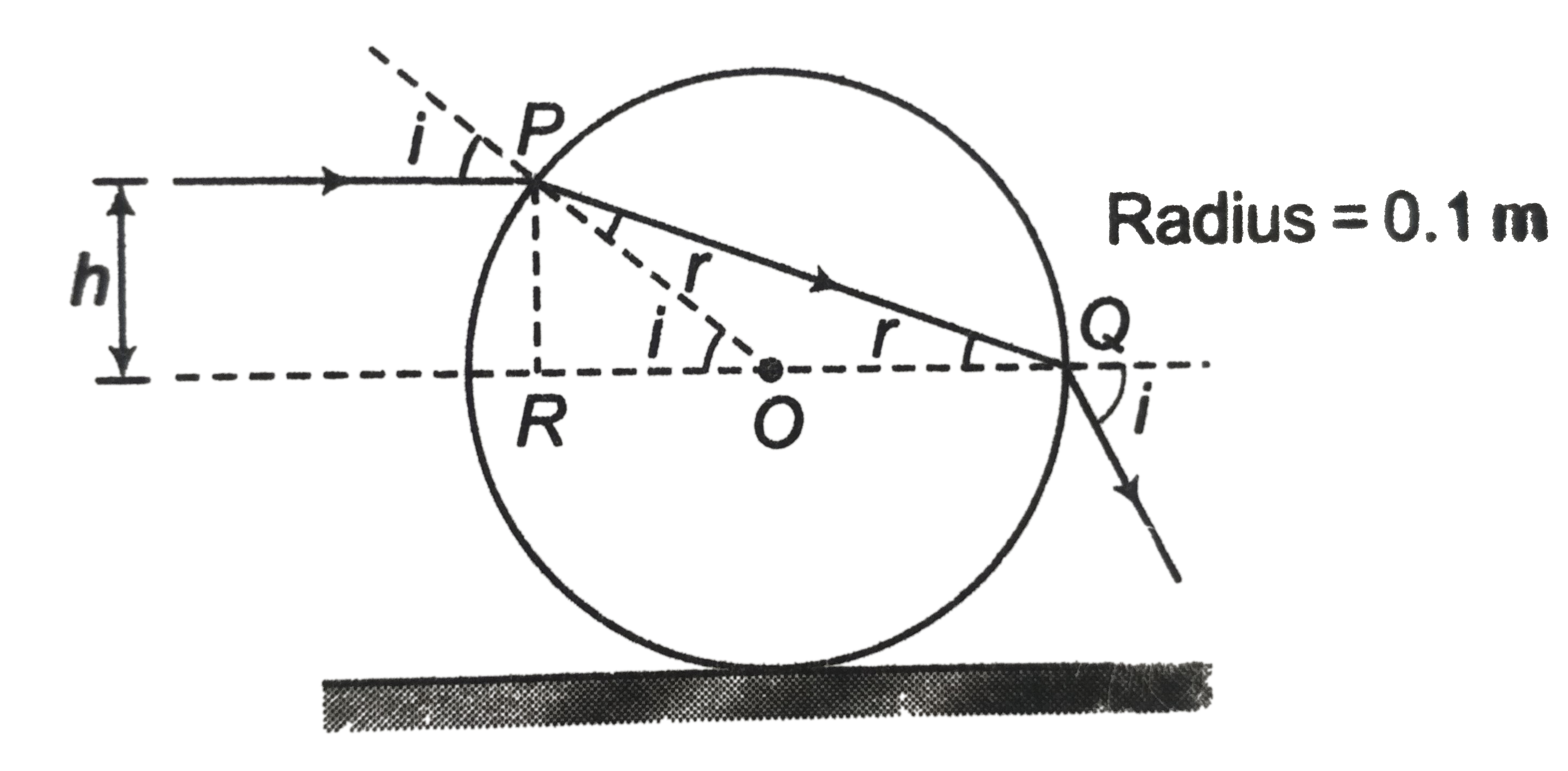
A cylinderical glass rod of radius `0.1 m` and refractive index `sqrt3` lies on a horizontal plane mirror. A horizontal ray of light moving perpendicular to the axis of the rod is incident on it. At what height from the mirror should the ray be incident so that it leaves the rod at a height of `0.1 m` above the plane mirror? At what centre to centre distance a second similar rod, parallel to the first, be placed on the mirror, such that the emergent ray from the second rod is in line with the incident ray on the first rod?

Text Solution

Verified by Experts

The correct Answer is:
A, C

(i) `PO = OQ`
`:. angleOPQ = angleOQP = r("say")`

Also, `i = r + r = 2r`
In `DeltaPQR, h = OP sin I = 0.1 sin t`
`= 0.1 sin 2r`
or `h = .0.2 sim r cosr`……(i)
Also `sqrt(3) = (sin i)/(sin r) = (2 sin r cos r)/(sin r)`
`= 2 cos r `
`:. r = 30^(@)`
Substituting in Eq. `(i)`, we get
` h = 0.2 xx (1)/(2) xx (sqrt(3))/(2)`
`= 0.086 m`.
Hence, height from the mirror is
`0.1 + 0.086 = 0.186 m`
(ii) Use the principle of reversiblity

`i = 2r = 60^(@)`
Now, `(QS)/(MS) = coti = cot 60^(@) = (1)/(sqrt(3))`
`:. QS = (MS)/(sqrt(3)) = (0.1)/(sqrt(3))`
`:.` The disered distance,
`OC = 2 xx 0.1 + (2 xx 0.1)/(sqrt(3))`
`0.315`
Promotional Banner

Topper's Solved these Questions

  • REFRACTION OF LIGHT

    DC PANDEY ENGLISH|Exercise Level 2 Single Correct|41 Videos
  • REFRACTION OF LIGHT

    DC PANDEY ENGLISH|Exercise Single Correct Option|3 Videos
  • REFRACTION OF LIGHT

    DC PANDEY ENGLISH|Exercise Level 1 Subjective|29 Videos
  • REFLECTION OF LIGHT

    DC PANDEY ENGLISH|Exercise Subjective|9 Videos
  • SEMICONDUCTORS

    DC PANDEY ENGLISH|Exercise Subjective|12 Videos

Similar Questions

Explore conceptually related problems

A cylindrical glass rod of raidus 0.1 m and Risqrt(3) lies on a horizontal plane mirror. A horizontal ray of light goind perpendicular to the axis of rod is incident on it As what height from plane mirror should the ray be incident so that it emerges from the rod at a height 0.1 m above the mirror.

Rays of light are incident on a plane mirror at 40^@ . At what angle with the first should a second mirror be placed such that the rays emerge from the second mirror parallel to the first mirror.

Two plane mirrors are inclined to each other at an angle 60^(@) if a ray of light incident on first mirror parallel to the second mirror, it is reflected from the second mirror

A uniform rod of mass M and length a lies on a smooth horizontal plane. A particle of mass m moving at a speed v perpendicular to the length of the rod strikes it at a distance a/4 from the centre and stops after the collision. Find a. the velocity of the cente of the rod and b. the angular velocity of the rod abut its centre just after the collision.

Find the angle between two plane mirrors such that a ray of light incident on the first mirror and parallel to the second mirror is reflected from the second mirror, parallel to the first mirror.

A ray of light falls normally on a plane mirror. What is the angle of incidence ?

Draw the incident ray and the reflected ray. if a light ray is incident on a plane mirror with the angle of incidence 30^@ .

A prism having an apex angle of 4^@ and refractive index of 1.50 is located in front of a vertical plane mirror as shown in the figure. A horizontal ray of light is incident on the prism. The total angle through which the ray is deviated is:

A ray of light is incident on a plane mirror at an angle of incidence of 30^@ . The deviation produced by the mirror is

Two plane mirrors are inclined to each other such that a ray of light incident on the first mirror and parallel to the second is reflected from the second mirror parallel to the first mirror. Determine the angle between the two mirrors:

