Home
Class 12
PHYSICS
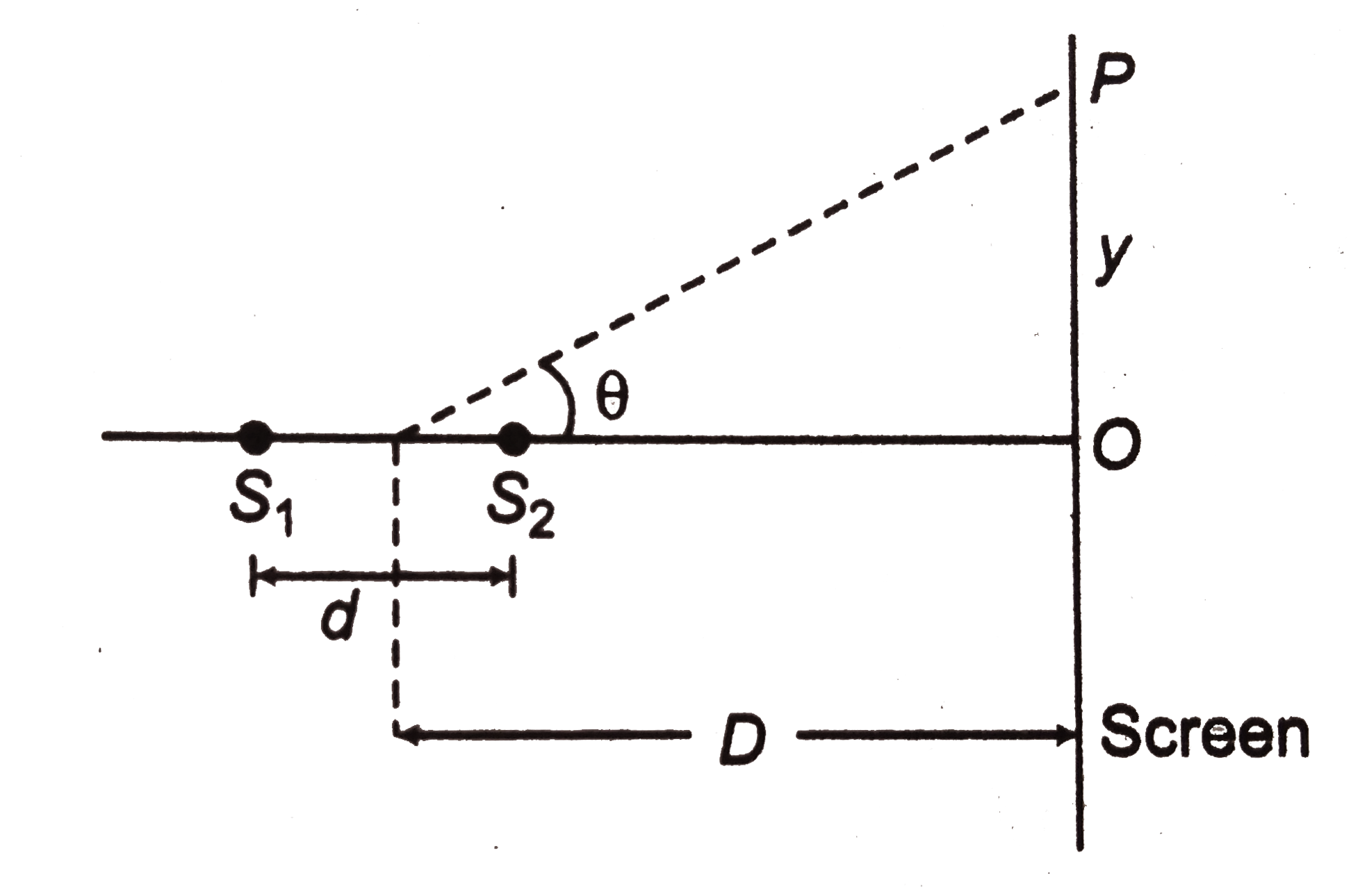
In the set up shown in figure dltltD and...

In the set up shown in figure dltltD and d=4lambda, find.

(a) total number of maximas and minimas on the screen
(b) y-coordinates corresponding to minima nearest to O.

Text Solution

Verified by Experts

(a) In the given set up, dltltD , therefore we can use
`Deltax = d cos theta`
`(Deltax)_min = 0 `at `theta = 90^@`
` (Deltax)_max = d = 4 lambda` at `theta = 0^@`
Therefore, total number of maximas are eight corresponding to
`Deltax = +- 4lambda,+-3lambda, +-2lambda and +-lambda`
(b) Minima nearest to O are corresponding to
`Deltax = +-3.5 lambda`
`:. d cos theta = +- 3.5lambda or 4lambda cos theta = +-3.5lambda`
or ` theta = +- cos^(-1)(3.5lambda/4lambda)` or `theta = +- cos^(-1)(7/8)`
Now, `y/D = tan theta rArr y= D tan theta`
`:. y= +- D tan { cos^-1 (7/8)} ` .
Promotional Banner

Topper's Solved these Questions

  • INTERFERENCE AND DIFFRACTION OF LIGHT

    DC PANDEY ENGLISH|Exercise type-3|1 Videos
  • INTERFERENCE AND DIFFRACTION OF LIGHT

    DC PANDEY ENGLISH|Exercise Example Type 4|1 Videos
  • INTERFERENCE AND DIFFRACTION OF LIGHT

    DC PANDEY ENGLISH|Exercise Example Type 2|2 Videos
  • GRAVITATION

    DC PANDEY ENGLISH|Exercise All Questions|135 Videos
  • MAGNETIC FIELD AND FORCES

    DC PANDEY ENGLISH|Exercise Medical entrance s gallery|59 Videos

Similar Questions

Explore conceptually related problems

In the YDSE apparatus shown in figure, dltltD and d = 6lambda . Find (a) total number of maximas and minimas on the screen . (b) two y-coordinates corresponding to third order maxima.

There is a large circle (not a screen this time) around two coherent sources S_1 and S_2 kept at a distance d = 3.4 lambda . (a) Find total number of maximas on this circle. (b) Four angular positions corresponding to third order maxima on this circle.

Assertion: In the YDSE apparatus shown in figure dltltD and d/lambda = 4 , then second order maxima will be obtained at theta = 30^@ Reason: Total seven maxima will be obtained on screen.

In a Young's double slit experiment, the light sources is at distance l_1 = 20mu m and l_2 = 40 mu m form the main slit. The light of wavelength lambda = 500nm is incident on slits separated at a distance 10mu m . A screen is placed at a distance D = 2 away from the slits as shown in figure. Find (a) the values of theta relative to the central line where maxima appear on the screen? (b) how many maxima will appear on the screen? what should be the minimum thickness of a slab of refractive index 1.5 placed on the path of one of the ray so that minima occurs at C ? .

Statement I: For the situation shown in figure two identecal coherent light sources produce interference pattern on the screen. The intensity of minima nearest to S_(1) is not exactly zero. Statement II: Minimum intensity is zero, when interfering waves have same intensity at the location of superposition.

In a YDSE, D = 1 M, d = 1 mm, and lambda = 1//2 mm. (a) Find the distance between the first and central maxima on the screen. (b) Find the number of maxima and minima obtained on the screen.

Assertion: Distance between two coherent sources S_1 and S_2 is 4lambda . A large circle is drawn around these sources with centre of circle lying at centre of S_1 and S_2 . There are total 16 maxima on this circle. Reason: Total number of minimas on this circle are less, compared to total number of maximas.

A coherent parallel beam of microwaves of wavelength lambda = 0.5 mm falls on aYoung's double- slit apparatus. The separation between the slits is 1.0 mm. The intensity of microwaves is measured on a screen placed parallel to the plane of the slits at a distance of 1.0 m from it as shown in Fig. 2.42. If the incident beam makes an angle or 30^(@) with the x-axis (as in the dotted arrow shown in the figure), find the y-coordinates of the first minima on either side of the central maximum.

Distance between the slit shown in figure is d = 20 lambda , where lambda is the wavelength of light used. Find the angle theta where a. central maxima (where path difference is zero) is obtained, and b. third-order maxima is obtained.

Assertion In the YDSE set up shown in figure a glass slab is inserted in front of the slit S_(1) as shown in figure Then zero order maxima (where path difference =0) will lie above point O. Reason Glass slab will produce an extra path difference in the path of the ray passing through S_(1)
