Home
Class 12
PHYSICS
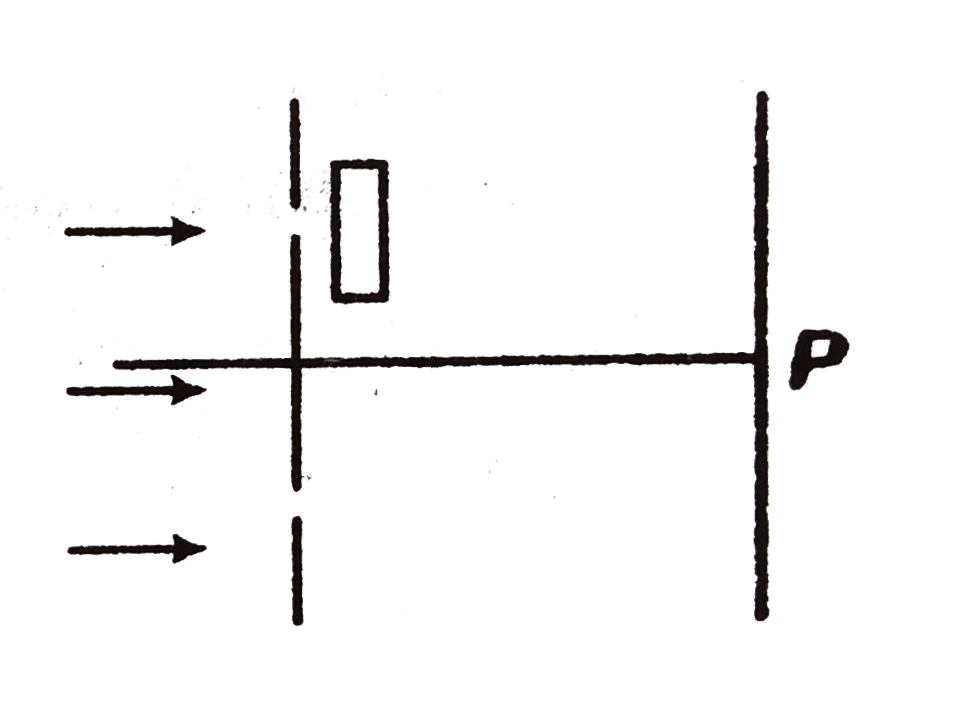
YDSE set up shown in figure....

YDSE set up shown in figure.

A

zero order maxima will lie above point P

B

first order maxima may lie above point P

C

first order maxima may lie below point P

D

zero order maxima may lie at point P

Text Solution

Verified by Experts

The correct Answer is:

A, B, C

Fringe pattern shifts in the direction of slab. But,
`Shift = ((mu-1)tD)/d`
So, actual shift will depend on the values of `mu, t , D and d.`
Promotional Banner

Topper's Solved these Questions

  • INTERFERENCE AND DIFFRACTION OF LIGHT

    DC PANDEY ENGLISH|Exercise Level 2 Comprehensionn Based|4 Videos
  • INTERFERENCE AND DIFFRACTION OF LIGHT

    DC PANDEY ENGLISH|Exercise Level 2 Subjective|5 Videos
  • INTERFERENCE AND DIFFRACTION OF LIGHT

    DC PANDEY ENGLISH|Exercise LEVEL 2 (single correct option)|1 Videos
  • GRAVITATION

    DC PANDEY ENGLISH|Exercise All Questions|135 Videos
  • MAGNETIC FIELD AND FORCES

    DC PANDEY ENGLISH|Exercise Medical entrance s gallery|59 Videos

Similar Questions

Explore conceptually related problems

In the set up shown in figure, the two slits S_1 and S_2 are not equidistant from the slit S. The central fringe at O is then

In the set up shown in figure dltltD and d=4lambda, find. (a) total number of maximas and minimas on the screen (b) y-coordinates corresponding to minima nearest to O.

The whole set up shown in the figure is rotating with constant angular velocity omega on a horizontal frictionless table. The ratio of tensions (T_(1))/(T_(2)) is ("Given" (l_(2))/(l_(2)) = 2/1 )

A cell is set up as shown in the figure. It is observed that EMF of the cell comes out to be 2.36 V. Which of the given statements is not correct about the cell?

In the YDSE apparatus shown in figure Deltax is the path difference between S_(2)P and S_(1)P . Now a glass slab is introduced in front of S_(2) , then match the following.

A monochromatic beam of light fall on YDSE apparatus at some angle (say theta ) as shown in figure. A thin sheet of glass is inserted in front of the lower slit s_(2) . The central bright fringe (path difference = 0 ) will be obtained

A monochromatic beam of light fall on YDSE apparatus at some angle (say theta ) as shown in figure. A thin sheet of glass is inserted in front of the lower slit s_(2) . The central bright fringe (path difference = 0 ) will be obtained

Assertion: In the YDSE apparatus shown in figure dltltD and d/lambda = 4 , then second order maxima will be obtained at theta = 30^@ Reason: Total seven maxima will be obtained on screen.

In the YDSE apparatus shown in figure, dltltD and d = 6lambda . Find (a) total number of maximas and minimas on the screen . (b) two y-coordinates corresponding to third order maxima.

A monochromatic beam of light fall on YDSE apparatus at some angle (say theta ) as shown in figure. A thin sheet of glass is inserted in front of the lower slit s_(2) . The central bright fringe (path difference = 0 ) will be obtained
