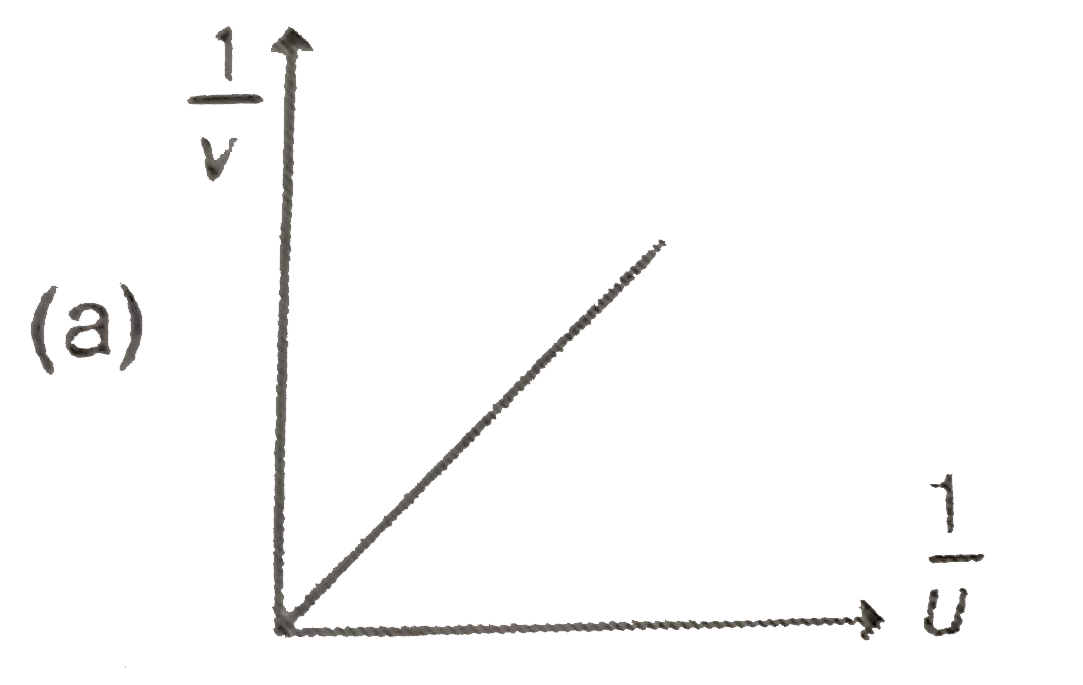
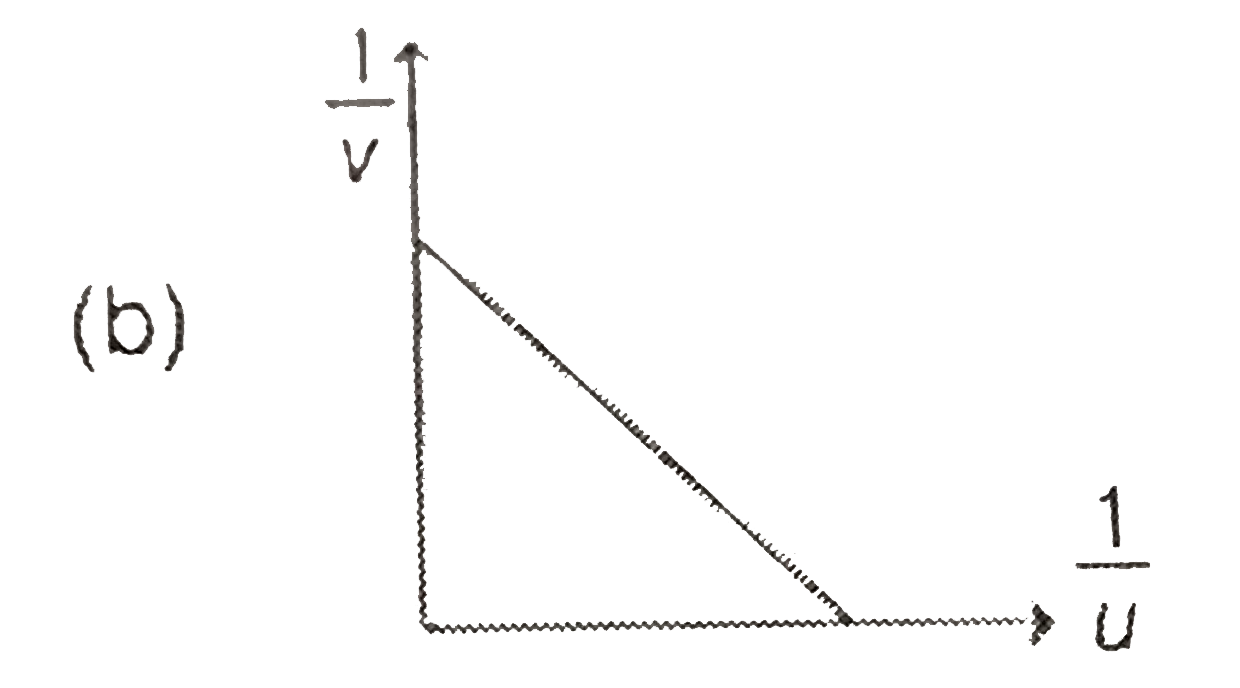
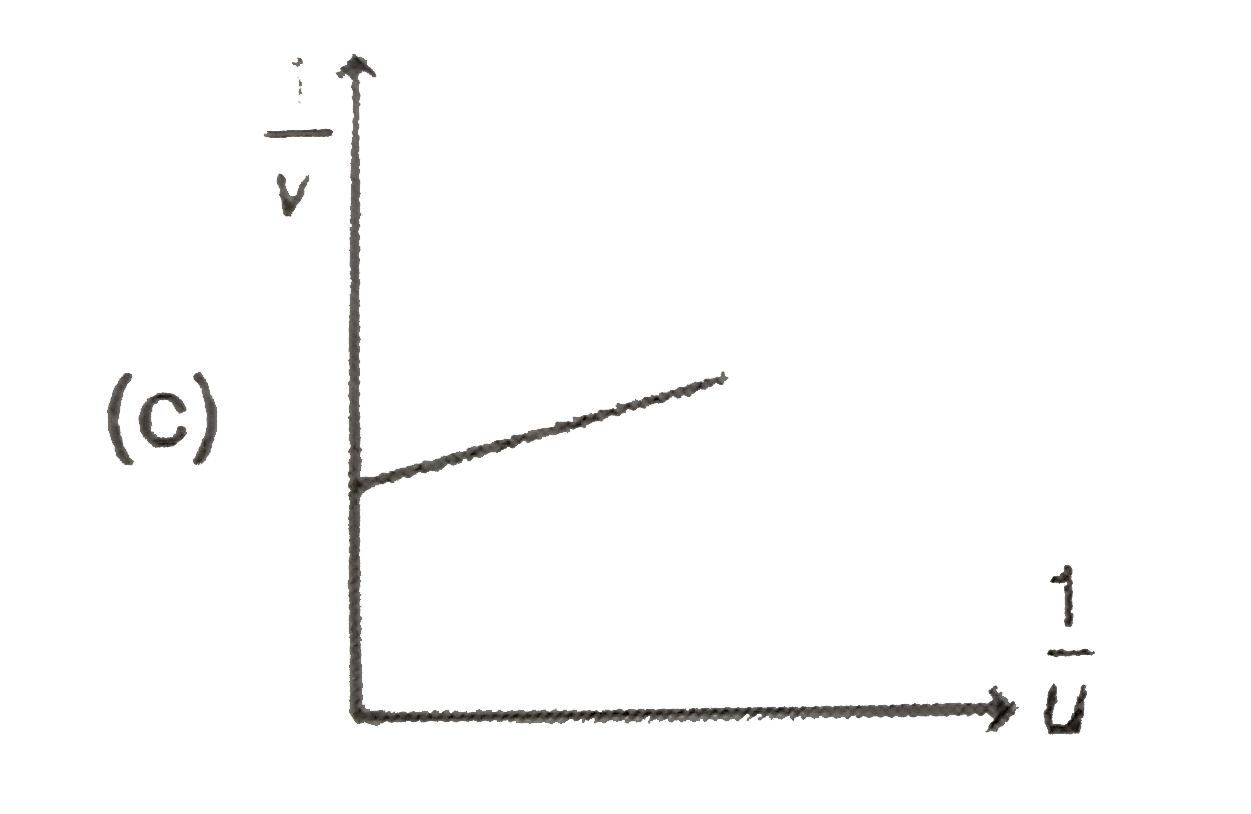
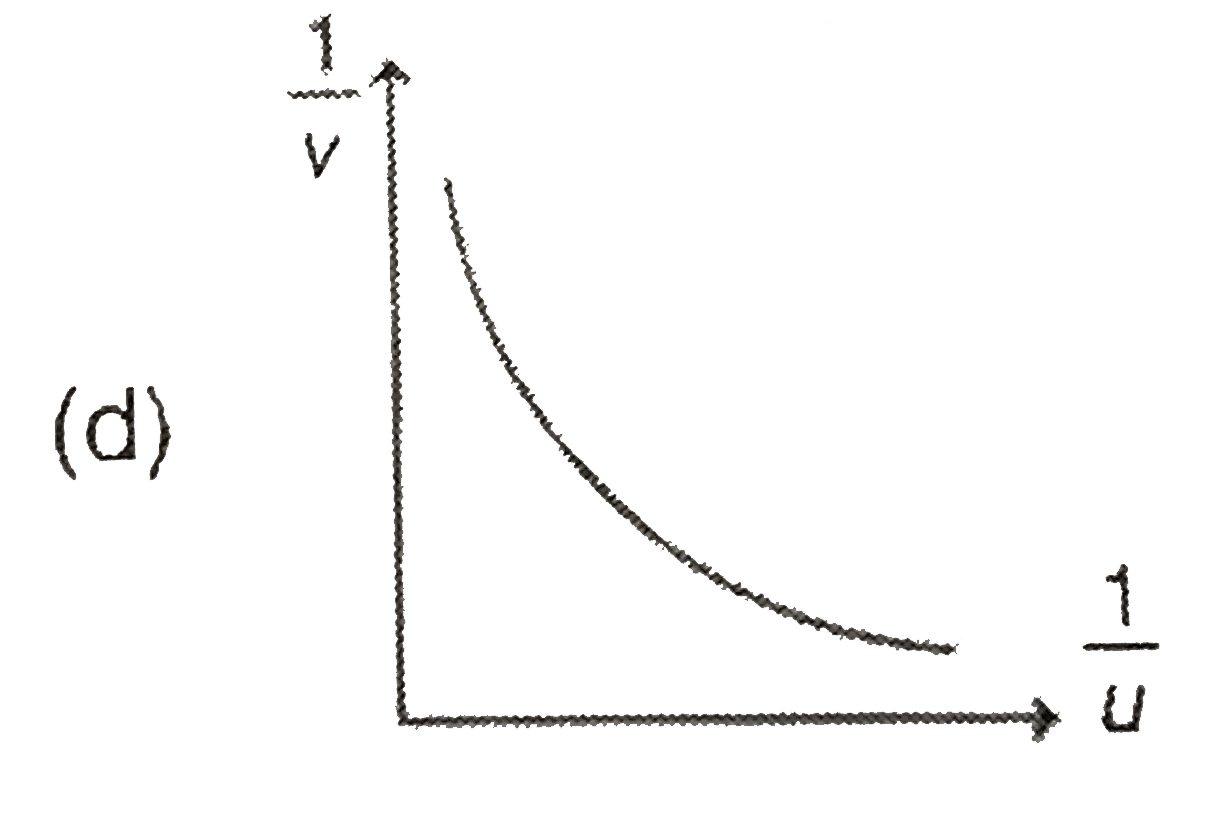
The graph between `(1)/(v)` and `(1)/(u)` for a concave mirror looks like.
A
B
C
D
Text Solution
AI Generated Solution
The correct Answer is:
To determine the graph between \(\frac{1}{v}\) and \(\frac{1}{u}\) for a concave mirror, we can follow these steps:
### Step 1: Write the Mirror Formula
The mirror formula for a concave mirror is given by:
\[
\frac{1}{f} = \frac{1}{v} + \frac{1}{u}
\]
where:
- \(f\) is the focal length of the mirror,
- \(v\) is the image distance,
- \(u\) is the object distance.
### Step 2: Rearrange the Mirror Formula
We can rearrange the mirror formula to express \(\frac{1}{v}\) in terms of \(\frac{1}{u}\):
\[
\frac{1}{v} = \frac{1}{f} - \frac{1}{u}
\]
This can be rewritten as:
\[
\frac{1}{v} = -\frac{1}{u} + \frac{1}{f}
\]
### Step 3: Identify the Form of the Equation
The equation \(\frac{1}{v} = -\frac{1}{u} + \frac{1}{f}\) is in the form of \(y = mx + c\), where:
- \(y = \frac{1}{v}\),
- \(x = \frac{1}{u}\),
- The slope \(m = -1\),
- The y-intercept \(c = \frac{1}{f}\).
### Step 4: Graph the Equation
From the equation, we can see that the graph will be a straight line with:
- A negative slope (indicating that as \(\frac{1}{u}\) increases, \(\frac{1}{v}\) decreases),
- A y-intercept at \(\frac{1}{f}\).
### Step 5: Conclusion
Thus, the graph between \(\frac{1}{v}\) and \(\frac{1}{u}\) for a concave mirror will be a straight line that slopes downwards from left to right, intersecting the y-axis at \(\frac{1}{f}\).
### Final Answer
The graph is a straight line with a negative slope, indicating the relationship between \(\frac{1}{v}\) and \(\frac{1}{u}\) for a concave mirror.
---
Topper's Solved these Questions
GENERAL PHYSICS
DC PANDEY ENGLISH|Exercise MCQ_TYPE|17 Videos
GENERAL PHYSICS
DC PANDEY ENGLISH|Exercise MATCH THE COLUMN|6 Videos
FLUID MECHANICS
DC PANDEY ENGLISH|Exercise Medical entranes gallery|49 Videos
GRAVITATION
DC PANDEY ENGLISH|Exercise (C) Chapter Exercises|45 Videos
Similar Questions
Explore conceptually related problems
For a concave mirrorr, if real image is formed the graph between (1)/(u) and (1)/(v) is of the form
The graph between u and v for a convex mirrorr is
The graph betwene P and V at constant temperature should look like
What is the type of graph between log P and log ((1)/(V)) at constant temperature for a given amount of gas ?
In an experiment to find focal length of a concave mirror, a graph is drawn between the magnitudes of (u) and (v). The graph looks like.
In an experiment to find focal length of a concave mirror, a graph is drawn between the magnitudes of (u) and (v). The graph looks like.
A student measures the focal length of a convex lens by putting an object pin at a distance u from the lens and measuring the distance v of the image pin. The graph between u and v plotted by the student should look like
By Plotting (1)/(v) verus (1)/(u) focal length of a convex mirror can be found .
An object is placed between a plane mirror and a concave mirror of focal length 15 cm as shown in Figure . Find the position of the images after two reflections.
For sperical mirros graph plotted between - (1)/(V) and -(1)/(u)is .