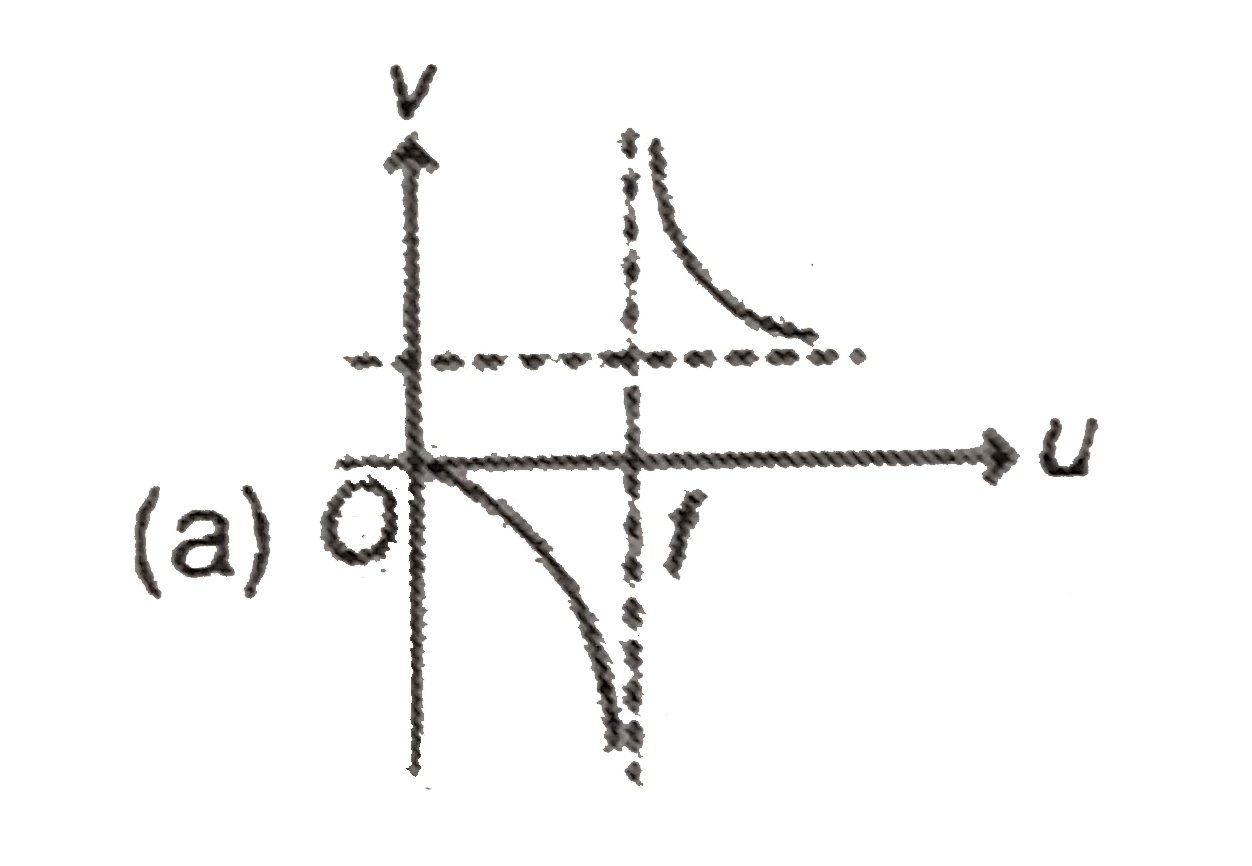
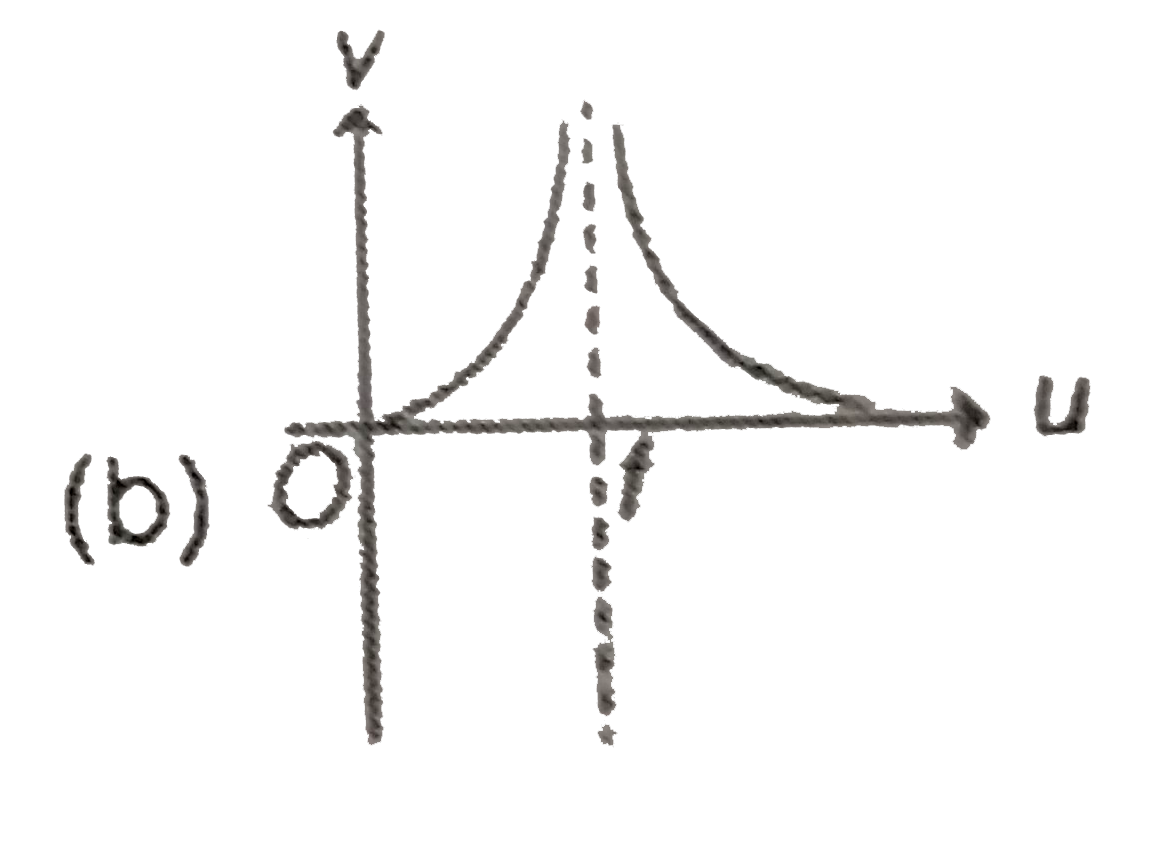
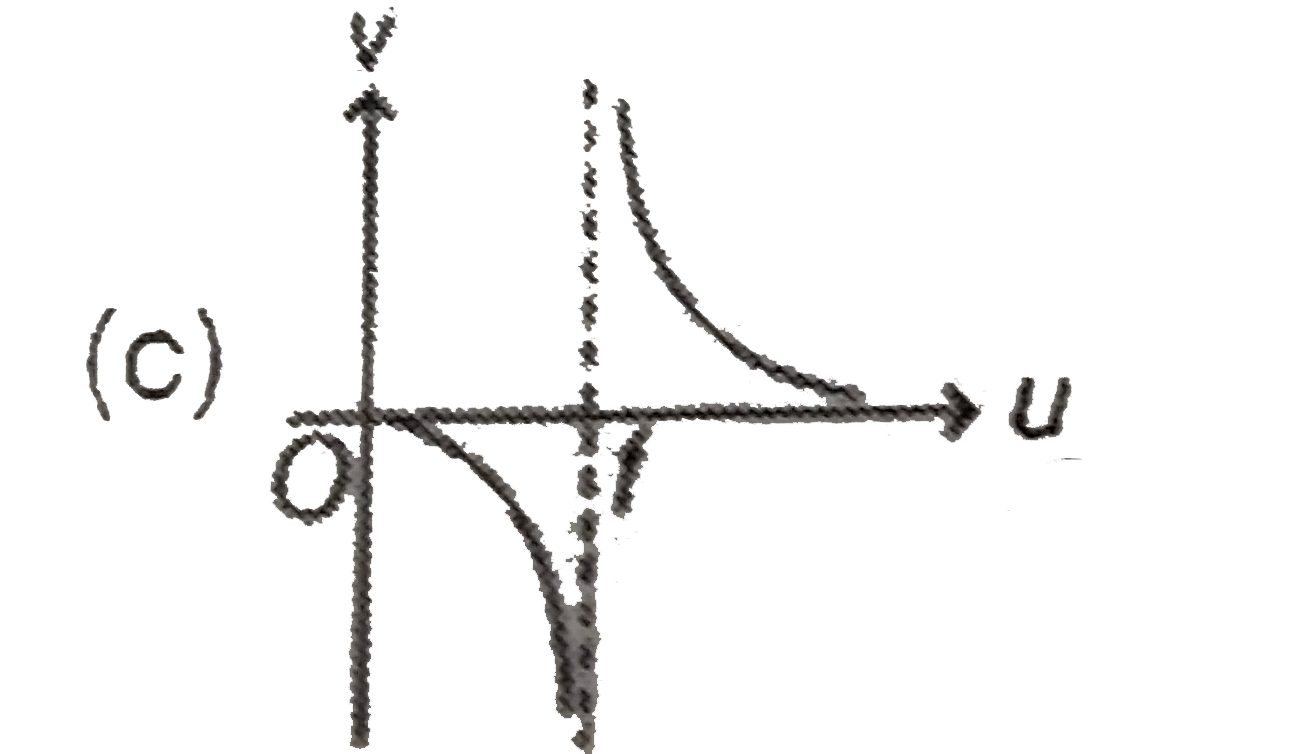
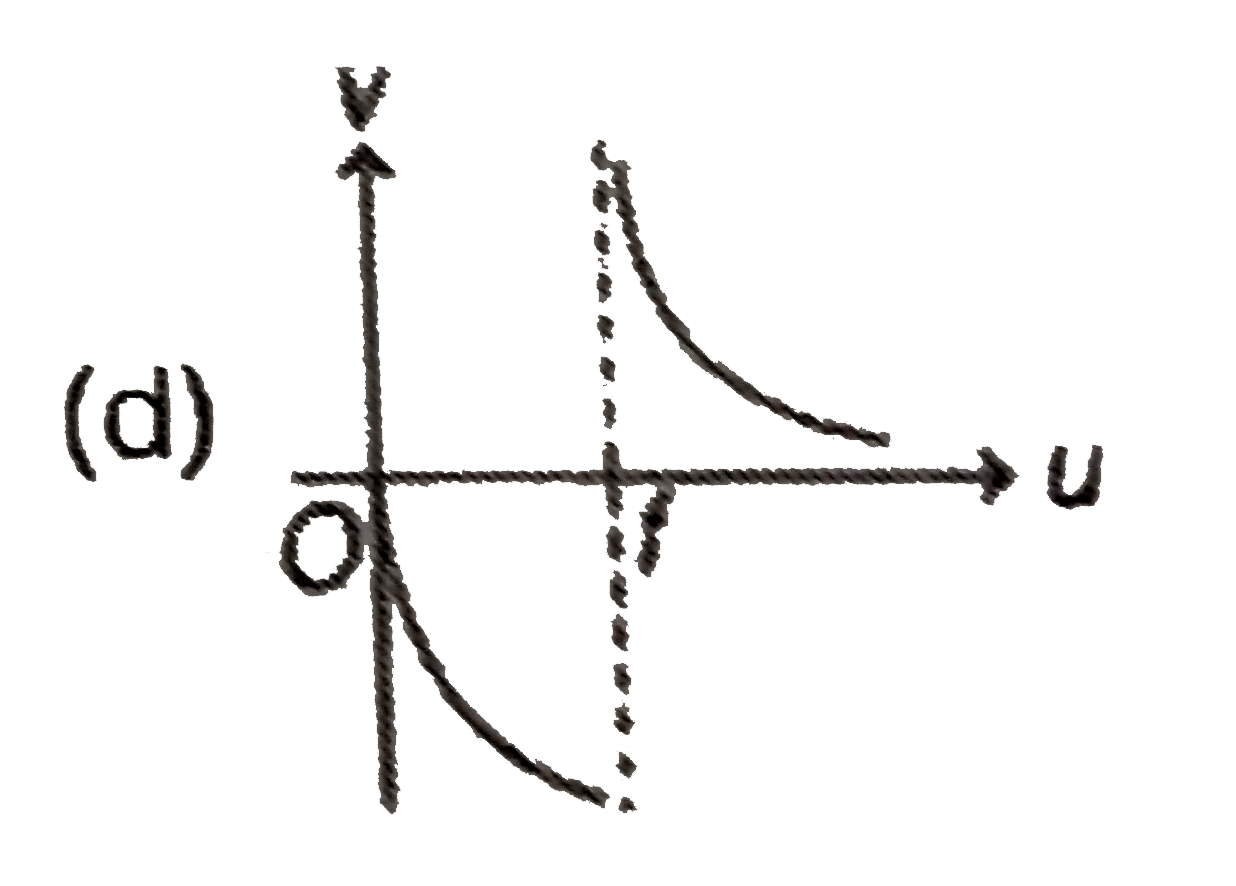
The graph showing correctly the variation of image distance `(v)` as a function of object distance `(u)` in case of a concave mirror is
A
B
C
D
Text Solution
AI Generated Solution
The correct Answer is:
To solve the problem of determining the correct graph that shows the variation of image distance \( v \) as a function of object distance \( u \) for a concave mirror, we can follow these steps:
### Step 1: Understand the Mirror Formula
The mirror formula for a concave mirror is given by:
\[
\frac{1}{f} = \frac{1}{v} + \frac{1}{u}
\]
Where:
- \( f \) is the focal length,
- \( v \) is the image distance,
- \( u \) is the object distance.
### Step 2: Rearrange the Mirror Formula
We can rearrange the mirror formula to express \( v \) in terms of \( u \):
\[
\frac{1}{v} = \frac{1}{f} - \frac{1}{u}
\]
This can be rewritten as:
\[
v = \frac{fu}{u - f}
\]
### Step 3: Analyze the Behavior of \( v \)
Now, let's analyze the behavior of \( v \) as \( u \) changes:
- As \( u \) approaches infinity (\( u \to \infty \)):
\[
v \to f \quad \text{(the image distance approaches the focal length)}
\]
- As \( u \) approaches the focal point (\( u \to f \)):
\[
v \to \infty \quad \text{(the image distance becomes very large)}
\]
- As \( u \) approaches zero (\( u \to 0 \)):
\[
v \to -f \quad \text{(the image distance becomes negative, indicating a virtual image)}
\]
### Step 4: Sketch the Graph
Based on the analysis:
- The graph should start from negative values (when \( u \) is close to 0) and increase towards the focal length \( f \) as \( u \) increases.
- The graph should show that as \( u \) increases from 0 to infinity, \( v \) transitions from negative to positive values, eventually approaching \( f \).
### Step 5: Identify the Correct Option
From the options provided, we need to identify which graph correctly represents this behavior:
- The correct graph should show that \( v \) starts from a negative value (indicating a virtual image) and increases towards \( f \) as \( u \) increases.
### Conclusion
Based on the analysis, the correct option is **Option A**, which accurately depicts the relationship between \( v \) and \( u \) for a concave mirror.
---
Topper's Solved these Questions
GENERAL PHYSICS
DC PANDEY ENGLISH|Exercise MCQ_TYPE|17 Videos
GENERAL PHYSICS
DC PANDEY ENGLISH|Exercise MATCH THE COLUMN|6 Videos
FLUID MECHANICS
DC PANDEY ENGLISH|Exercise Medical entranes gallery|49 Videos
GRAVITATION
DC PANDEY ENGLISH|Exercise (C) Chapter Exercises|45 Videos
Similar Questions
Explore conceptually related problems
The minimum distance between the object and its real image for concave mirror is
The graph shown part of variation of v with change in u for a concave mirror. Points plotted above the point P on the curve are for values of v
By drawing a neat diagram show the formation of an image in a concave mirror when the object is between the pole and the principal focus of the mirror. State the characteristics of the image.
A particle is moving at a constant speed V from a large distance towards a concave mirror of radius R along its principal axis. Find the speed of the image formed by the mirror as a function of the distance x of the particle from the mirror.
Which of the following graph represents relation between the image position (v) and object position (u) from the concave lens.
The graph between (1)/(v) and (1)/(u) for a concave mirror looks like.
The graph between (1)/(v) and (1)/(u) for a concave mirror looks like.
The minimum sum of the distances of a real object and a real image from a concave mirror of radius of curvature 20cm is:
A convex mirror offocal length fforms an image which is 1/n times the object. The distance of the object from the mirror is:
When an object is placed at a distance of 40 cm from a concave mirror, the size of image is one fourth that of the object. A. Calculate the distance of image from the mirror b. What will be the focal length of the mirror?