Home
Class 11
PHYSICS
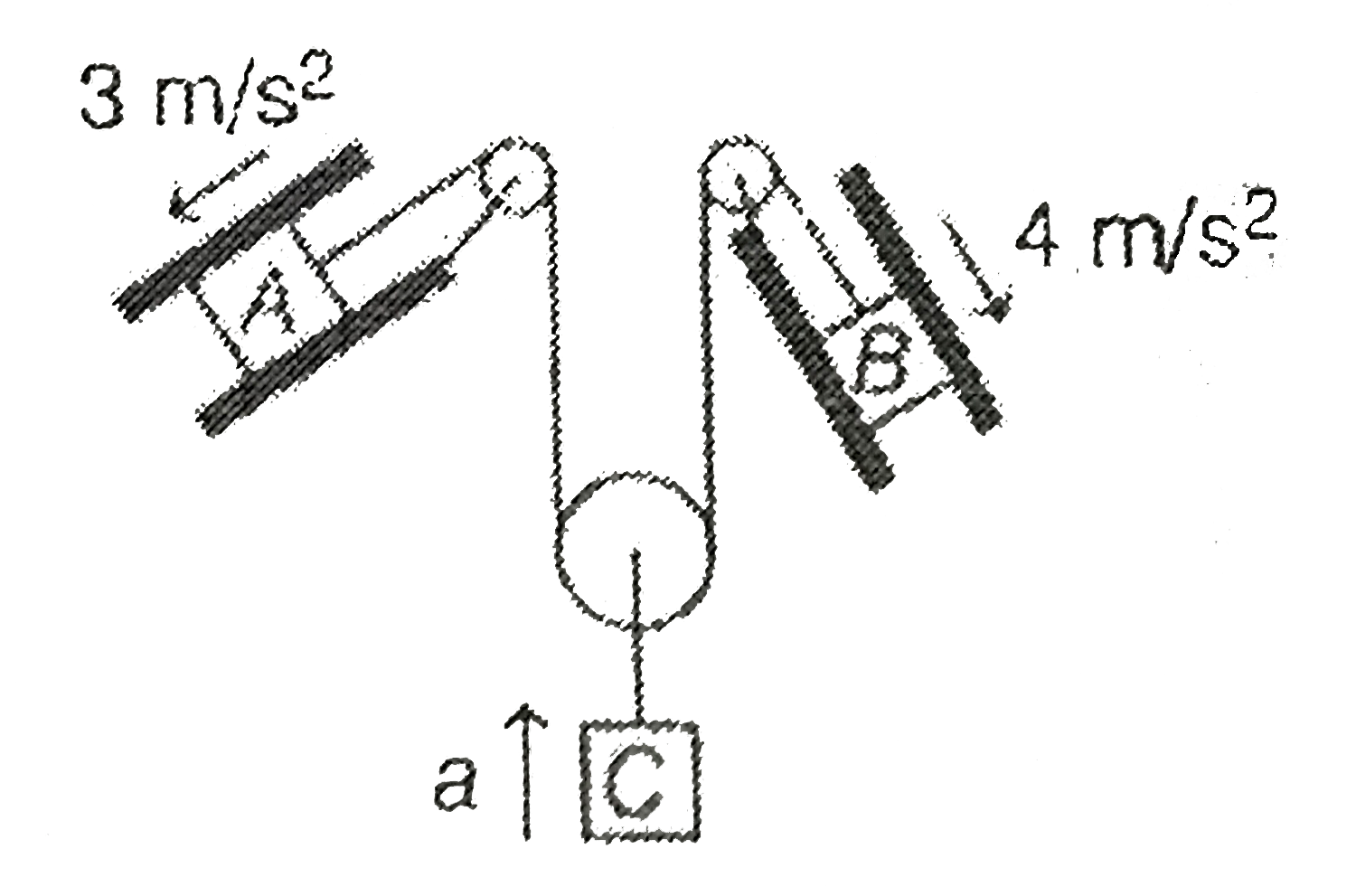
Assuming all the surfaces to be friction...

Assuming all the surfaces to be frictionless accelration of the block c shown in the figure is

A

`5m//s^(2)`

B

`7m//s^(2)`

C

`3.5m//s^(2)`

D

`4m//s^(2)`

Text Solution

Verified by Experts

The correct Answer is:

c
Promotional Banner

Similar Questions

Explore conceptually related problems

In the arrangement shown in figure, the rod of mass m held by two smooth walls, remains always perpendicular to the surface of the wedge of mass M . Assumming all the surface to be frictionless, find the acceleration of the rod and that of the wedge.

In the figure shown, accelration of the block is

Three block A,B,and C of mass m_(1),m_(2) and m_(3) , respectively are resting one on top of the other as shown in fig. A horizontal force F is applied on block B. Assuming all the surfaces are frictionless, calculate (1) acceleration of block A, block B, and block C, (2) normal reactions between A and B, B and C, and between C and ground .

The system shown in fig. is given an acceleration a towards left. Assuming all the surfaces to be frictionless, find the normal reactions applied by wedge on the sphere.

In the arrangement shown in the figure , the rod of mass m held by two smooth walls , remain always perpendicular to the surface of the wedge of mass M . Assuming all the surface are frictionless, find the acceleration of the rod wedge.

Assuming all the surface to be frictionless. The smaller block m is moving horizontally with acceleration a and vertically downwards with acceleration a. Then magnitude of net acceleration of smaller block m with respect to ground

A small block B of mass m_2 is placed on another block A of mass m_1 A constant horizontal force F is applied to the block A. All the surfaces are assumed to be frictionless. Find the acceleration of center of mass of the system

The left block in figure moves at a speed v towards the right block placed in equilibrium. All collisions to take place are elastic and the surfaces are frictionless. Show that motion of the two blocks are periodic. Find the time period of these periodic motions. Neglect the widths of the blocks.

The pulley shown in figure has a radius 10 cm and moment of inertia 0.5 kg-m^2 about its axis. Assuming the inclined planes to be frictionless, calculate the acceleration of the 4.0 kg block.

In the shown arrangement , both pulleys and the string are massless and all the surface are frictionless. Find the acceleration of the wedge.
