Home
Class 11
PHYSICS
A non-uniform bar of weight W is suspend...

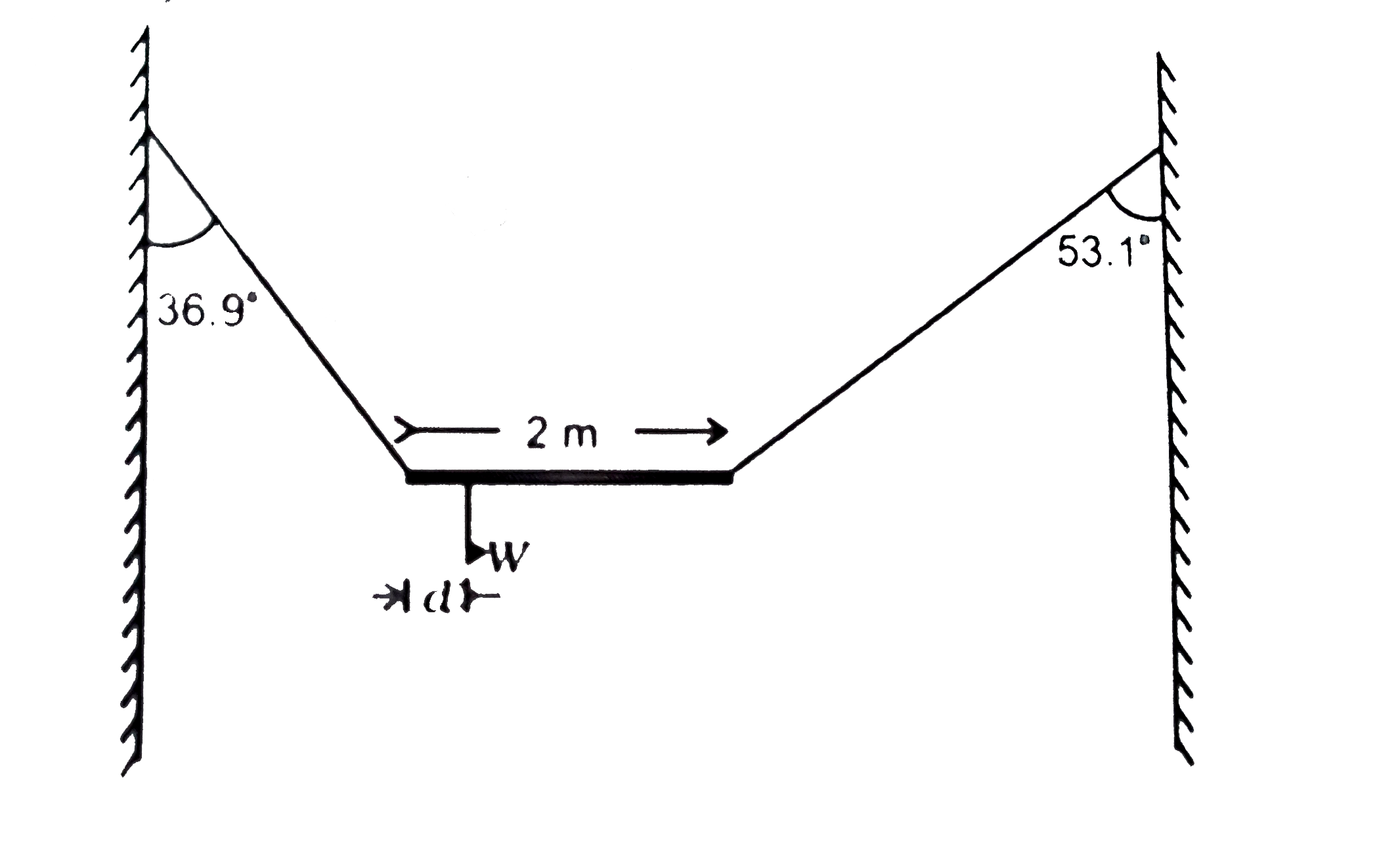
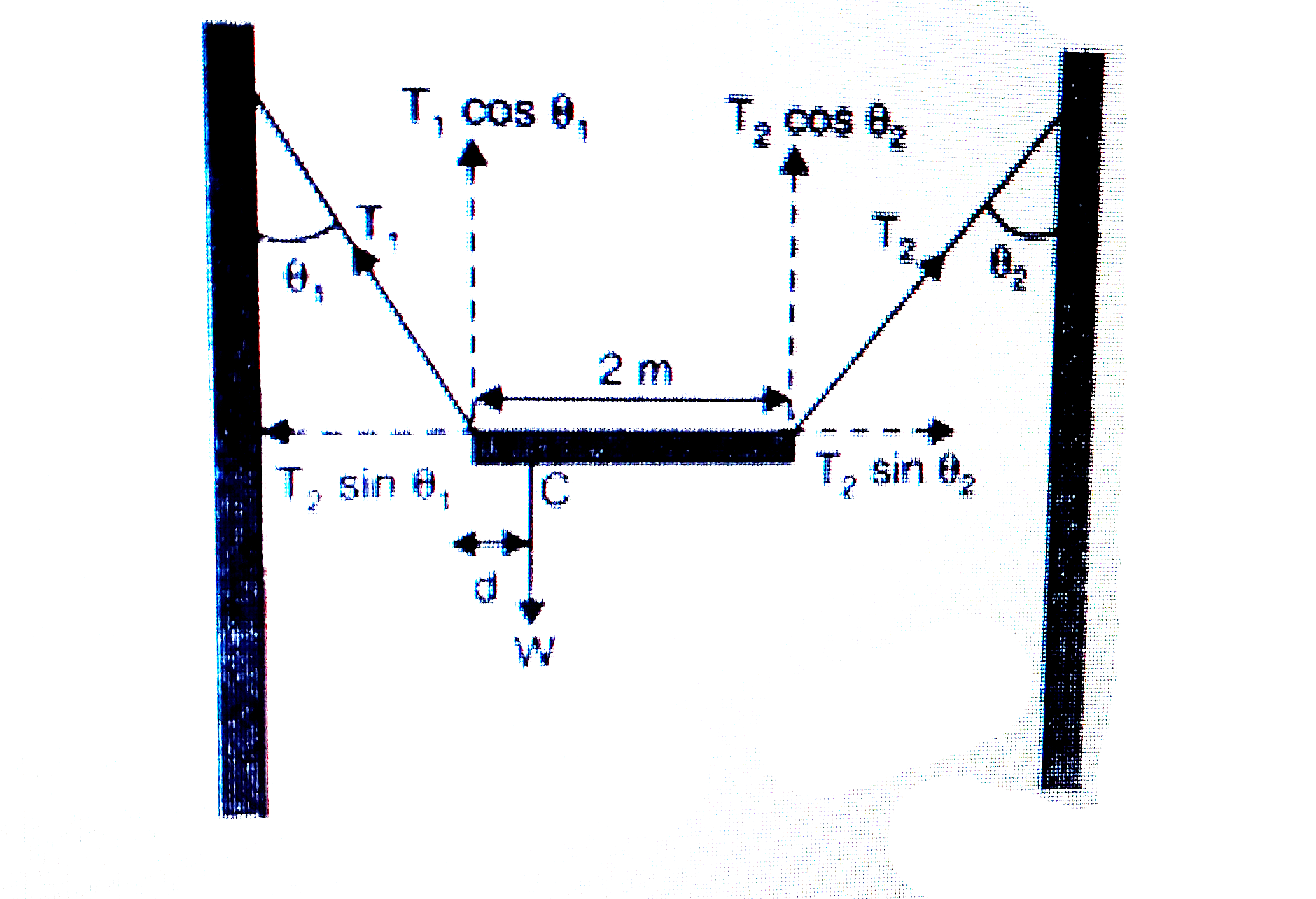
A non-uniform bar of weight W is suspended at rest by two strings of negligible weight as shown in Fig.7.39. The angles made by the strings with the vertical are `36.9^(@) " and" 53.1^(@)` respectively. The bar is 2 m long. Calculate the distance d of the centre of gravity of the bar from its left end.

A

72cm

B

64cm

C

100cm

D

40cm

Text Solution

Verified by Experts

The correct Answer is:

a
Promotional Banner

Similar Questions

Explore conceptually related problems

A non-uniform bar of weight W is suspended at rest by two strings of negligible weight as shown in Fig. The angles made by the strings with the vertical are 36.9^(@) and 53.1^(@) respectively. The bar is 2m long. Calculate the distance d of the centre of gravity of the bar from its left end.

A non-uniform bar of weight W and weight L is suspended by two strings of neigligible weight as shown in figure. The angles made by the strings with the vertical are theta_1 and theta_2 respectively. The distance d of the centre of gravity of the bar from left end is. .

A non-uniform rod AB of weight w is supported horizontally in a vertical plane by two light strings PA and QB as shown in the figure.G is the centre of gravity of the rod. If PA and QB make angles 30^(@) and 60^(@) respectively with the vertical, the ratio ("AG")/("GB") is

A spring of weight W and force constant k is suspended is a horizontal position by tw3o ligth strings attached to its two ends. Each string makes an angle theta with the vertical. The extension of the spring is.

A uniform rod of length l and mass m is suspended from one end by inextensible string and other end less lies on smooth ground. The angle made by the rod with vertical is theta="sin"^(-1)(1//sqrt(3)) . If N_(1) and N_(2) represent the contact force from ground on rod just before and just after cutting the string then the ratio of N_(1)//N_(2) is 0.25 x. Find the value of x.

A thin uniform bar of mass m and length 2L is held at an angle 30^@ with the horizontal by means of two vertical inextensible strings, at each end as shown in figure. If the string at the right end breaks, leaving the bar to swing, determine the tension in the string at the left end and the angular acceleration of the bar immediately after string breaks.

In an aluminium (Al) bar of square cross section, a square hole is drilled and is filled with iron (Fe) as shown in the figure. The electrical resistivities of Al and Fe are 2.7 xx (10^-8) Omega m and 1.0 xx (10^-7) Omegam, respectively. The electrical resistance between the two faces P and Q of the composite bar is

A uniform bar of mass M and length L is horizontally suspended from the ceiling by two vertical light cables as shown. Cable A is connected (1)/(4) th distance from the left end of the bar. Cable B is attached at the far right end of the bar. What is the tension in cable A?

A thin uniform bar lies on a frictionless horizonta surface and is free to move in any way on th surface. Its mass is 0.16 kg and length sqrt3 meters. Two particless, each of mass 0.08 kg, are moving on the same surface and towards the bar in a direction perpendicular to the bar, one with a velocity of 10 m/s, and other with 6m/s as shown in fig. The first particle strikes the bar at point A and the other at point B. Points A and B are at a distane of 0.5m from the centre of the bar. The particles strike the bar at the same instant of time and stick to the bar on collision. Calculate the loss of the kinetic energy of the system in the above collision process.

A uniform bar of length 6a and mass 8m lies on a smooth horizontal table. Two point masses m and 2m moving in the same horizontal plane with speeds 2v and v , respectively, strike the bar (as shown in the figure) and stick to the bar after collision. Denoting angular velocity (about the centre of mass), total energy and centre of mass velocity by omega , E and V_(C) , respectively, we have after collision
