Home
Class 11
PHYSICS
A block A of mass m is placed over a pla...

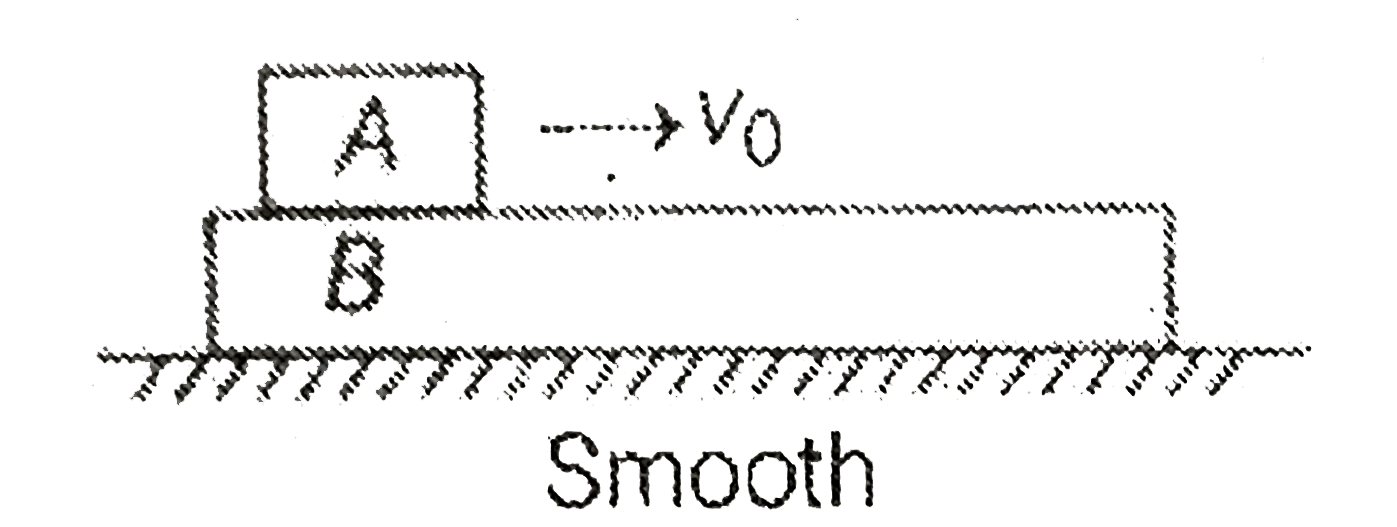
A block A of mass m is placed over a plank B of mass 2m. Plank B is placed over a smooth horizontal surface. The coefficient of friction between A and B is `(1)/(2)` block A is given a velocity `v_(0)` towards right. Accelration of B relative to A is

A

`(g)/(2)`

B

zero

C

`(3g)/(4)`

D

`(g)/(4)`

Text Solution

Verified by Experts

The correct Answer is:

c
Promotional Banner

Similar Questions

Explore conceptually related problems

A block A of mass m is placed over a plank B of mass 2m plank B is placed over a smooth horizontal surface .The coefficient of friction between A and B is 0.4 Block A is given a velocity v_(0) toward right Find acceleration (in ms^(-2) of B relative to A

A block A of mass 2 kg is placed over smooth block B of mass 4 kg which is placed over a smooth horizontal floor The coefficient of friction between A and B is 0.4 when a horizontal forces of magnitude 10 N is applied on A the acceleration of block of A and B are

A block of mass m is placed at rest on a smooth wedge of mass M placed at rest on a smooth horizontal surface. As the system is released

A bolck of mass m =2 kg is placed on a plank of mass M = 10 kg, which is placed on a smooth horizontal plane as shown in the figure. The coefficient of friction between the block and the plank is mu=(1)/(3) . If a horizontal force F is applied on the plank, then the maximum value of F for which the block and the plank move together is (g=10m//s^(2))

A block A is placed over a long rough plank B same mass as shown below. The plank is placed over a smooth horizontal surface. At time t = 0 , block A is given a velocity v_(0) in horizontal direction. Let v_(1) and v_(2) be the velocity of A & B at time 't'. Then choose the correct graph between v_(1) or v_(2) and t.

A block of mass m is kept over another block of mass 2 m and the system rests on a smooth horizontal surface. The coefficient of friction between the blocks is 0.50. Find the work done by the force of friction on the smaller block by the bigger block during a displacement d of the system, when a force mg is applied to the lower block.

Block A of mass 2kg is placed over a block B of mass 8kg . The combination is placed on a rough horizontal surface. If g=10ms^(-2) , coefficient of friction between B and floor =0.5 , coefficient of friction between B and floor =0.5 , coefficient of friction between A and B=0.4 and a horizontal force of 10N is applied on 8kg block, then the force of friction between A and B is.

Block A of mass 2kg is placed over a block B of mass 8kg . The combination is placed on a rough horizontal surface. If g=10ms^(-2) , coefficient of friction between B and floor =0.5 , coefficient of friction between B and floor =0.5 , coefficient of friction between A and B=0.4 and a horizontal force of 10N is applied on 8kg block, then the force of friction between A and B is.

A block of mass m=2kg of shown dimensions is placed on a plank of mass M = 6Kg which is placed on smooth horizontal plane. The coefficient of friction between the block and the plank is mu=1/3 . If a horizontal froce F is applied on the plank, then find the maximum value of F (in N) for which the block and the plank move together

A block A slides over an another block B which is placed over a smooth inclined plane as shown in figure . The coefficient of friction between the two blocks A and B is mu . Mass of block B is two times the mass of block A . The acceleration of the centre of mass of two blocks is
