Home
Class 11
PHYSICS
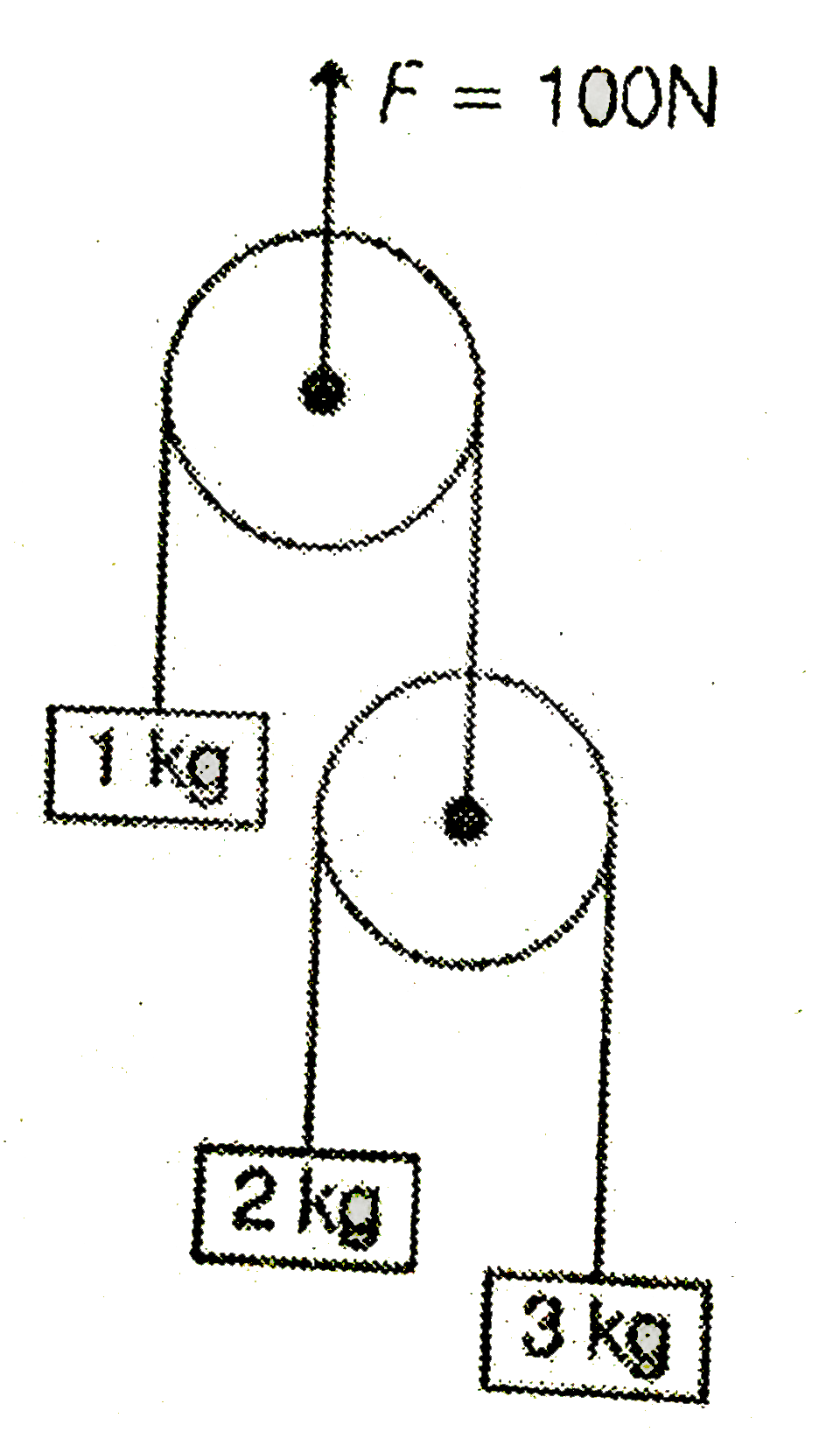
In the diagram shown in figure, both pul...

In the diagram shown in figure, both pulleys and strings are massless. The acceleration of 2 kg block is

A

`2.5 m//s^(2) (uarr)`

B

`5 m//s^(2) (uarr)`

C

`7.5 m//s^(2) (darr)`

D

`10 m//s^(2) (uarr)`

Text Solution

Verified by Experts

The correct Answer is:

A
Promotional Banner

Similar Questions

Explore conceptually related problems

In the arrangement shown, the pulleys and strings are massless. The acceleration of block B is :

Find the acceleration of blocks in fig. The pulley and the string are massless.

In the shown mass pulley system, pulleys and string are massless. The one end of the string is pulleed by the force F=2mg . The acceleration of the block will be

In the shown mass pulley system, pulleys and string are massless. The one end of the string is pulleed by the force F=2mg . The acceleration of the block will be

In the shown arrangement , both pulleys and the string are massless and all the surface are frictionless. Find the acceleration of the wedge.

In the arrangement shown the fixed pulley is massless and frictionless. If the acceleration of block of mass 1kg is (30)/(x)m//s^(2) . Find the value of x .

Figure shows an arrangement of pulleys and two blocks. All surfaces are frictionless . All pulleys and strings are massless. All string are smooth and massless. The acceleration of block A is :

In the following arrangement, the system is initially at rest. The 5-kg block is now released. Assuming the pulley and string to be massless and smooth, the acceleration of block C will be

In the system shown all the surfaces are frictionless while pulley and string are massless. The mass of block A is 2m and that of block B is m. The acceleration of block B immediately after system is released from rest is

In the diagram shown in figure, all pulleys are smooth and massless and string are light. Match the following columns. {:("Column I","Column II"),("(A) 1kg block","(p) will remain stationary"),("(B) 2 kg block","(q) will move down"),("(C) 3 kg block","(r) will move up"),("(D) 4 kg block",(s) 5 ms^(-2)),(,(t) 10 ms^(-2)):}
