Home
Class 11
PHYSICS
Two block of masses m1 and m2 are connec...

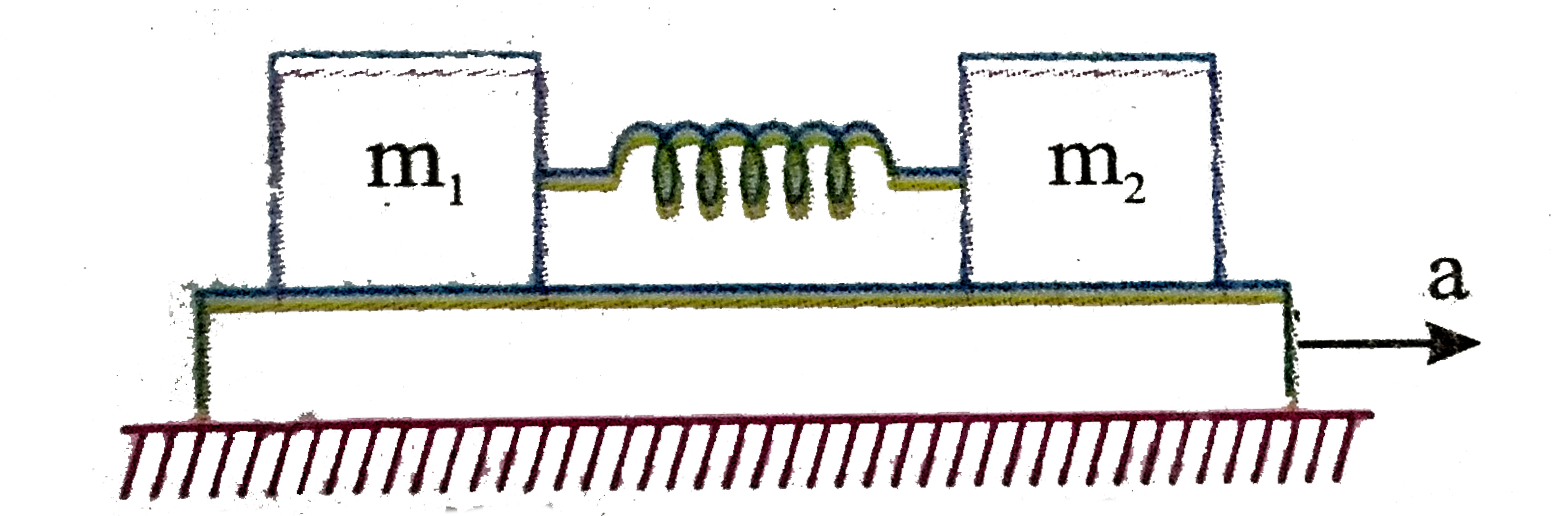
Two block of masses `m1` and `m2` are connected with a massless unstretched spring and placed over a plank moving with an acceleration `'a'` as shown in figure. The coefficient of friction between the blocks and platform is `mu`

A

spring will be stretched if `a gt mu g`

B

spring will be compressed if ` a le mu g`

C

spring will be stretched if `a le mu g`

D

spring will be its natural length under all conditions if initial velocity of blocks and platform is zero.

Text Solution

Verified by Experts

The correct Answer is:

D
Promotional Banner

Similar Questions

Explore conceptually related problems

Two blocks A and B of respective masses 6 kg and 4 kg are connected with a string passing over a light friction less pulley as shown in the figure . The coefficient of friction between the block A and horizontal surface is 0.4 . Then the minimum mass of block C which should be placed over A to prevent it from moving is :

Two blocks of masses m_(1) and m_(2) are placed in contact with each other on a horizontal platform as shown in figure The coefficent of friction between m_(1) and platform is 2mu and that between block m_(2) and platform is mu .The platform moves with an acceleration a . The normal reation between the blocks is

Two blocks of masses m_(1) and m_(2) are connected by a massless spring and placed on smooth surface. The spring initially stretched and released. Then :

Two blocks of masses m_(1) and m_(2) are connected by a string of negligible mass which pass over a frictionless pulley fixed on the top of an inclined plane as shown in figure. The coefficient of friction between m_(1) and plane is mu .

Two block of same mass'm' are joined with an dideal spring of spring constant k and sept on a rough surface as shown in figure. The spring is initially unstretched and coefficient of friction between the blocks and horizontal surface is mu and 2 mu respectively. What should be the maximum speed of block 'A' such that the block 'B' does not move ?

A small block of mass 'm' is placed on a plank of mass 'M'. The block is connected to plank with the help of a light string passing over a light smooth pulley as shown in figure. The co-efficient of static friction between the block and plank is mu . The co-efficient of friction between the plank and the horizontal surface is zero. What maximum horizontal force F applied on the block of mass m can make the block and plank not to slide relatively?

Two block of masses M_(1) and M_(2) are connected with a string passing over a pulley as shown in figure The block M_(1) lies on a horizontal surface friction between the block M_(1) and the horizontal surface is mu The system accelerates. What additional mass m should be plased on the block M_(1) so that the system does not accelerate ?

Two blocks of masses m_1 and m_2 are connected as shown in the figure. The acceleration of the block m_2 is :

Two block of masses m_(1) and m_(2) are connected as shown in the figure. The acceleration of the block m_(2) is:

A bolck of mass m =2 kg is placed on a plank of mass M = 10 kg, which is placed on a smooth horizontal plane as shown in the figure. The coefficient of friction between the block and the plank is mu=(1)/(3) . If a horizontal force F is applied on the plank, then the maximum value of F for which the block and the plank move together is (g=10m//s^(2))
