Home
Class 11
PHYSICS
Two spheres each of mass 8 sqrt(3) kg an...

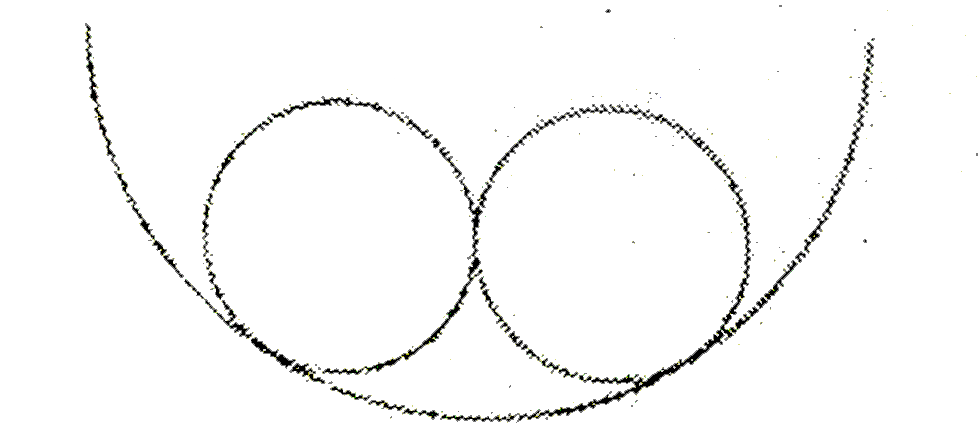
Two spheres each of mass `8 sqrt(3)` kg and radius 5 cm lie in contact in a hemispherical bowl of radius 40 cm. There is no friction between any of the contact surfaces. The contact force exerted by one sphere to another is____ (take `g=10 m//s^(2))`

A

10 N

B

20 N

C

30 N

D

None of these

Text Solution

Verified by Experts

The correct Answer is:

B
Promotional Banner

Similar Questions

Explore conceptually related problems

Two smooth sphere each of radius 5cm and weight W rest one on the other inside a fixed smooth cylinder of radius 8cm. The reaction between the sphere and the vertical side of the cylinder are:

Two smooth sphere each of radius 5cm and weight W rest one on the other inside a fixed smooth cylinder of radius 8cm. The reaction between the sphere and the vertical side of the cylinder are:

In the arrangement shown in the figure, the pulley has a mass 3m, Neglecting friction on the contact surface, the force exerted by the supporting rope AB on the ceiling is

Two soap bubbles of radii 2 cm and 3 cm are brought in contact. Find the radius of curvature (in cm) of the contact surface.

A ball of mass 1 kg is released from position A inside a wedge with a hemispherical cut of radius 0.5 m as shown in figure. The force exerted by the wedge on ball, when the ball is in position B is (neglect friction everywhere) (Take g = 10 m//s^(2) )

Two balls, each of radius R, equal mass and density are placed in contact, then the force of gravitation between them is proportional to

Two balls, each of radius R, equal mass and density are placed in contact, then the force of gravitation between them is proportional to

A uniform sphere of mass 20kg and radius 10cm is placed on a rough horizontal surface . The coefficient of friction between the sphere and the surface is 0.5.If a force of magnitude 14.14 N is applied on the sphere at an angle of 45^(@) with horizontal as shown in the figure, calculate (a) frictional force (b) acceleration of the sphere (c ) angular acceleration of the sphere

A small sphere of radius R is held against the inner surface of a larger sphere of radius 6R. The mass of large and small spheres are 4M and M respectively. This arrangement is placed on a horizontal table. There is no friction between any surface of contact. The small sphere is now released. The x coordinate of the centre of the larger sphere when the smaller sphere reaches the other extreme position, is found to be (L + nR) , find n.

A uniform ring of mas m and radius a is placed directly above a uniform sphere of mass M and of equal radius. The centre of the ring is at a distance sqrt3 a from the centre of the sphere. Find the gravitational force exerted by the sphere on the ring.
