Home
Class 11
PHYSICS
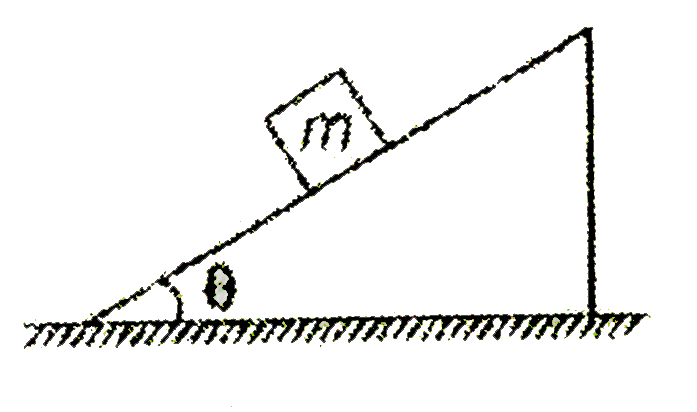
a Block of mass m is placed on a wedge o...

a Block of mass m is placed on a wedge of mass M there is no friction between the block and the wedge .The minmum coefficient of friction between the wedge and the gound so that wedge does not move is,

A

`(mcos^(2)theta)/(M+mcos^(2) theta)`

B

`(msin^(2)theta)/(M+mcos^(2) theta)`

C

`(mcos thetasintheta)/(M+mcos^(2) theta)`

D

`(mcos thetasintheta)/(M+msin^(2) theta)`

Text Solution

Verified by Experts

The correct Answer is:

C
Promotional Banner

Similar Questions

Explore conceptually related problems

A cube of mass m is placed on top of a wedge of mass 2m, as shown in figure. There is no friction between the cube and the wedge. The minimum co - efficient of friction between the wedge and the horizontal surface, so that the wedge does not move is

Two wedges, each of mass m , are placed next to each other on a flat horizontal floor. A cube of mass M is balanced on the wedges as shown in figure. Assume no friction between the cube and the wedges, but a coefficent of static friction mult1 between the wedges and the floor. What is the largest M that can be balanced as shown without motion of the wedges ?

Calculate angle of friction between wedge and block system is at rest M coefficient of friction between wedge and block.

Two small blcok m=2kg each kept on wedge of mass 12kg. There is no friction between blocks and wedge coefficient of friction between wedge and ground in μ=0.3. Calculate frictional force by ground on wedge.

A block of mass m is placed on a smooth wedge of mass M, as shown in the figure . Just after placiing block m over wedge M.

In the figure if block A and wedge b will move with same acceleration, then the magnitude of normal reaction between the block and the wedge will be (There is no friction between block and the wedge and the wedge moves on horizontal surface as shown.)

The block of mass m_(1) is placed on a wedge of an angle theta , as shown. The block is moving over the inclined surface of the wedge. Friction coefficient between the block and the wedge is mu_(1) , whereas it is mu_(2) between the wedge and the horizontal surface. if mu_(1)=1/2, theta=45^(@), m_(1)=4 kg, m_(2)=5 kg and g=10 m//s^(2) , find minimum value of mu_(2) so that the wedge remains stationary on the surface. express your answer in multiple of 10^(-3)

The block of mass m_(1) is placed on a wedge of an angle theta , as shown. The block is moving over the inclined surface of the wedge. Friction coefficient between the block and the wedge is mu_(1) , whereas it is mu_(2) between the wedge and the horizontal surface. if mu_(1)=1/2, theta=45^(@), m_(1)=4 kg, m_(2)=5 kg and g=10 m//s^(2) , find minimum value of mu_(2) so that the wedge remains stationary on the surface. express your answer in multiple of 10^(-3)

A block of mass m is at rest on wedge as shown in figure. Let N be the normal reaction between two and f the force of friction, then choose the wrong option.

A block of mass m lies on wedge of mass Mas shown in figure. Find the minimum friction coeffcient required between wedge Mand ground so that it does not move while block m slips down on it.
