Home
Class 11
PHYSICS
Impending state of motion is a critical ...

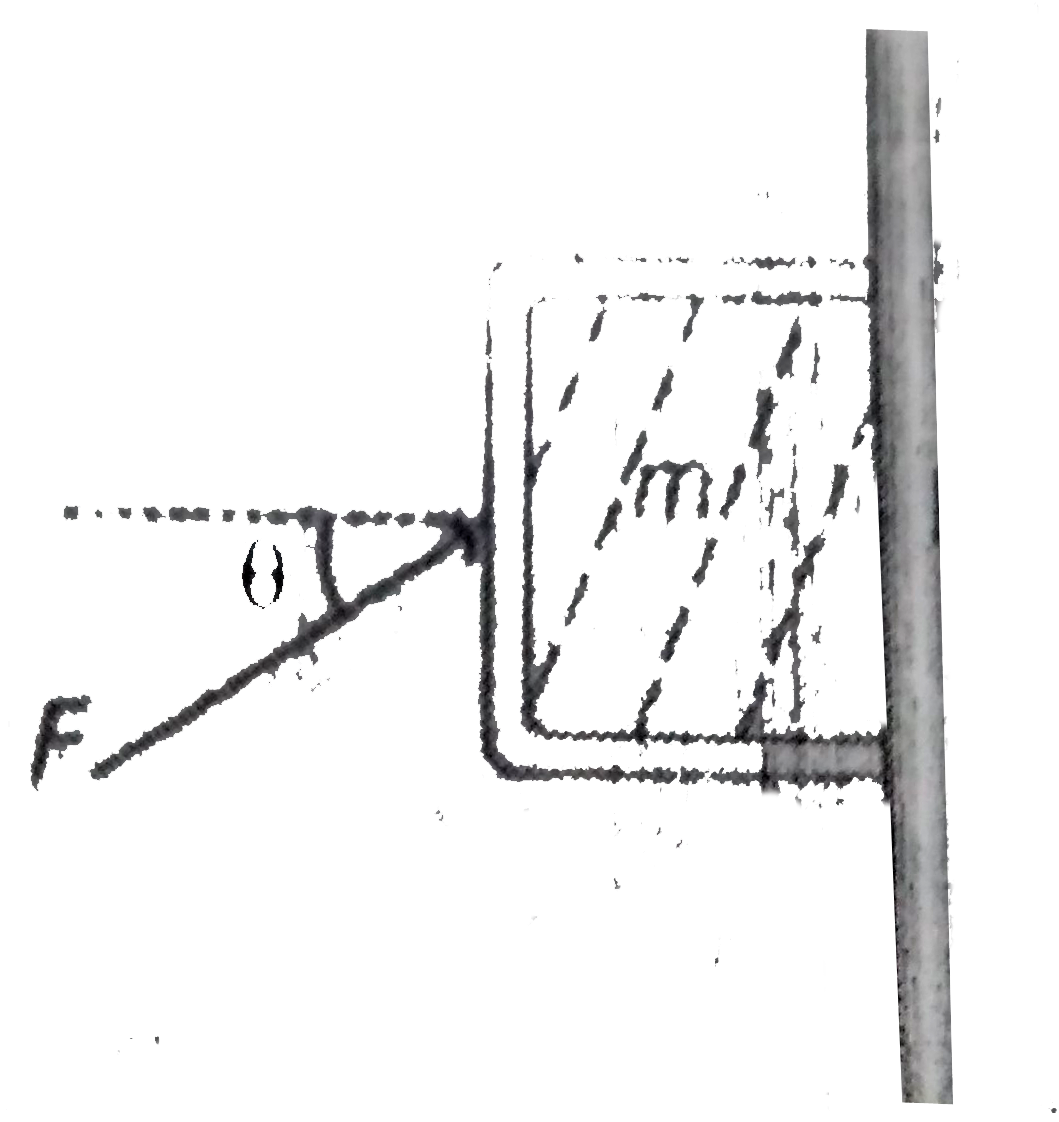
Impending state of motion is a critical border line between static and dynamic states of a body A block of mass m is supported on a rough vertical wall by applying a rough vertical wall by applying a force F as shown in figure coefficient of static friction between block and wall is `mu` The block under the influence F sin`theta` may have a tendency to move upward or it may be assumed that F `sin theta` just prevents downward fall of the block read the above prevents downward fall of the block .Read the above passage carefully and answer the following question. if F is the force applied on the block as shown and `F_("min") ` is the minimum value of force required to keep the block stationary . then choose the correct alternative.

A

`If Flt F_("min"),` the block slides downward

B

`If Flt F_("min"),` the block will slide upwards

C

Both are correct

D

Both are wrong

Text Solution

Verified by Experts

The correct Answer is:

a
Promotional Banner

Similar Questions

Explore conceptually related problems

Impending state of motion is a critical border line between static and dynamic states of a body A block of mass m is supported on a rough vertical wall by applying a rough vertical wall by appying a force F as shwon in figure coefficent of static fricition between block and wall is mu The block under the influeance F sin theta may have a tendency to move upward or it may be assumed that F sin theta just prevents downward fall of the block read the above prevents downward fall of the block .Read the above passage carefully and answer the following questions the value of F for which friction force between the block and the wall is zero .

A block of mass m is supported on a rough wall by applying a force in figure Coefficient of static friction between block and wall is mu For what range of value of p , the block remain in static equilibrium ?

A wooden block of mass m resting on a rough horizontal table is pulled by a force F as shown in the figure. If mu is the coefficient of friction between block and table, its acceleration will be

A block of mass 1 kg is pressed against a wall by applying a horizontal force of 10N on the block. If the coefficient of friction between the block and the wall is 0.5, magnitude of the frictional force acting on the block is

A block of mass 0.1 is held against a wall applying a horizontal force of 5N on block. If the coefficient of friction between the block and the wall is 0.5, the magnitude of the frictional force acting on the block is:

A block of mass m kg is pushed up against a wall by a force P that makes an angle 'theta' with the horizontal as shown in figure. The coefficient of static friction between the block and the wall is mu . The minimum value of P that allows the block to remain stationary is

A block of mass 3 kg rests on a rough inclined plane making an angle of 30^(@) . With the horizontal. The coefficient of static friction between the block and the plane is 0.7. The frictional force on the block is

A block of mass 4kg pressed againest a rought wall by two perpendicular horizontal forces F_(1) and F_(2) as shown in figure Coefficient of static friction between the block and wall is 0.6 and that of kinetic friction is 0.5 For the data of Q 28 ,Find the magnitude of acceleration of the block

A block of mass 4kg pressed againest a rought wall by two perpendicular horizontal forces F_(1)=300N and F_(2)=100N as shown in figure Coefficient of static friction between the block and wall is 0.6 and that of kinetic friction is 0.5 For the above data, what is the acceleration of block?

A block of mass 0.1 kg is held against a wall applying a horizontal force of 5N on block. If the coefficient of friction between the block and the wall is 0.5, the magnitude of the frictional force acting on the block is:
