Home
Class 11
PHYSICS
Two identiacal masses are as shown in fi...

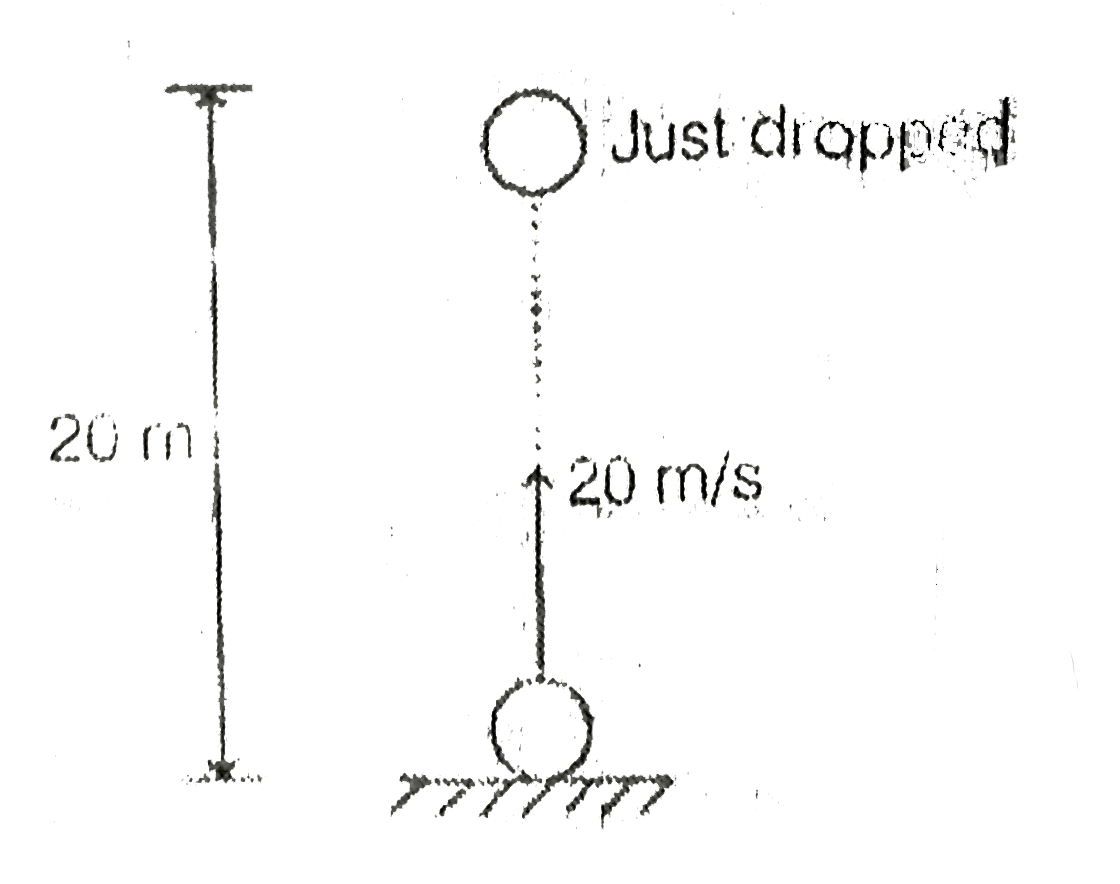
Two identiacal masses are as shown in figure. One is thrown upwards with velocity 20 m/s and another is just dropped simultaneously.
The masses collide I air and stick together. After how much time the combined mass will fall to the gorund (calculate the time from the starting when the motion was started )

A

`(1+sqrt2)s`

B

`2sqrt2s`

C

`(2+sqrt2)s`

D

None of the above

Text Solution

Verified by Experts

Promotional Banner

Topper's Solved these Questions

  • CENTRE OF MASS, IMPULSE AND MOMENTUM

    DC PANDEY ENGLISH|Exercise More a than one option is Correct|1 Videos
  • CENTRE OF MASS

    DC PANDEY ENGLISH|Exercise Medical entrances gallery|27 Videos
  • CENTRE OF MASS, LINEAR MOMENTUM AND COLLISION

    DC PANDEY ENGLISH|Exercise Level 2 Subjective|21 Videos

Similar Questions

Explore conceptually related problems

Two identiacal masses are as shown in figure. One is thrown upwards with velocity 20 m/s and another is just dropped simultaneously. In the above problem, to what maximum height (from ground) with the combined mass rise ?

Two identical masses are as shown in figure. One is thrown upwards with velocity 20 m/s and another is just dropped simultaneously. If the collision between them is elastic, find the time interval between their striking with ground

A sphere A is thrown up with velocity 20m/sec from the ground. Sphere B of same mass is dropped from a height of 80 m simultaneously, at time t = 0 so that both collide in air and stick together. Find the time (in second) after which the combined mass will fall on the ground. (Calculate from t = 0) (g = 10m//"sec"^2)

A balloon carring a stone is moving vartically upward with velocity 12 m//s . When the balloon is at height 64 m , the stone is dropped. After how much time and with what velocity will it strike the ground?

A stone is dropped freely while another thrown vertically downward with an initial velocity of 4 m/s from the same point simultaneously. The distance of separation between them will become 30 m after a time of

A ball of mass 3 kg is thrown upwards with velocity 20 m/s. After 1 s it explodes in 2 pieces one of mass 1 kg and other or 2 kg. After explosion both the pices maintain their vertical velocities but on ground they fall 90 m aport. Speed of both the pieces just after explosion are (both in m/s)

A ball of mass 3 kg is thrown upwards with velocity 20 m/s. After 1 s it explodes in 2 pieces one of mass 1 kg and other or 2 kg. After explosion both the pices maintain their vertical velocities but on ground they fall 90 m aport Energy produced (in joule) during explosion is

Two masses 2m and m are connected by an inextensible light string. The string is passing over a light frictionless pulley. The mass 2m is resting on a surface and mass m is hanging in air as shown in the figure. A particle of mass m strikes the mass m from below and with a velocity v_(0) and sticks to it. In another case a particle of mass m strikes the mass m with a velocity v_()) from top and sticks to it. Calculate the ratio of velocities of mass m just after collision in first and second case.

A body of mass 4 kg moving with velocity 12 m//s collides with another body of mass 6 kg at rest. If two bodies stick together after collision , then the loss of kinetic energy of system is

A body of mass 4 kg moving with velocity 12 m//s collides with another body of mass 6 kg at rest. If two bodies stick together after collision , then the loss of kinetic energy of system is

