Home
Class 11
PHYSICS
A car has total mass 50 kg. Gases are ej...

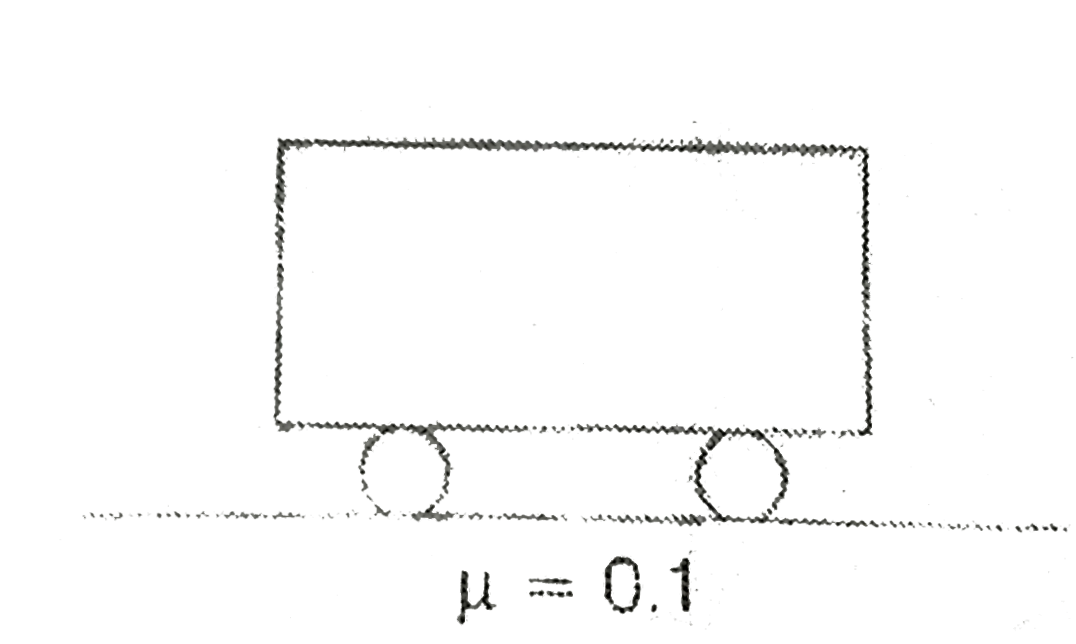
A car has total mass 50 kg. Gases are ejected from this car backwards with relative velocity 20 m/s. The rate of ejection of gases is 2 kg/s. Total mass of gas is 20 kg. Coefficient of friction between the car and road is `mu=0.1`

Car will start moving after time t=.......... second.

A

12.2

B

6.4

C

10.6

D

5.8

Text Solution

Verified by Experts

Promotional Banner

Topper's Solved these Questions

  • CENTRE OF MASS, IMPULSE AND MOMENTUM

    DC PANDEY ENGLISH|Exercise More a than one option is Correct|1 Videos
  • CENTRE OF MASS

    DC PANDEY ENGLISH|Exercise Medical entrances gallery|27 Videos
  • CENTRE OF MASS, LINEAR MOMENTUM AND COLLISION

    DC PANDEY ENGLISH|Exercise Level 2 Subjective|21 Videos

Similar Questions

Explore conceptually related problems

Comprehension # 4 When the mass of a system is variable, a thrust force has to be applied on it in addition to all other forces acting on it. This thrust force is given by : vec(F) = vec(v)_(r) (+- (dm)/(dt)) . Here vec(v)_(r) is the relative velocity with which the mass dm either enters or leaves the system. A car has total mass 50 kg . Gases are ejected from its backwards with relative velocity 20 m//s . The rate of ejection of gas is 2 kg//s . Total mass of gas is 20 kg . Coefficient of friction between the car and road is mu = 0.1 . Car will start moving after time t = ......... s .

Comprehension # 4 When the mass of a system is variable, a thrust force has to be applied on it in addition to all other forces acting on it. This thrust force is given by : vec(F) = vec(v)_(r) (+- (dm)/(dt)) . Here vec(v)_(r) is the relative velocity with which the mass dm either enters or leaves the system. A car has total mass 50 kg . Gases are ejected from its backwards with relative velocity 20 m//s . The rate of ejection of gas is 2 kg//s . Total mass of gas is 20 kg . Coefficient of friction between the car and road is mu = 0.1 . Maximum speed of car will be v = ....... m//s :- (Take ln ((4)/(3)) = 0.28 )

A car has to take a safe circular turn on horizontal flat rough road of radius 200 m. If the coefficient of friction between the tyres and road is 0.1 ,then maximum speed of car would be(All are in SI units)

A car has to move on a level turn of radius 45 m. If the coefficient of static friction between the tyre and the road is mu_s=2.0, find the maximum speed the car can take without skidding.

A car is moving on a horizontal circular road of radius 0.1 km with constant speed. If coefficient of friction between tyres of car and road is 0.4, then speed of car may be (g=10m//s^(2))

A circular road of radius 1000m has hanging angle 45^(@) The maximum safe speed (in ms^(-1) of a car having a mass 2000kg will be (if the coefficient of friction between tying and road is 0.3)

A motor car needs an engine of 7500 watt to keep it moving with a constant velocity of 20 m/s on horizontal road. The force of fric­tion between the car tyres and the ground is

A car is moving on a horizontal circular track of radius 0.2 km with a constant speed. If coefficient of friction between tyres of car and road is 0.45, then maximum speed of car may be [Take g=10 m//s^(2) ]

When a car of 3mass 1000 kg is moving with a velocity of 20ms^(-1) on a rough horizontal road, its engine is switched off. How far does the car move before it comes to rest if the coefficient of kinetic friction between the road and tyres of the car is 0.75 ?

A car starts moving from rest on a horizontal circular road of radius of curvature R at . The speed of the car is increasing at a constant rate a. The coefficient of friction between the road and the tyres of the car is The car starts slipping at time t = t_(0) . Then t_(0) is equal to:

