Home
Class 11
PHYSICS
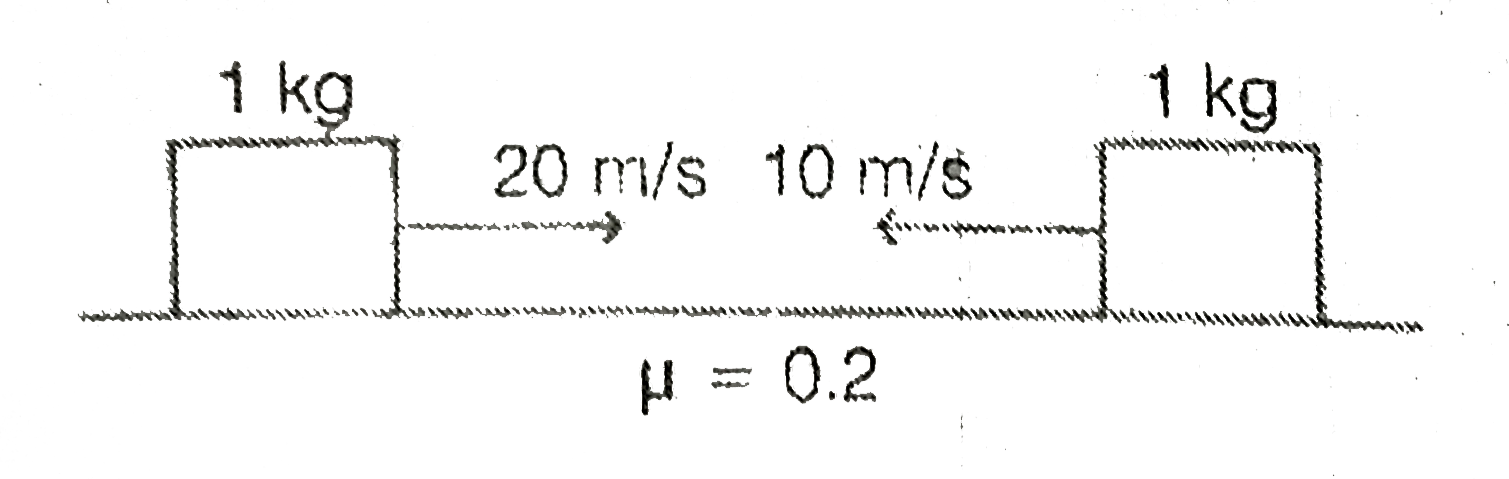
Two blocks (from very far apart) are app...

Two blocks (from very far apart) are approaching towards each other with velocities as shown in figure. The coefficient of friction for the blocks is `mu=0.2`.

How much distance will centre of mass travel before coming permanently to rest.

A

25 m

B

37.5 m

C

42.5 m

D

50 m

Text Solution

Verified by Experts

Promotional Banner

Similar Questions

Explore conceptually related problems

Two blocks (from very far apart) are approaching towards each other with velocities as shown in figure. The coefficient of friction for the blocks is mu=0.2 . Linear momentum of the system is

Blocks A and B each of mass 1kg are moving with 4m//s and 2m//s respectively as shown. The coefficient of friction for all surface is 0.10 . Find the distance (in m) by which centre of mass will travell before coming to rest. Assume large distance between the blocks

Assertion: Two blocks of masses m_(A) and m_(B) (gtm_(A) are thrown towards each other with same speed over a rough ground. The coefficient of friction of both the blocks with ground is same. Initial velocity of CM is towards left. Reason: Initial acceleration of center of mass is towards right.

For the arrangement shown in the figure the coefficient of friction between the two blocks is mu . If both the blocks are identical and moving ,then the acceleration of each block is

A block A slides over an another block B which is placed over a smooth inclined plane as shown in figure . The coefficient of friction between the two blocks A and B is mu . Mass of block B is two times the mass of block A . The acceleration of the centre of mass of two blocks is

On a smooth table two blocks of masses 2.5kg and 1.5kg are placed one over the other as shown in figure. If the coefficient of static friction between two blocks is 0.2, the maximum horizontal force to be applied on the lower block so that the two blocks move together is (g = ms^(-2) )

A small block of mass m is projected on a larger block of mass 10 m and length l with a velocity v as shown in the figure. The coefficient of friction between the two block is mu_(2) while that between the lower block and the ground is mu_(1) . Given that mu_(2) gt 11 mu_(1) . (a) Find the minimum value of v , such that the mass m falls off the block of mass 10 m . (b) If v has minimum value, find the time taken by block m to do so.

Two blocks A and B of masses 10 kg and 15 kg are placed in contact with each other rest on a rough horizontal surface as shown in the figure. The coefficient of friction between the blocks and surface is 0.2. A horizontal force of 200 N is applied to block A. The acceleration of the system is ("Take g"=10ms^(-2))

A cart of mass M has a block of mass m in contact with it as shown in the figure-2.133. The coefficient of friction between the block and the cart is mu . What is the minimum acceleration of the cart so that the block m does not fall ?

Two blocks A and B are lying on the table as shown in the figure. The coefficient of friciton between block A and block B is mu . The coefficient of friction between block B and ground also mu . An external force F is applied in the direction shown. The maximum value of the force F that can be applied without moving the blocks.

