Home
Class 11
PHYSICS
The area of cross-section of the two ver...

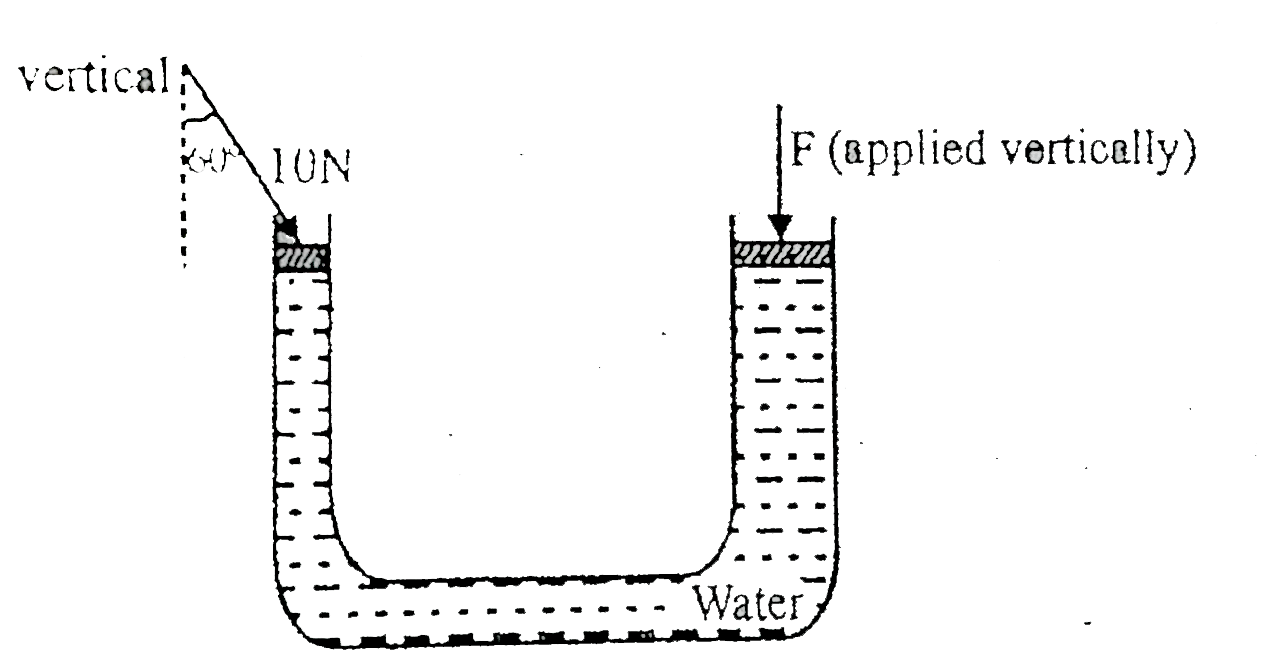
The area of cross-section of the two vertical arms of a hydraulic press are 1 `cm ^(2)` and `10 cm^(2)` respectively. A force of 10N applied. As shown in the figure, to a tight fitting light piston in the thinner arm balances a force F applied to the corresponding piston in the thicker arm. Assuming that the levels of water in both the arms are the same, we can conclude:-

A

`F = 100 N`

B

F = 50 N

C

F = 25

D

F cannot balance the effect of the force on the thinner piston

Text Solution

Verified by Experts

The correct Answer is:

B
Promotional Banner

Topper's Solved these Questions

  • PROPERTIES OF MATTER

    DC PANDEY ENGLISH|Exercise JEE Advanced|57 Videos
  • PROPERTIES OF MATTER

    DC PANDEY ENGLISH|Exercise More than one option is correct|21 Videos
  • PROJECTILE MOTION

    DC PANDEY ENGLISH|Exercise Level - 2 Subjective|10 Videos
  • RAY OPTICS

    DC PANDEY ENGLISH|Exercise Integer type q.|14 Videos

Similar Questions

Explore conceptually related problems

The area of cross sectioin of the two arms of a hydraulic press is 1cm^(2) and 20 cm^(2) respectively. A force of 10 N is applied on the water in the thinner arm. What force should be applid on the water in the thicker arms so that water may remain in equilibrium?

The area of cross section of the two arms of a hydraulilc press are 1 cm^2 and 10 cm^2 respectively figure. A force of 5N is applied on the water in the thinner arm. What force should be applied on the water in the thicker arm so that the water may remain in equilibrium? ,

The area of cross section of the two arms of a hydraulilc press are 1 cm^2 and 10 cm^2 respectively figure. A force of 5N is applied on the water in the thinner arm. What force should be applied on the water in the thicker arm so that the water may remain in equilibrium? ,

In an arrangement similar to a hydraulic lift, the diameters of smaller and larger pistons are 1.0 cm and 3.0 cm respectively. What is the force exerted on the larger piston when a force of 10 N is applied to the smaller piston?

The area of cross section of the wider tube shown in figure is 900 cm^2 . If the boy standing on the piston weights 45 kg, find the difference in the levels of water in the two tubes.

The area of cross-section of the wider tube shown in fig., is 800cm^(2) . If a mass of 12 kg is placed on the massless piston, what is the difference in the level of water in two tubes.

The area of a cross-section of steel wire is 0.1 cm^(-2) and Young's modulus of steel is 2 x 10^(11) N m^(-2) . The force required to stretch by 0.1% of its length is

The area of cross section of a steel wire (Y=2.0 xx 10^(11) N//m^(2)) is 0.1 cm^(2) . The force required to double is length will be

Two syringes of different cross-section (without needle filled with water are connected with a tightly fitted rubber tube filled with water. Diameters of the smaller piston an larger piston are 1 cm and 3 cm respectively. If a force of 10N is applied to the smaller piston then the force exerted on the larger piston is

A piston of cross-sectional area 100 cm^(2) is used in a hydraulic pressure to exert a force of 10^(7) dyne on the water. The cross-sectional area of the other piston which support a truck of mass 2000 kg is
