Home
Class 11
PHYSICS
In the arrangement shown in the figure (...


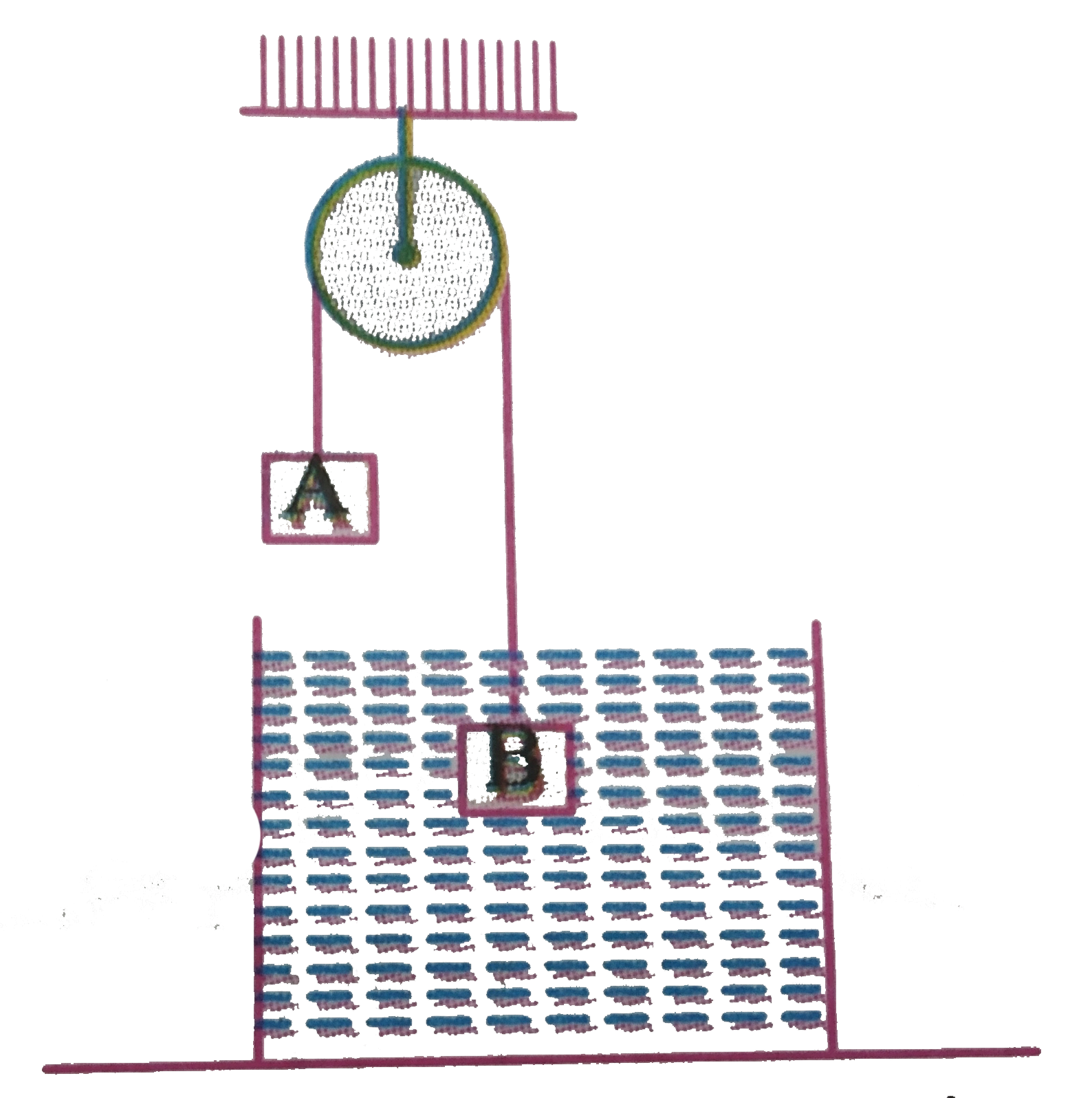
In the arrangement shown in the figure `(m_(A))/(m_(B))=(2)/(3)` and the ratio of density of block B and the liquid is `2:1` The system is released from rest. Then

A

block B will oscillate but not simple harmonically

B

block B will oscillate simple harmonically

C

the system will remain in equilibrium

D

None of the above

Text Solution

Verified by Experts

The correct Answer is:

A
Promotional Banner

Topper's Solved these Questions

  • PROPERTIES OF MATTER

    DC PANDEY ENGLISH|Exercise More than one option is correct|21 Videos
  • PROPERTIES OF MATTER

    DC PANDEY ENGLISH|Exercise Comprehension|32 Videos
  • PROPERTIES OF MATTER

    DC PANDEY ENGLISH|Exercise Integer|8 Videos
  • PROJECTILE MOTION

    DC PANDEY ENGLISH|Exercise Level - 2 Subjective|10 Videos
  • RAY OPTICS

    DC PANDEY ENGLISH|Exercise Integer type q.|14 Videos

Similar Questions

Explore conceptually related problems

In the arrangement as shown, m_(B)=3m , density of liquid is rho and density of block B is 2rho . The system is released from rest so that block B moves up when in liquid and moves down when out of liquid with the same acceleration. Find the mass of block A .

Block A of mass m and block B of mass 2m are placed on a fixed triangular wedge by means of a light and inextensible string and a frictionless pulley as shown in fig . The wedge is inclined at 45^(@) to the horizontal on both sides . The coefficient of friction between the block A and the wedge is 2//3 and that between the block B and the wedge is 1//3 .If the system of A and B is released from rest then find . a. the acceleration of A b. tension in the string c.the magnitude and direction of the frictional force acting on A

Wedge shown in the figure is fixed . System is released from rest (Neglect friction )

In the system shown in fig., m_(A)=4m , m_(B)=3m , and m_(c)=8m . Friction is absent everywhere. String is inextensible and light. If the system is released from rest, then Acceleration of Block B is

Consider the system shown in the figure. Coefficient of friction between the block and table is mu=0.5. The system is released from rest. Find the work done by friction, when the speed of block is 10 m/s (m=1kg)

In the arrangement shown in figure m_(A)=4.kg and m_(B)=1.0kg . The system is released from rest and block B is found to have a speed 0.3m//s after it has descended through a distance of 1.m find the coefficient of friction between the block and the table. Neglect friction elsewhere. (Take g=10 m//s^(2) ). .

In the arrangement shown in figure m_(A)=4.kg and m_(B)=1.0kg . The system is released from rest and block B is found to have a speed 0.3m//s after it has descended through a distance of 1.m find the coefficient of friction between the block and the table. Neglect friction elsewhere. (Take g=10 m//s^(2) ). .

Two discs A and B each of mass 2kg and radius 0.5m are rigidly fixed to the end of a thin shaft S , which is supported in horizontal position with the help of two smooth bearings at points P_(1) and P_(2) . Two blocks of masses 2 kg and 1 kg are connected to the light cords wrapped around the discs as shown in the figure. There is no slipping between the cord and the discs. If the system is released from rest from the position shown, the mark released from rest from the position shown,

An arrangement of the masses and pulleys is shown in the figure. Strings connecting masses A and B with pulley are horizontal and all pulleys and strings are light. Friction coefficient between the surface and the block B is 0.2 and between block A and B is 0.7 . The system is released from rest. (use g=10m//s^(2))

The acceleration of 3 kg block in the arrangement shown in the diagram ,when the given system is released from rest is

DC PANDEY ENGLISH-PROPERTIES OF MATTER-JEE Advanced
  1. Two spheres of volume 250 cc each but of relative densities 0.8 and 1....

    Text Solution

    |

  2. A tube 1 cm^(2) in cross section is attached to the top of a vessel 1 ...

    Text Solution

    |

  3. In the arrangement shown in the figure (m(A))/(m(B))=(2)/(3) and the r...

    Text Solution

    |

  4. A uniform elastic plank moves due to a constant force F(0) applied at...

    Text Solution

    |

  5. if rho is the density of the meterial of a wire and sigma is the break...

    Text Solution

    |

  6. If the ratio of lengths, radii and Young's moduli of steel and brass w...

    Text Solution

    |

  7. A uniform rod of length L, has a mass per unit length lambda and ar...

    Text Solution

    |

  8. A vertical capillary is brought in contact with the water surface (sur...

    Text Solution

    |

  9. An empty container has a circular hole of radius r at its bottom. The ...

    Text Solution

    |

  10. Water rises to a height h in a capillary tube lowered vertically into ...

    Text Solution

    |

  11. A cylindrical vessel of area of cross-section A is filled with water t...

    Text Solution

    |

  12. One end of a glass capillary tube with a radius r=0.05cm is immersed i...

    Text Solution

    |

  13. The range of water flowing out of a small hole made at a depth 10 m be...

    Text Solution

    |

  14. What force must be applied to detach two wetted photographic plates (9...

    Text Solution

    |

  15. A cylinder with a movable piston contains air under a pressure p(1) an...

    Text Solution

    |

  16. A vertically jet of water coming out of a nozzle with velocity 20 m//s...

    Text Solution

    |

  17. A uniform rod OB of length 1m, cross-sectional areal 0.012 m^(2) and r...

    Text Solution

    |

  18. Water (density rho) is flowing through the uniform tube of cross-secti...

    Text Solution

    |

  19. A tube of fine bore AB is connected to a manometer M as shown. The sto...

    Text Solution

    |

  20. A bucket water filled upto a height = 15 cm. The bucket is tied to a r...

    Text Solution

    |
