Home
Class 11
PHYSICS
source and observer both start moving si...

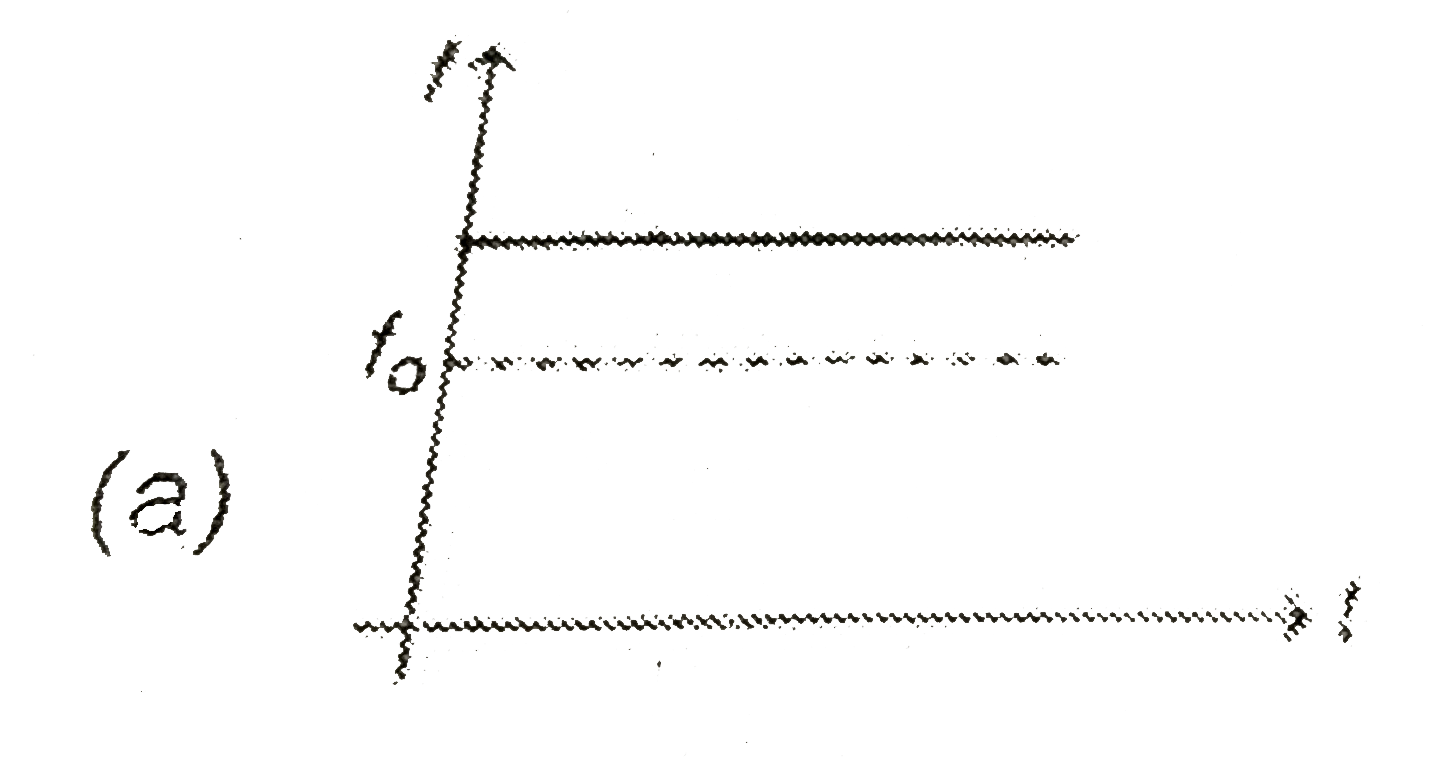
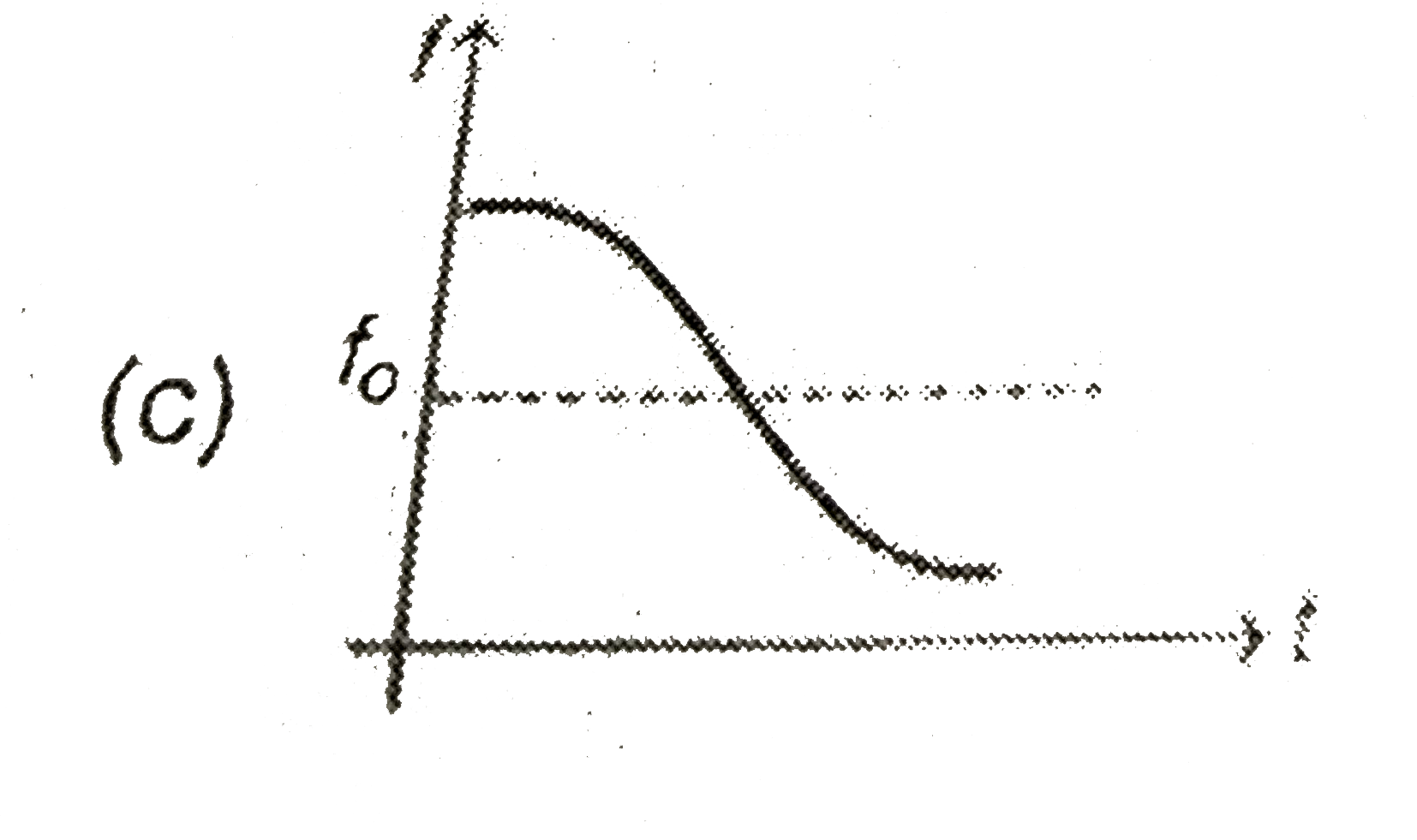
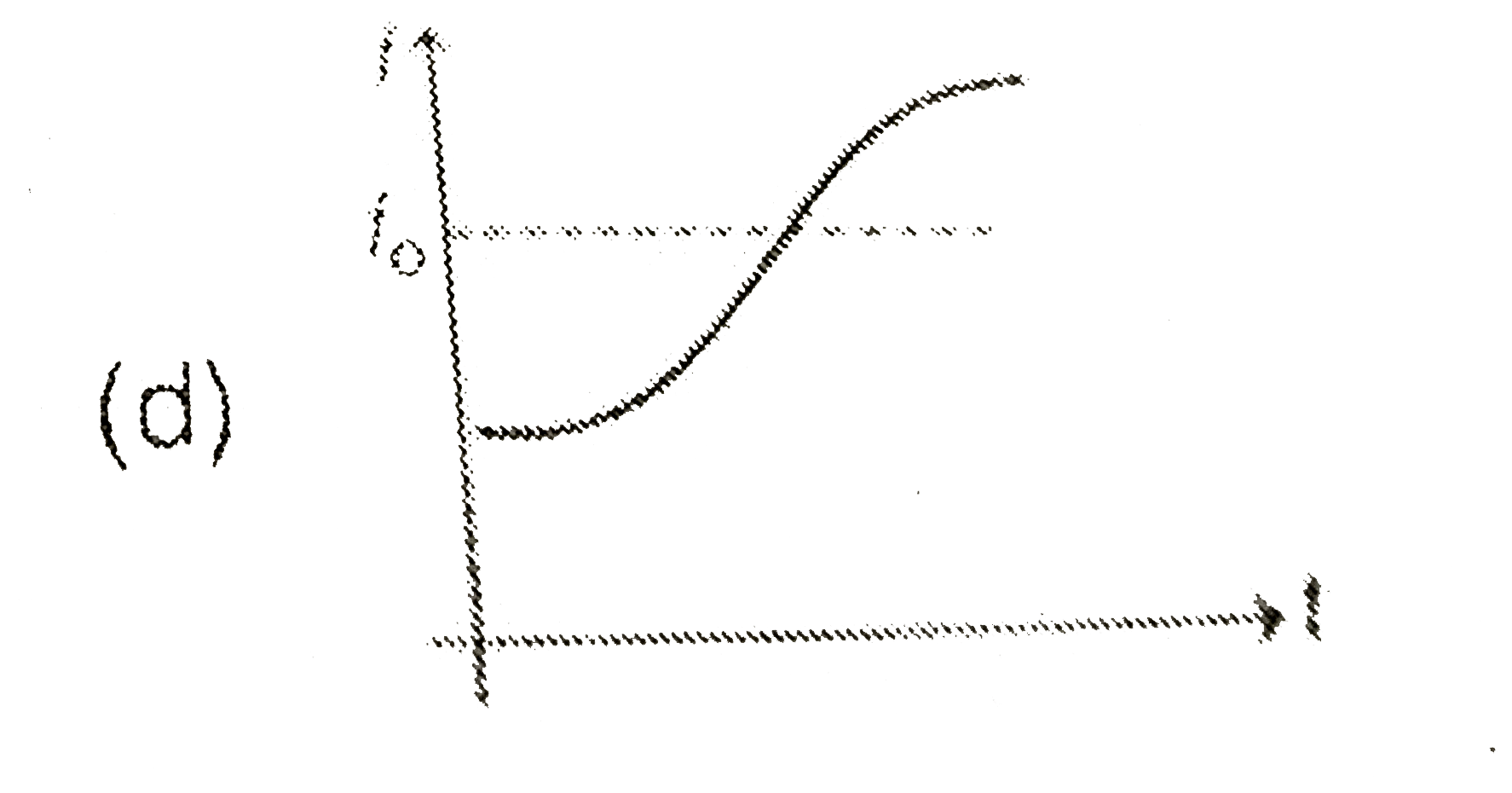
source and observer both start moving simultaneously from origion one along y - axis with speed of source = 2 (speed of observer ). The graph between the apparent frequency observed by observer (f) and time (t) would be

A

B

C

D

Text Solution

AI Generated Solution

The correct Answer is:

To solve the problem step by step, we need to analyze the situation where both the source and the observer are moving away from each other, and we need to determine the relationship between the apparent frequency observed by the observer and time. ### Step 1: Define the Variables Let: - \( v_0 \) = speed of the observer - \( v_s = 2v_0 \) = speed of the source (twice the speed of the observer) - \( v \) = speed of sound ### Step 2: Determine the Direction of Motion - The observer is moving along the y-axis. - The source is moving along the x-axis. - Since both are moving away from each other, we need to consider their velocities in the direction of the line joining them. ### Step 3: Calculate the Components of Velocity - The component of the observer's velocity in the direction of the line joining them can be expressed as: \[ v'_{o} = v_0 \cos(\beta) \] - The component of the source's velocity in the direction of the line joining them can be expressed as: \[ v'_{s} = v_s \cos(\alpha) = 2v_0 \cos(\alpha) \] ### Step 4: Use the Doppler Effect Formula The apparent frequency (\( f' \)) can be calculated using the Doppler effect formula: \[ f' = f \frac{v - v'_{o}}{v + v'_{s}} \] Substituting the values: \[ f' = f \frac{v - \frac{v_0}{\sqrt{5}}}{v + \frac{4v_0}{\sqrt{5}}} \] ### Step 5: Analyze the Frequency Change Since \( v_s = 2v_0 \), we can substitute this into the formula: \[ f' = f \frac{v - \frac{v_0}{\sqrt{5}}}{v + \frac{4v_0}{\sqrt{5}}} \] This shows that \( f' \) is dependent on \( v_0 \) and \( v \), but the original frequency \( f \) remains constant. ### Step 6: Determine the Relationship Over Time - As both the source and observer are moving away from each other, the apparent frequency \( f' \) will be less than the original frequency \( f \). - There is no time dependence in the expression for \( f' \) since it does not change with time. ### Step 7: Graphical Representation - Since \( f' < f \) and there is no time dependence, the graph of apparent frequency \( f' \) against time \( t \) will be a horizontal line below the original frequency \( f \). ### Conclusion The graph between the apparent frequency observed by the observer and time \( t \) would be a horizontal line indicating that the apparent frequency remains constant but is less than the original frequency.
Promotional Banner

Topper's Solved these Questions

  • WAVE MOTION

    DC PANDEY ENGLISH|Exercise More Than One Option is Correct|23 Videos
  • WAVE MOTION

    DC PANDEY ENGLISH|Exercise Comprehion Type Questions|20 Videos
  • WAVE MOTION

    DC PANDEY ENGLISH|Exercise JEE MAINS|50 Videos
  • VECTORS

    DC PANDEY ENGLISH|Exercise Medical enrances gallery|9 Videos
  • WORK, ENERGY & POWER

    DC PANDEY ENGLISH|Exercise Level 2 Comprehension Based|2 Videos

Similar Questions

Explore conceptually related problems

Source and observer start moving simulatneously along x and y-axis respectively. The speed of source is twice the speed of observer V_0 . If the ratio of observer frequency to the frequency of the source is 0.75 , find the velocity of sound.

Source and observer start moving simulatneously along x and y-axis respectively. The speed of source is twice the speed of observer V_0 . If the ratio of observer frequency to the frequency of the source is 0.75 , find the velocity of sound.

A sound source has frequency f. Source and observer both have same speed.For the apparent frequency observed by observer match the following.

A source and detector both start moving simultaneously from the position shown in the figure, one along x-axis and the other along y-axis with speeds 40 ms^(-1) and 30 ms^(-1) respectively. If n is the frequency of the source then the graph between the apparent frequency n' observed by detector and time t would be [assume that source and detector do not collide]

An observer starts moving with unifrom acceleration a towards a stationary sound soure of frequency f_(o) . As the observer approaches the source ,the apparent frequency f heard by the observer varies with time t as

An observer moves towards a stationary source of sound. The percentage change in the apparent frequency is

A source is approaching towards an observer with constant speed along the line joining them. After crossing the observer, source recedes from observer with same speed. Let f is apparent frequency heard by observer. Then, 1) f will keep on increasing during approaching 2) f will keep on decreasing during receding 3) f will remain constant during approaching 4) f will remain constant during receding

A source of sound S emitting waves of frequency 100 Hz and an observer O are located at some distance from each other. The source is moving with a speed of 19.4ms^-1 at an angle of 60^(@) with the source observer line as shown in the figure. The observer is at rest. The apparent frequency observed by the observer (velocity of sound in air 330ms^-1 ) is

At what speed should a source of sound move so that observer finds the apparent frequency equal to half of the original frequency ?

A sound source is moving towards a stationary observer with 1/10 of the speed of sound. The ratio of apparent to real frequency is

DC PANDEY ENGLISH-WAVE MOTION-ONLY ONE OPTION IS CORRECT
  1. A string is under tension sot that its length uncreased by 1/n times ...

    Text Solution

    |

  2. the frequency of a sonometer wire is 100 Hz. When the weight producing...

    Text Solution

    |

  3. source and observer both start moving simultaneously from origion one ...

    Text Solution

    |

  4. An observer starts moving with unifrom acceleration a towards a statio...

    Text Solution

    |

  5. Speed of sound wave is v. If a reflector moves towards a stationary so...

    Text Solution

    |

  6. A train is moving with a constant speed along a circular track. The en...

    Text Solution

    |

  7. A conveyor belt moves to the right with speed v=300 m/min. A pieman pu...

    Text Solution

    |

  8. Equations of two progressive waves are given by y(1) = asin (omegat +p...

    Text Solution

    |

  9. A transverse sine wave of amplitude 10 cm and wavelength 200 cm travel...

    Text Solution

    |

  10. A string of mass 0.2 kg/m and length l= 0.6 m is fixed at both ends a...

    Text Solution

    |

  11. A string fixed at both is vibrating in the lowest mode of vibration fo...

    Text Solution

    |

  12. two sound waves moves in the same direction .if the average power tran...

    Text Solution

    |

  13. the fundamental frequency of a sonometer wire of length is f(0).A brid...

    Text Solution

    |

  14. in a sine wave ,postive of different particles at time t=0 is shown in...

    Text Solution

    |

  15. A detector is released from rest over a source of sound of frequency f...

    Text Solution

    |

  16. A standing wave is maintained in a homogeneous string of cross - secti...

    Text Solution

    |

  17. A 100 Hz sinusoidal wave is travelling in the positve x - direaction a...

    Text Solution

    |

  18. At t=0 , observer and source are at same place. Now the source is proj...

    Text Solution

    |

  19. there are three strings RP, Pqand QS as shown. Their mass and length a...

    Text Solution

    |

  20. minimum frequency of audible sound is 20 Hz and maximum frequency is 2...

    Text Solution

    |
