Home
Class 11
PHYSICS
The sides of an isosceles right prism ar...

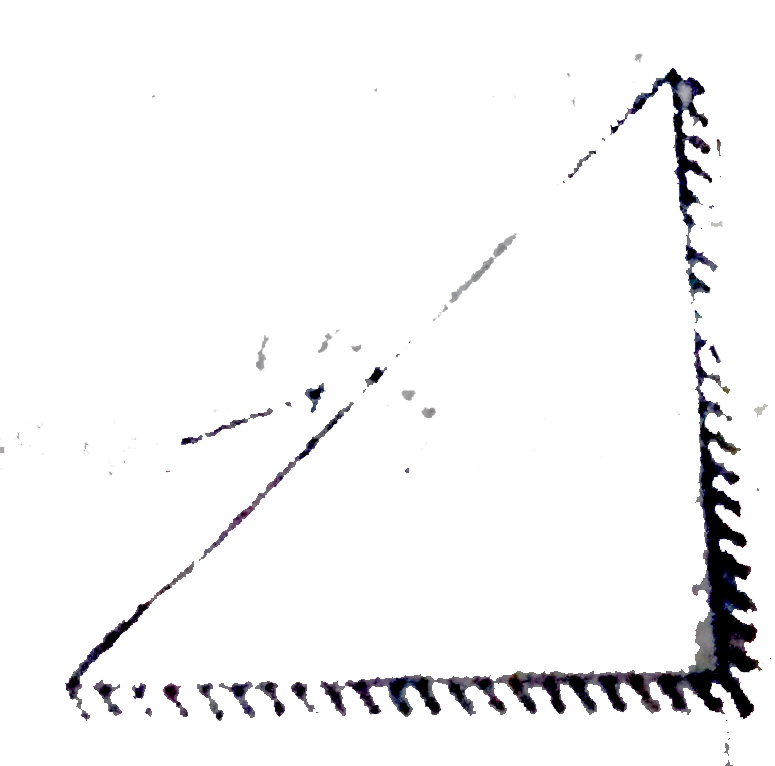
The sides of an isosceles right prism are coated with a reflecting coating. A ray of light falls on the hypotenuse at an arbitrary angle i. For what value of i the ray leaving the prism is parallel to the incident ray ?

A

`30^(@)`

B

`60^(@)`

C

`tan^(-1)(2)`

D

Any arbitrary angle

Text Solution

Verified by Experts

The correct Answer is:

D
Promotional Banner

Topper's Solved these Questions

  • RAY OPTICS

    DC PANDEY ENGLISH|Exercise B. More than one option is correct|20 Videos
  • RAY OPTICS

    DC PANDEY ENGLISH|Exercise C. comprehension type question|14 Videos
  • RAY OPTICS

    DC PANDEY ENGLISH|Exercise Integer type q.|14 Videos
  • PROPERTIES OF MATTER

    DC PANDEY ENGLISH|Exercise Integer|8 Videos
  • ROTATION

    DC PANDEY ENGLISH|Exercise (C) Chapter Exercises|39 Videos

Similar Questions

Explore conceptually related problems

A ray of light PQ is incident normally on the hypotenuse of a right angled prism ABC as shown in the diagram given below: What is the value of the angle of deviation of the ray ?

A ray of light PQ is incident normally on the hypotenuse of a right angled prism ABC as shown in the diagram. Name an instrument where this action of the prism is used.

A total reflecting right angled isosceles prism can be used to deviate a ray of light through :

A ray of light falls on a right angled prism ABC (AB=BC) and travels as shown in figure. What is the refractive index of material of the prism ?

Light of wavelength 5000Å falls on a plane reflecting surface. What are the wavelength and frequency of reflected light ? For what angle of incidence is the reflected ray normal to the incident ray ?

An isosceles prism has one of the refracting surfaces silvered. A ray of light is incident normally on the refracting face AB. After two reflections, the ray emerges from the base of the prism perpendicular to it. Find the angle of the prism.

In figure, a ray of light PQ is incident normally on the hypotenuse of an isosceles right angled prism ABC. (a) complete the path of the ray PQ till it emerges from the prism. Mark in the diagram the angle wherever necessary. (b) what is the angle of deviation of the ray PQ ? (c) Name a device in which this action is used.

A ray of light falls on a normally on a refracting face of a prism. Find the angle of prism if the ray just fails to emerge from the prism (mu=3//2).

(a) Figure shows two isosceles right angled prisms A and B and the light rays incident on the prism A. complete the diagram to show the rays emerging out of the prism B. (b) State the principle used for completing the ray diagram in part (a) above.

What is the angle of incidence for an equilateral prism of refractive index sqrt(3) so that the ray si parallel to the base inside the prism?

DC PANDEY ENGLISH-RAY OPTICS-A. Only one option is correct (JEE Advance)
  1. An object is placed at A(OA gt f). Here, f is the focal length of the ...

    Text Solution

    |

  2. The x-z plane separates two media A and B of refractive indices mu(1) ...

    Text Solution

    |

  3. The sides of an isosceles right prism are coated with a reflecting coa...

    Text Solution

    |

  4. A point object is placed at a distance of 20 cm from a glass slab, H=1...

    Text Solution

    |

  5. A point source S is placed at a height h from the bottom of a vessel o...

    Text Solution

    |

  6. A point object O is placed slightly above the centre C of a glass sphe...

    Text Solution

    |

  7. In the figure shown, mu(1) gt mu(2) gt mu(3). What are the limits of a...

    Text Solution

    |

  8. A bi-convex lens is cut from the middle as shown in figure. Refractive...

    Text Solution

    |

  9. A hemishperical surface of radius R and refractive index mu = 1.5 is p...

    Text Solution

    |

  10. A ray is travelling along x-axis in negative x-direction. A plane mir...

    Text Solution

    |

  11. Liquid is filled vessel of height (2H)/(3). At the bottom of the vesse...

    Text Solution

    |

  12. In displacement method distance of object from convex lens of focal le...

    Text Solution

    |

  13. Two mirrors are inclined at angle theta as shown in figure. Light ray...

    Text Solution

    |

  14. A plane mirror is moving with velocity 4 (hat i) + 4 (hat j) + 8 (hat ...

    Text Solution

    |

  15. A square ABCD of side 1mm is kept at distance 15cm in front of the con...

    Text Solution

    |

  16. A point object on the principal axis at a distance 1.5 cm in front of ...

    Text Solution

    |

  17. A ray of light is incident on a parallel slab of thickness t and refra...

    Text Solution

    |

  18. A beam of diameter 'd' is incident on a glass hemisphere as shown. If ...

    Text Solution

    |

  19. A light ray I is incident on a plane mirror M.The mirror is rotated in...

    Text Solution

    |

  20. A bird is flying up at an angle sin^(-1)(3//5) with the horizontal. A ...

    Text Solution

    |
