Home
Class 11
PHYSICS
A block of mass m is attached to a sprin...

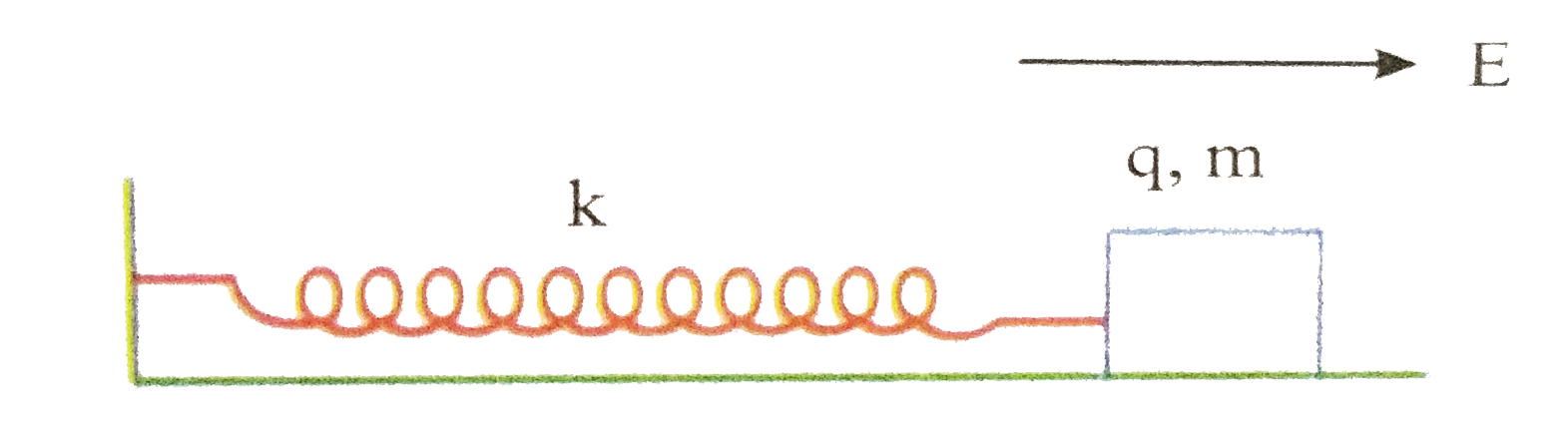
A block of mass `m` is attached to a spring of force constant k .Charges on the block is `q`. A horizontal electric field E is acting in the directions as shown.Block is released with the spring in unstretched position

(a) block will execute `SHM`
(b) time period of osciallation is `2pisqrt(m)/(k)`
(c) amplitude of oscillation is `(qE)/(k)`
(d) Block will oscillate but not simple harmonically
choose the correct answer

A

Block will execute SHM

B

Time period of oscillation is `2pi sqrt((m)/(k))`

C

Amplitude of oscillation is `(qE)/(k)`

D

Block will oscillate but not simple harmonically.

Text Solution

Verified by Experts

The correct Answer is:

A, B, C
Promotional Banner

Similar Questions

Explore conceptually related problems

A block of mass m suspended from a spring of spring constant k . Find the amplitude of S.H.M.

A block of mass m is attached to two unstretched springs of spring constant k , each as shown. The block is displaced towards right through a distance x and is released The speed of the block as it passes through the mean position will be

A block of mass m held touching the upper end of a light spring of force constant K as shown in figure. Find the maximum potential energy stored in the spring if the block is released suddenly on the spring.

A block of mass m is attached to a spring of force constant k whose other end is fixed to a horizontal surface. Initially the spring is in its natural length and the block is released from rest. The average force acting on the surface by the spring till the instant when the block has zero acceleration for the first time is

A block of mass m having charge q is attached to a spring of spring constant k . This arrangement is placed in uniform electric field E on smooth horizontal surface as shown in the figure. Initially spring in unstretched. Find the extension of spring in equilibrium position and maximum extension of spring.

Two blocks each of mass m are connected with springs each of force constant K as shown in fig. The mass A is displaced to the left & B to the right by the same amount and released then the time period of oscillation is -

Passage III A block of mass m =1/2 kg is attached with two springs each of force contant k=10N/m as shown. The block is oscillating vertically up and down with amplitude A=25cm. When the block is at its mean position one of the spring breaks without changing momentum of block. What is the new amplitude of osciallation of the block.

A block of mass m is attached to a cart of mass 4m through spring of spring constant k as shown in the figure. Friction is absent everywhere. The time period of oscillations of the system, when spring is compressed and then released, is

A block of mass m hangs from a vertical spring of spring constant k. If it is displaced from its equilibrium position, find the time period of oscillations.

A block of mass m is attached to two unstretched springs of spring constants k_1 and k_2 as shown in figure. The block is displaced towards right through a distance x and is released. Find the speed of the block as it passes through the mean position shown.
