Home
Class 11
PHYSICS
A particle moves in x-y plane, starting ...

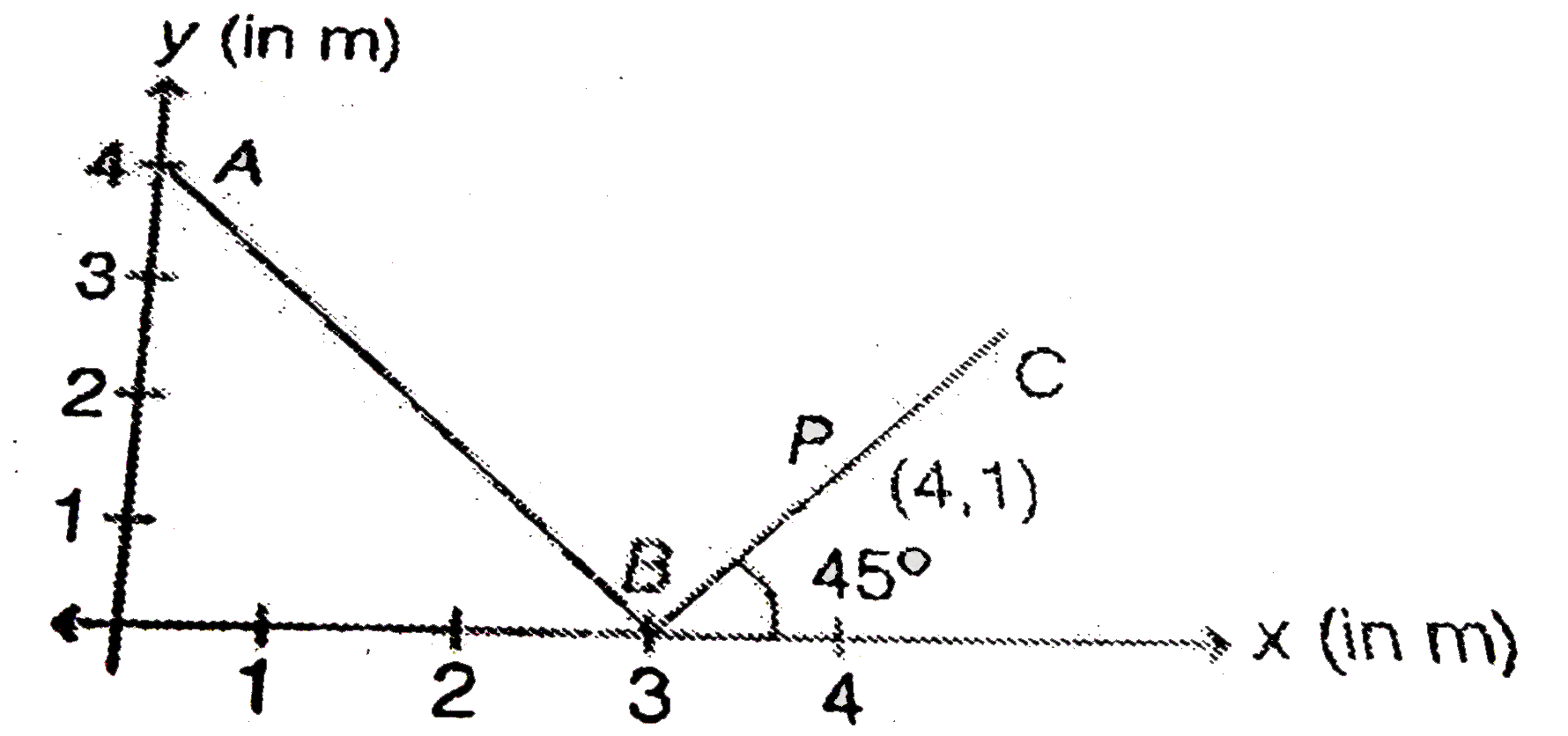
A particle moves in `x-y` plane, starting from `A` along straight line path `AB` and `BC` as shown in the graph. When it is at point `P` angle between diections of its average velocity and instantaneous velocity is `[tan37^(@)=3//4]`

A

`90^(@)`

B

`82^(@)`

C

`98^(@)`

D

`74^(@)`

Text Solution

Verified by Experts

The correct Answer is:

B
Promotional Banner

Topper's Solved these Questions

  • KINEMATICS 1

    DC PANDEY ENGLISH|Exercise MCQ_TYPE|27 Videos
  • KINEMATICS 1

    DC PANDEY ENGLISH|Exercise COMPREHENSION_TYPE|19 Videos
  • KINEMATICS

    DC PANDEY ENGLISH|Exercise INTEGER_TYPE|10 Videos
  • LAWS OF MOTION

    DC PANDEY ENGLISH|Exercise Medical entrances gallery|39 Videos

Similar Questions

Explore conceptually related problems

Two particles move with constant velocities towards point O along straight lines in a plane as shown. The shortest distance A and B is

A particle of mass m moves in the XY plane with constant velocity v along the straight line PQ as shown in the figure. Its angular momentum with respect to origin O is( theta is angle between vec v and x-axis)

A particle starting from rest moves in a straight line with acceleration as shown in the a-t graph. Find the distance (in m) travelled by the particle in the first four seconds from start of its motion. Q

The v-x graph for a particle moving along a straight line is shown in the figure. At which of the points marked, the acceleration is negative?

The acceleration-time (a-t) graph of a particle moving along straight line is as shown in figure. The time at which velocity of particle becomes equal to its initial velocity is

The velocity and time graph for a particle moving in a straight line s shown in the figure. Then, the average velocity between t=4 s and t=6 s is _____

A particle starting from rest moves along a straight line with constant acceleration for this velocity displacement graph will have the form-

The variation of velocity of a particle moving along a straight line is shown in the figure. The distance travelled by the particle in 4s is

Two particles are moving along a straight line as shown. The velocity of approach between A and B is

A particle moves in a plane from A to E along the shown path. It is given that Ab=BC=CD=DE=10 metre. Then the magnitude of net displacement of particle is : .

DC PANDEY ENGLISH-KINEMATICS 1-INTEGER_TYPE
  1. A particle moves in x-y plane, starting from A along straight line pat...

    Text Solution

    |

  2. A stone is dropped from a certain height which can reach the ground in...

    Text Solution

    |

  3. A car starts moving along a line, first with acceleration a=5m//s^(2) ...

    Text Solution

    |

  4. Two particles P and Q simultaneously start moving from point A with ve...

    Text Solution

    |

  5. If a particle takes t second less and acquire a velocity of vms^(-1) m...

    Text Solution

    |

  6. Speed time graph of two cars A and B approaching towards each other is...

    Text Solution

    |

  7. The acceleration-time graph of a particle moving along a straight line...

    Text Solution

    |

  8. A lift performs the first part of its ascent with uniform acceleration...

    Text Solution

    |

  9. A small electric car has a maximum constant acceleration of 1m//s^(2),...

    Text Solution

    |

  10. The diagram shows the variatioin of 1//v (where v is velocity of the p...

    Text Solution

    |

  11. Two particles are moving with velocities v(1)=hati-thatj+hatk and v(2)...

    Text Solution

    |

  12. A particle A moves with velocity (2hati-3hatj)m//s from a point (4,5m)...

    Text Solution

    |

  13. A ball is thrown upwards with a speed of 40m//s. When the speed become...

    Text Solution

    |

  14. Figure shows the velocity time graph for a particle travelling along a...

    Text Solution

    |

  15. Two bodies A and B are moving along y-axis and x -axis as shown. Find ...

    Text Solution

    |

  16. The 1//v versus positions graph of a particle is shown in the figure, ...

    Text Solution

    |
