Home
Class 11
PHYSICS
For the velocity -time graph shown in fi...

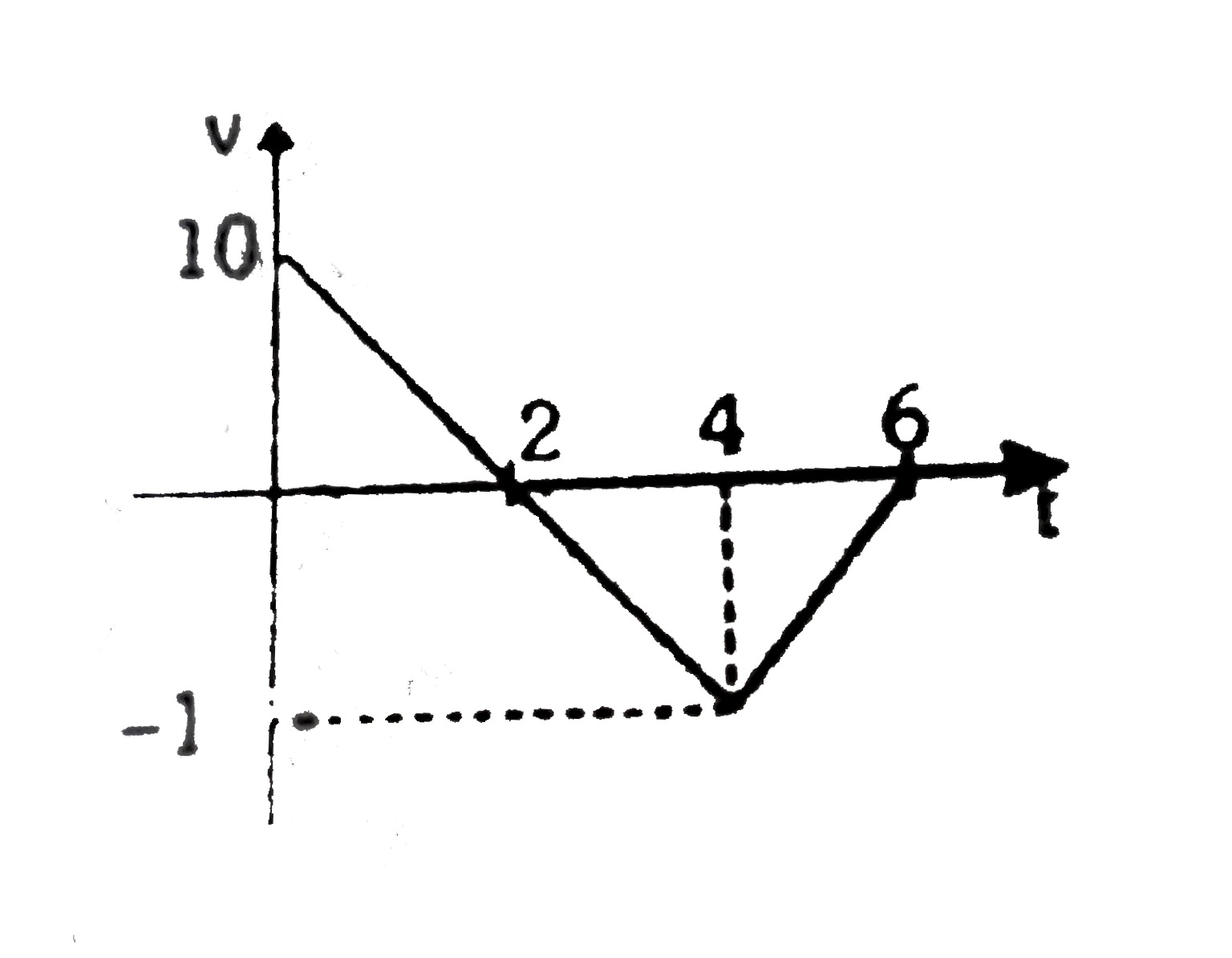
For the velocity -time graph shown in figure, in a time interval from `t=0` to `t=6 s`, match the following:

`{:(,"Column I",,,"Column II"),((A),"Change in velocity",,(p),-5//3 SI "unit"),((B),"Average acceleration",,(q),-20 SI "unit"),((C),"Total displacement",,(r),-10 SI "unit"),((D),"Acceleration ay t=3s",,(s),-5 SI "unit"):}`

Text Solution

Verified by Experts

The correct Answer is:

A, B, C, D
Promotional Banner

Topper's Solved these Questions

  • KINEMATICS 1

    DC PANDEY ENGLISH|Exercise INTEGER_TYPE|15 Videos
  • KINEMATICS 1

    DC PANDEY ENGLISH|Exercise COMPREHENSION_TYPE|19 Videos
  • KINEMATICS

    DC PANDEY ENGLISH|Exercise INTEGER_TYPE|10 Videos
  • LAWS OF MOTION

    DC PANDEY ENGLISH|Exercise Medical entrances gallery|39 Videos

Similar Questions

Explore conceptually related problems

A balloon rises up with constant net acceleration of 10 m//s^(2) . After 2 s a particle drops from the balloon. After further 2 s match the following : ("Take" g=10 m//s^(2)) {:(,"Column I",,,"Column II"),((A),"Height of perticle from ground",,(p),"Zero"),((B),"Speed of particle",,(q),10 SI "units"),((C),"Displacement of Particle",,(r),40 SI "units"),((D),"Acceleration of particle",,(s),20 SI "units"):}

In the s-t equation (s=10+20 t-5t^(2)) match the following columns. |{:(,"Column I",,"Column II"),((A),"Distancec travelled in 3s",(p),-20" units"),((B),"Displacement 1 s",(q),15" units"),((C ),"Initial acceleration",(r ),25" units"),((D),"Velocity at 4 s",(s),-10" units"):}|

In the diagram shown in figure, match the following (g=10 m//s^(2)) {:(,"Column-I",,,"Coloumn-II"),((A),"Acceleration of 2kg block",,(P), "8 Si unit"),((B),"Net force on 3kg block",,(Q),"25 SI unit"),((C),"Normal reaction between 2 kg and 1kg",,(R),"2 SI unit"),((D),"Normal reaction between 3 kg and 2kg " ,,(S)," 45 SI unit"),(,,,(T)," None"):}

For the acceleration - time (a - t) graph shown in figure, the change in velocity of particle from t = 0 to t = 6 s is

In the diagram shown in figure, match the following columns (take g=10 ms^(-2) ) {:("Column I","Column II"),("(A) Normal reaction","(p) 12 SI unit"),("(B) Force of friction","(q) 20 SI unit"),("(C) Acceleration of block","(r) zero"),(,"(s) 2 SI unit"):}

Match the following columns. |{:(,"Column I",,"Column II"),((A),"d v/dt",(p),"Acceleration"),((B),"d|v|/dt",(q),"Magnitude of acceleration"),((C ),(dr)/(dt),(r ),"Velocity"),((D),|(dr)/(dt)|,(s),"Magnitude of velocity"),(,,(t),"Rate of change of speed"):}|

Match the following : {:(,"Column-I",,"Column-II"),((A),3s^(1),(p),n=3),((B), 3p^(1),(q), l=0),((C ), 4s^(1),(r ) , l=1),((D),4d^(1),(s),m=0),(,,(t),m=+-1):}

A particle of mass 1 kg is projected upwards with velocity 60ms^(-1) . Another particle of mass 2kg is just dropped from a certain height. After 2s, match the following. [Take, g =10 ms^(-2)] {:("column1","column2"),("Accelertion of CM","P Zero"),("B Velocity of CM","Q 10 SI unit"),("C Displacement of CM","R 20 SI unit"),("-","S None"):}

A particle of mass 1 kg has velocity vec(v)_(1) = (2t)hat(i) and another particle of mass 2 kg has velocity vec(v)_(2) = (t^(2))hat(j) {:(,"Column I",,"Column II",),((A),"Netforce on centre of mass at 2 s",(p),(20)/(9) unit,),((B),"Velocity of centre of mass at 2 s",(q),sqrt68 " unit",),((C ),"Displacement of centre of mass in 2s",(r ),(sqrt80)/(3) "unit",),(,,(s),"None",):}

Match {:("Column I","Column II"),((A)"Sheet silicate",(p)"Contain Si-O-Si bond"),((B)"Silicone",(q)"General formula" (SiO_3)_(n)^(-2n)),(( C)"Cyclic silicates",(r)Si_2O_7^(-6)),((D)"Pyro silicate",(s)(Si_2O_5)_n^(-2n)):}
