Home
Class 11
PHYSICS
In the circuit shown E, F, G and H are c...

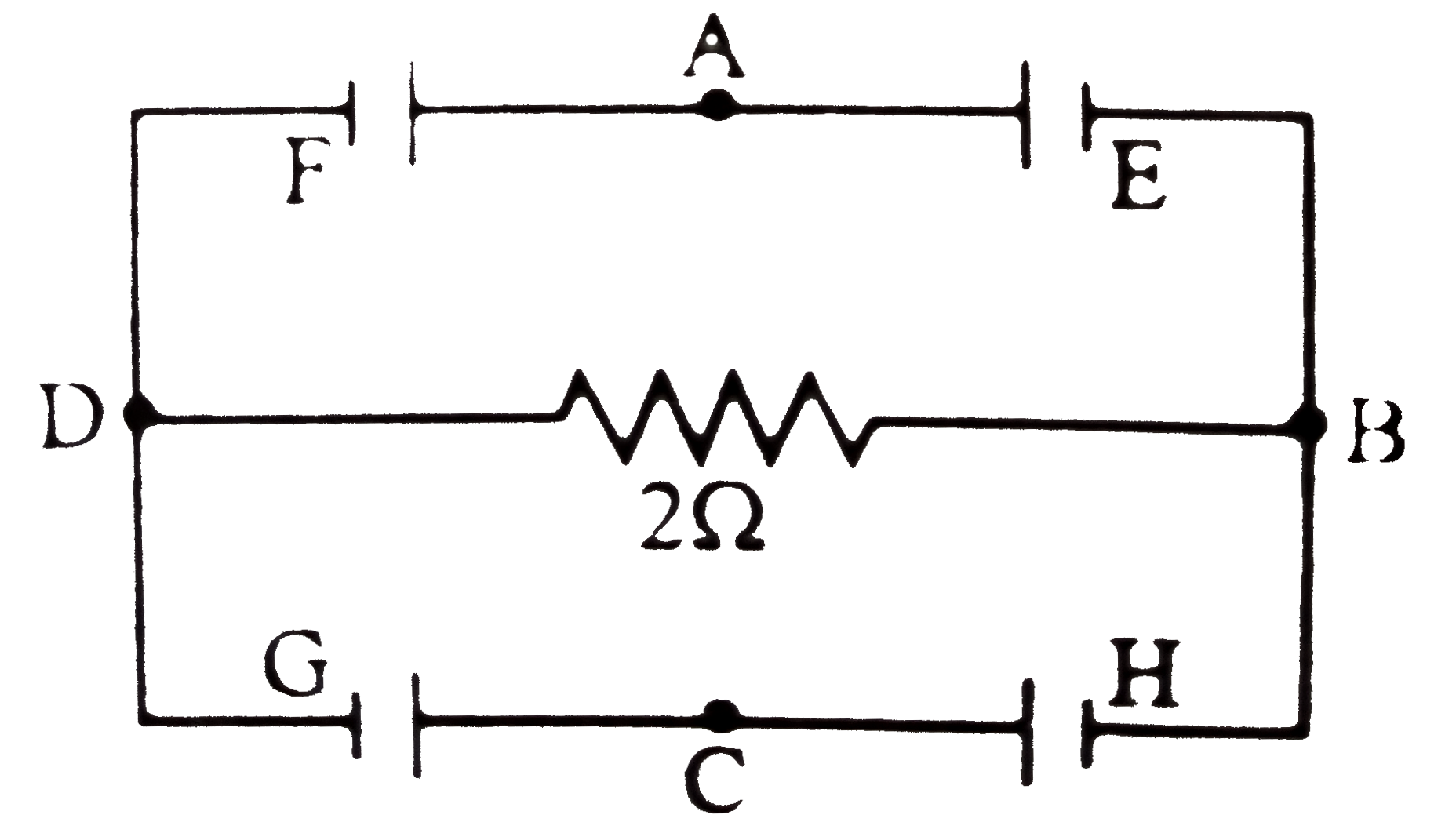
In the circuit shown `E, F, G` and `H` are cells of emf `2V, 1V, 3V` and `1V` respectively and their internal resistance are `2Omega, 1Omega, 3Omega` and `1Omega` respectively.

A

`V_(D) - V_(B) = -(2)/(13)V`

B

`V_(D) - V_(B) = (2)/(13) V`

C

`V_(G) = (21)/(13) V =` potential difference across G

D

`V_(H) = (19)/(13) V =` potential difference across H

Text Solution

Verified by Experts

The correct Answer is:

B, C, D
Promotional Banner

Topper's Solved these Questions

  • COMMUNICATION SYSTEM

    DC PANDEY ENGLISH|Exercise Only One Option is Correct|27 Videos
  • ELASTICITY

    DC PANDEY ENGLISH|Exercise Medical entrances s gallery|21 Videos

Similar Questions

Explore conceptually related problems

In the circuit shown in figure 16, E, F, G and H are cells of emf 2 V, 1 V, 3 V and 1 V and their internal resistance are 2 Omega, 1 Omega, 3 Omega and 1 Omega respectively. Calculate (i) the potential differnce between B and D and (ii) the potential difference across the terminals of each of the cells G and H.

In the circuit shown in E, F, G, and H are cells of emf 2,1,3 and 1 V, respectively. The resistances 2Omega, 1Omega, 3Omega and 1Omega are their respectivle internal resistances. i. Find the potential difference between B and D. (ii) Calculate the potential differences across the terminals of each of the cells G and H.

In the circuit shown in figure below, E_(1) and E_(2) are batteries having emfs 4.0 V and 3.5 V respectively and internal resistance 1Omega and 2Omega respectively. Using Kirchhoff.s laws, calculate currents : I_(1),I_(2) and I_(3) .

In the circuit shown in fig. the cell has emf 10V and internal resistance 1 Omega

A potentiometer circuit is shown in Figure 3. AB is a uniform metallic wire having length of 2 m and resistance of 8Omega . The batteries E_(1) and E_(2) have emfs of 4V and 1.5 V and their internal resistance are 1Omega" and "2Omega respectively. If the jockey J is made to touch the wire AB at a point C such that the galvanometer (G) shows no defection. Calculate the length AC.

A potentiometer circuit is shown in Figure 3 below. AB is a uniform metallic wire having length of 2m and resistance of 8Omega . The batteries E_(1) and E_(2) have emfs of 4V and 1.5V and their internal resistances are 1Omega and 2Omega respectively. Now the jockey J is made to touch the wire AB at a point C such that the galvanometer (G) shows no deflection. Calculate the length AC.

A potentiometer circuit is shown in Figure 3. AB is a uniform metallic wire having length of 2 m and resistance of 8Omega . The batteries E_(1) and E_(2) have emfs of 4V and 1.5 V and their internal resistance are 1Omega" and "2Omega respectively. When the jockey J does not touch the wire AB, calculate : (a) the current flowing through the potentiometer wire AB. (b) the potential gradient across the wire AB.

A potentiometer circuit is shown in Figure 3 below. AB is a uniform metallic wire having length of 2m and resistance of 8Omega . The batteries E_(1) and E_(2) have emfs of 4V and 1.5V and their internal resistances are 1Omega and 2Omega respectively. When the jockey J does not touch the wire AB, calculate: the potential gradient across the wire AB

A potentiometer circuit is shown in Figure 3 below. AB is a uniform metallic wire having length of 2m and resistance of 8Omega . The batteries E_(1) and E_(2) have emfs of 4V and 1.5V and their internal resistances are 1Omega and 2Omega respectively. When the jockey J does not touch the wire AB, calculate: the current flowing through the potentiometer wire AB.

A circuit consists of three bateries of emf E_(1) = 1V, E_(2)=2V and E_(3)=3V and internal resistance 1Omega, 2Omega and 1Omega respectively which are connected in parallel as shown in figure. The potential difference between points P and Q is

DC PANDEY ENGLISH-CURRENT ELECTRICITY-All Questions
  1. In the network shown in fig. , points A, B, and C are at potentials of...

    Text Solution

    |

  2. The value of the resistance R in figure is adjusted such that power di...

    Text Solution

    |

  3. In the circuit shown E, F, G and H are cells of emf 2V, 1V, 3V and 1V ...

    Text Solution

    |

  4. A 20 m long potentiometer wire has a resistance of 20 Ohm. It is conne...

    Text Solution

    |

  5. In the circuit shown, both cells are ideal and of fixed emf, the resis...

    Text Solution

    |

  6. Two identical voltmeters and two identical ammeter are connected to a ...

    Text Solution

    |

  7. In the circuit shown, total power supplied by an ideal battery is 80 W...

    Text Solution

    |

  8. In the circuit shown, total power supplied by an ideal battery is 80 W...

    Text Solution

    |

  9. In the circuit shown, total power supplied by an ideal battery is 80 W...

    Text Solution

    |

  10. In the circuit shown in figure Current through R(2) is zero if R...

    Text Solution

    |

  11. In the circuit shown in figure Current thorugh R(1) is independen...

    Text Solution

    |

  12. In the circuit shown in figure For what ratio (R(2))/(R(4)), curr...

    Text Solution

    |

  13. For the circuit shown figure answer the following questions For w...

    Text Solution

    |

  14. For the circuit shown figure answer the following questions For w...

    Text Solution

    |

  15. In series, potential difference distributes in direct ratio of resista...

    Text Solution

    |

  16. In series, potential difference distributes in direct ratio of resista...

    Text Solution

    |

  17. In the circuit shown in figure points a, b and c are maintained at con...

    Text Solution

    |

  18. In the circuit shown in figure points a, b and c are maintained at con...

    Text Solution

    |

  19. All bulbs consume same power. The resistance of bulb 1 is 36 Omega . ...

    Text Solution

    |

  20. All bulbs consume same power. The resistance of bulb 1 is 36 Omega . ...

    Text Solution

    |
