Home
Class 11
PHYSICS
When a system is taken from state 'a' to...

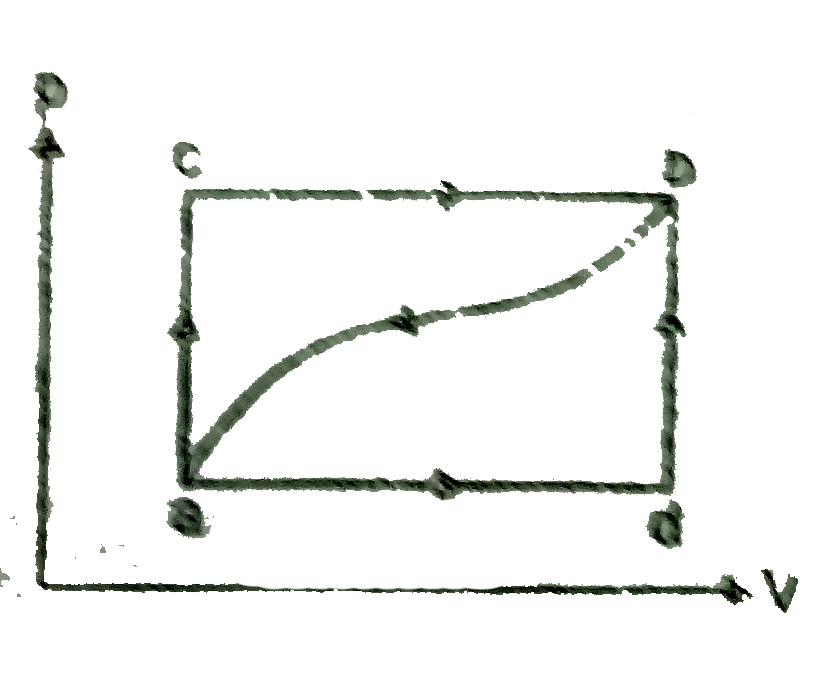
When a system is taken from state 'a' to state 'b' along the path 'acd', is is found that a quantity of heat `Q = 200J` is absorbed by the system and a work `W = 80 J` is done by it. Along the path 'adb', `Q = 144J`. The work done along the path 'adb' is

A

6 J

B

12 J

C

18 J

D

24 J

Text Solution

Verified by Experts

The correct Answer is:

D
Promotional Banner

Topper's Solved these Questions

  • COMMUNICATION SYSTEM

    DC PANDEY ENGLISH|Exercise Only One Option is Correct|27 Videos
  • ELASTICITY

    DC PANDEY ENGLISH|Exercise Medical entrances s gallery|21 Videos

Similar Questions

Explore conceptually related problems

When a system is taken from state 'a' to state 'b' along the path 'acb', it is found that a quantity of heat Q = 200 J is absorbed by the system and a work W = 80 J is done by it. Along the path 'adb', Q = 144 J In the above question, if the work done on the system along the curved path 'ba' is 52J, heat absorbed is

When a system is taken from state 'a' to state 'b' along the path 'acb', it is found that a quantity of heat Q = 200 J is absorbed by the system and a work W = 80 J is done by it. Along the path 'adb', Q = 144 J In the above question, if U_(d)=88J , heat absorbed for the path 'db' is

When a system is taken from state 'a' to state 'b' along the path 'acb', it is found that a quantity of heat Q = 200 J is absorbed by the system and a work W = 80 J is done by it. Along the path 'adb', Q = 144 J In above question, if U_(a)=40J , value of U_(b) will be

a thermodynamic system is taken from the state i to statef along the path iaf. It is found that the heat absorbed by the system is 40 cal and work done by the system is 16.19 cal. Along the path i bf, the heat absorbed is 35 cal. (a) Find the work done along the path i bf. (b) If W = - 10 cal for the curved return path fi, what is for this path ? (c) Take U_(b) = 20 cal, what is U _(f)? (d) If U _(b) = 20 cal, what is for the process ib?

When a system is taken from state i to state f along the path iaf, it is found that Q=50 cal and W=20 cal . Along the path ibf Q=36cal . W along the path ibf is

When a system is taken from state i to state f along the path iaf, it is found that Q=50 cal and W=20 cal . Along the path ibf Q=36cal . W along the path ibf is

When a system is taken from state A to state B along path ACB as shown in figure below, 80 J of heat flows into the system and the system does 30 J of work. When the system is returned from state B to A along the curve path, the work done on the system is 20 J . Does the system absorb or liberate heat and by how much ?

When a system is taken from state a to state b, in figure along the path a to c to b , 60J of heat flow into the system, and 30 J of work is done : (i) How much heat flows into the system along the path a to d to b if the work is 10J . (ii) When the system is returned from b to along the curved path, the work done by the system is -20J . Does the system absorb or liberate heat, and how much ? (iii) If , U_(a) = 0 and U_(d)= 22J , find the heat absorbed in the process a to d and d to b .

When a system is taken from state A to state B along path ACB as shown in figure below, 80 J of heat flows into the system and the system does 30 J of work. How much heat flows into the system along path ADB if the work done by the system is 10 J :

When a thermodynamic system is taken from an initial state I to a final state F along the path IAF, as shown in Fig. the heat energy absorbed by the system is Q = 55 J and work done by the system is W = 25 J . If the same system is taken along the path IBF, the value of Q = 35 J . (a) If W = - 15 J for the curved path FI, how much heat energy is lost by the system along this path ? (b) If U_(1) = 10 J , what is U_(F) ? (d) If U_(B) = 20 J , what is Q for the process BF and IB ?

DC PANDEY ENGLISH-CURRENT ELECTRICITY-All Questions
  1. An ideal diatomic gas with C(V)=(5R)/(2) occupies a volume V(1) at a p...

    Text Solution

    |

  2. An ideal diatomic gas with C(V)=(5R)/(2) occupies a volume V(1) at a p...

    Text Solution

    |

  3. When a system is taken from state 'a' to state 'b' along the path 'acd...

    Text Solution

    |

  4. When a system is taken from state 'a' to state 'b' along the path 'acb...

    Text Solution

    |

  5. When a system is taken from state 'a' to state 'b' along the path 'acb...

    Text Solution

    |

  6. When a system is taken from state 'a' to state 'b' along the path 'acb...

    Text Solution

    |

  7. Two rods A and B of same cross-sectional area A and length l are conne...

    Text Solution

    |

  8. Two rods A and B of same cross-sectional area A and length l are conne...

    Text Solution

    |

  9. Two rods A and B of same cross-sectional area A and length l are conne...

    Text Solution

    |

  10. A sample of ideal gas is taken through the cyclic process shown in the...

    Text Solution

    |

  11. A sample of ideal gas is taken through the cyclic process shown in the...

    Text Solution

    |

  12. A sample of ideal gas is taken through the cyclic process shown in the...

    Text Solution

    |

  13. One mole of an ideal monoatomic has is taken through cyclic process AB...

    Text Solution

    |

  14. One mole of an ideal monoatomic has is taken through cyclic process AB...

    Text Solution

    |

  15. One mole of an ideal monotomic gas undergoes a linear process from A t...

    Text Solution

    |

  16. One mole of an ideal monotomic gas undergoes a linear process from A t...

    Text Solution

    |

  17. A sample of mono-atomic ideal gas is taken through a cyclic process AB...

    Text Solution

    |

  18. A sample of mono-atomic ideal gas is taken through a cyclic process AB...

    Text Solution

    |

  19. A metal block is placed in a room which is at 10^(@)C for long time. N...

    Text Solution

    |

  20. A metal block is placed in a room which is at 10^(@)C for long time. N...

    Text Solution

    |
