Home
Class 11
PHYSICS
Two rods A and B of same cross-sectional...

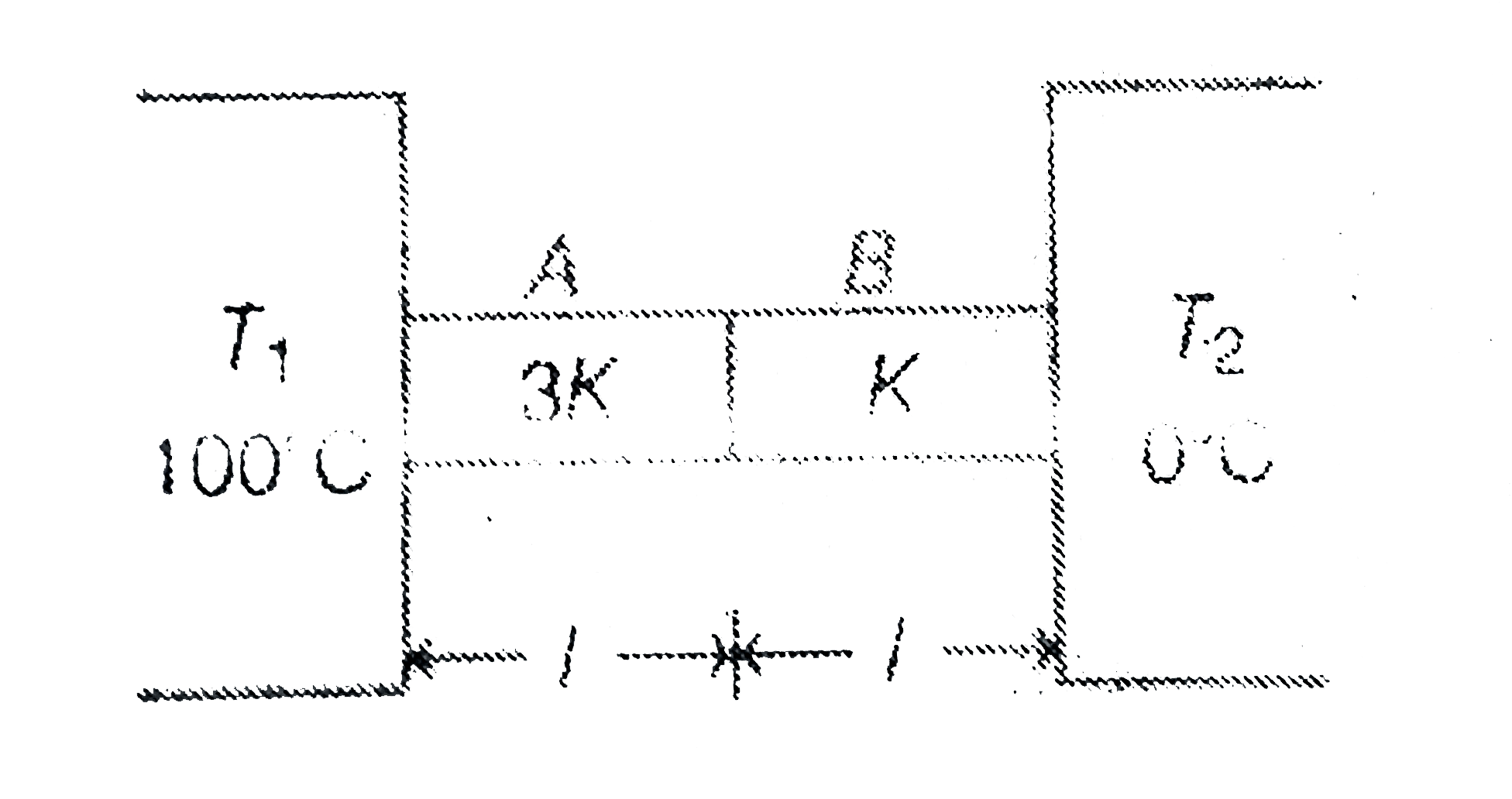
Two rods A and B of same cross-sectional area A and length l are connected in series between a source `(T_(1)=100^(@)C)` and a sink `(T_(2)-0^(@)C)` as shown in figure. The rod is laterally insulated.

If `T_(A)` and `T_(B)` are the temperature drops across the rod A and B, then

A

`(T_(A))/(T_(B))=(3)/(1)`

B

`(T_(A))/(T_(B))=(1)/(3)`

C

`(T_(A))/(T_(B))=(3)/(4)`

D

`(T_(A))/(T_(B))=(4)/(3)`

Text Solution

Verified by Experts

The correct Answer is:

B
Promotional Banner

Topper's Solved these Questions

  • COMMUNICATION SYSTEM

    DC PANDEY ENGLISH|Exercise Only One Option is Correct|27 Videos
  • ELASTICITY

    DC PANDEY ENGLISH|Exercise Medical entrances s gallery|21 Videos

Similar Questions

Explore conceptually related problems

Two rods A and B of same cross-sectional area A and length l are connected in series between a source (T_(1)=100^(@)C) and a sink (T_(2)-0^(@)C) as shown in figure. The rod is laterally insulated. If G_(A) and G_(B) are the temperature gradients across the rod A and B, then

Two rods A and B of same cross-sectional area A and length l are connected in series between a source (T_(1)=100^(@)C) and a sink (T_(2)-0^(@)C) as shown in figure. The rod is laterally insulated. The ratio of the thermal resistance of the rods is

Two rods A and B of same length and cross-sectional area are connected in series and a temperature difference of 100^@C is maintained across the combination as shoen in Fig. If the thermal conductivity of the rod A is 3 k and that of rod B is k, Then i.Determine the thermal resistance of each rod. ii. determine the heat current flowing through each rod. iii. determine the heat current flowing through each rod. iv. plot the variation of temperature along the length of the rod.

Three rods of same cross-section but different length and conductivity are joined in series . If the temperature of the two extreme ends are T_(1) and T_(2) (T_(1)gtT_(2)) find the rate of heat transfer H.

A conducting cylindrical rod of uniform cross-sectional area is kept between two large chambers which are at temperatures 100^(@) C and 0^(@) C, respectively. The cconductivety of the rod increases with x, where x is distance from 100^(@) C end. The temperature profile of the rod in steady -state will be as

Two ends of a rod of uniform cross sectional area are kept at temperature 3T_(0) and T_(0) as shown. Thermal conductivity of rod varies as k=alphaT , (where alpha is a constant and T is absolute temperature). In steady state, the temperature of the middle section of the rod is

Three rods of identical cross-sectional area and made from the same metal form the sides of an isosceles triangle ABC right angled at B as shown in the figure. The points A and B are maintained at temperature T and (sqrt2)T respectively in the steady state. Assuming that only heat conduction takes place, temperature of point C will be

Two bars of same length and same cross-sectional area but of different thermal conductivites K_(1) and K_(2) are joined end to end as shown in the figure. One end of the compound bar it is at temperature T_(1) and the opposite end at temperature T_(2) (where T_(1) gt T_(2) ). The temperature of the junction is

Three rods of the same length and the same area of the cross-section are joined. The temperature of two ends one T_(1) and T_(2) as shown in the figure. As we move along the rod the variation of temperature are as shown in the following [Rods are insulated from the surrounding except at the faces]

Two rods A and B of same area of cross-section are joined together end to end The free end of the rod A is kept in melting ice at 300 K and free end of B rod at 400 K. The rods are of the same length. The conductivity of A is 3 times that of B. Calculate the temperature of the junction of the rods.

DC PANDEY ENGLISH-CURRENT ELECTRICITY-All Questions
  1. When a system is taken from state 'a' to state 'b' along the path 'acb...

    Text Solution

    |

  2. Two rods A and B of same cross-sectional area A and length l are conne...

    Text Solution

    |

  3. Two rods A and B of same cross-sectional area A and length l are conne...

    Text Solution

    |

  4. Two rods A and B of same cross-sectional area A and length l are conne...

    Text Solution

    |

  5. A sample of ideal gas is taken through the cyclic process shown in the...

    Text Solution

    |

  6. A sample of ideal gas is taken through the cyclic process shown in the...

    Text Solution

    |

  7. A sample of ideal gas is taken through the cyclic process shown in the...

    Text Solution

    |

  8. One mole of an ideal monoatomic has is taken through cyclic process AB...

    Text Solution

    |

  9. One mole of an ideal monoatomic has is taken through cyclic process AB...

    Text Solution

    |

  10. One mole of an ideal monotomic gas undergoes a linear process from A t...

    Text Solution

    |

  11. One mole of an ideal monotomic gas undergoes a linear process from A t...

    Text Solution

    |

  12. A sample of mono-atomic ideal gas is taken through a cyclic process AB...

    Text Solution

    |

  13. A sample of mono-atomic ideal gas is taken through a cyclic process AB...

    Text Solution

    |

  14. A metal block is placed in a room which is at 10^(@)C for long time. N...

    Text Solution

    |

  15. A metal block is placed in a room which is at 10^(@)C for long time. N...

    Text Solution

    |

  16. Four moles of an ideal gas is initially in a state A having pressure 2...

    Text Solution

    |

  17. Four moles of an ideal gas is initially in a state A having pressure 2...

    Text Solution

    |

  18. Two moles of a diatomic gas are carried trhough the cycle ABCDA as sho...

    Text Solution

    |

  19. Two moles of a diatomic gas are carried trhough the cycle ABCDA as sho...

    Text Solution

    |

  20. Two moles of a diatomic gas are carried trhough the cycle ABCDA as sho...

    Text Solution

    |
