Home
Class 11
PHYSICS
Four moles of an ideal gas is initially ...

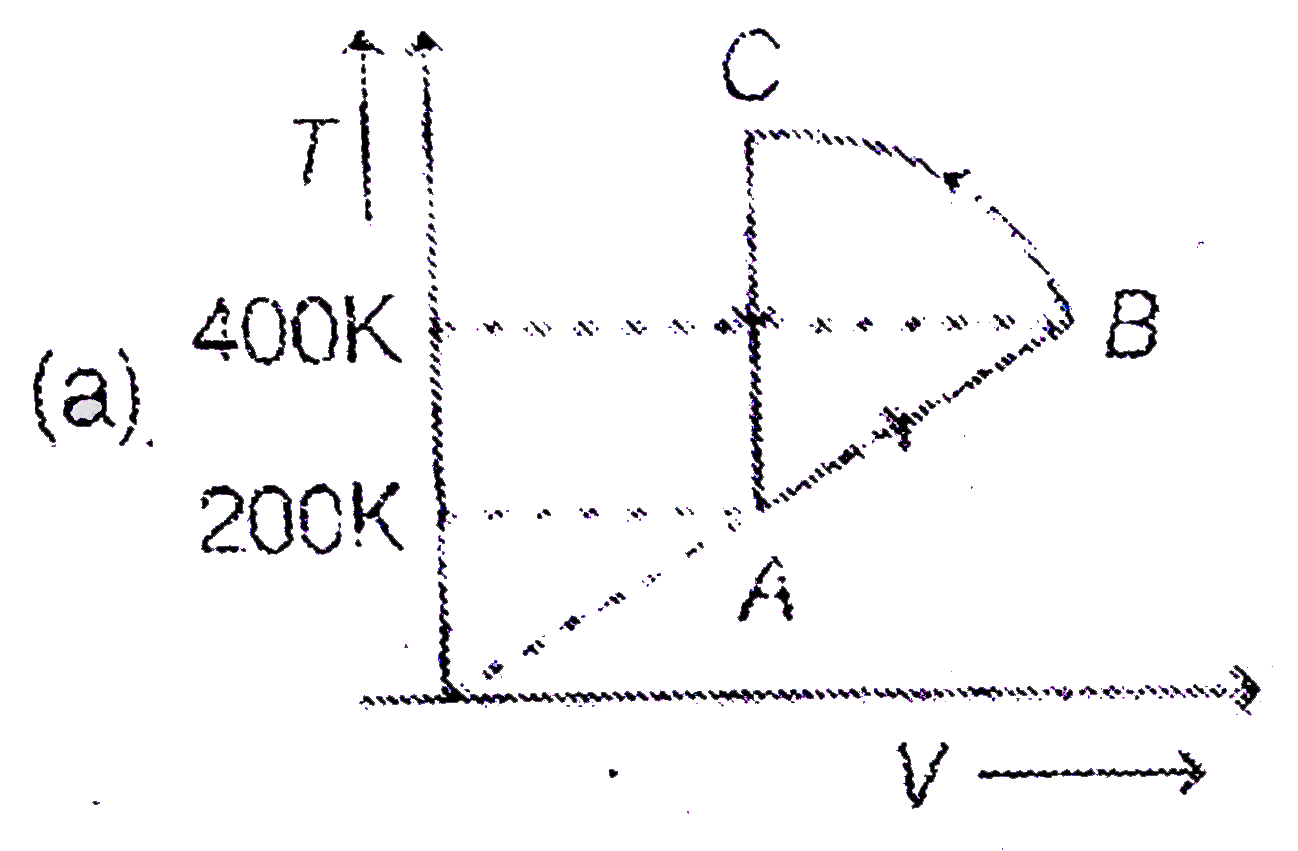
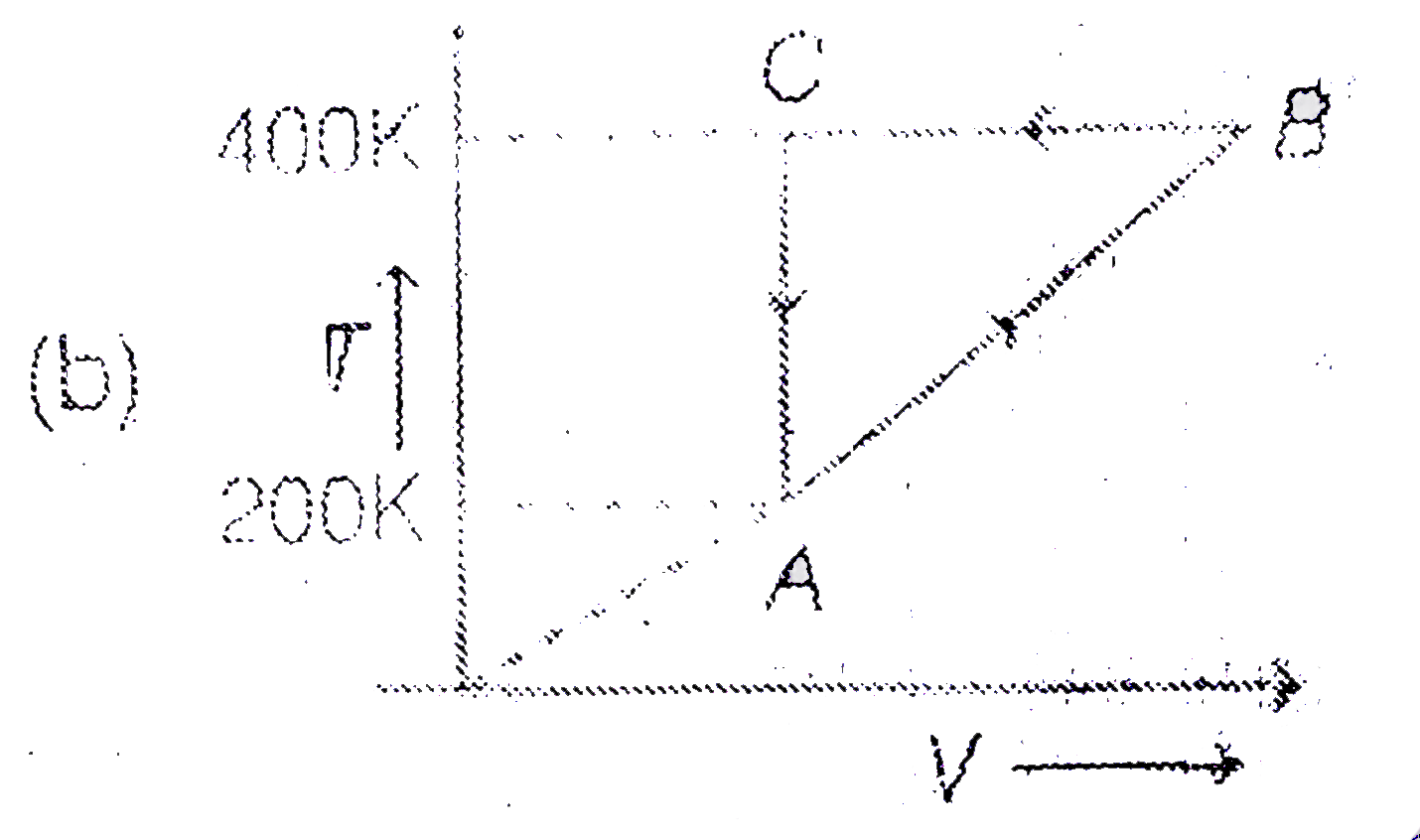
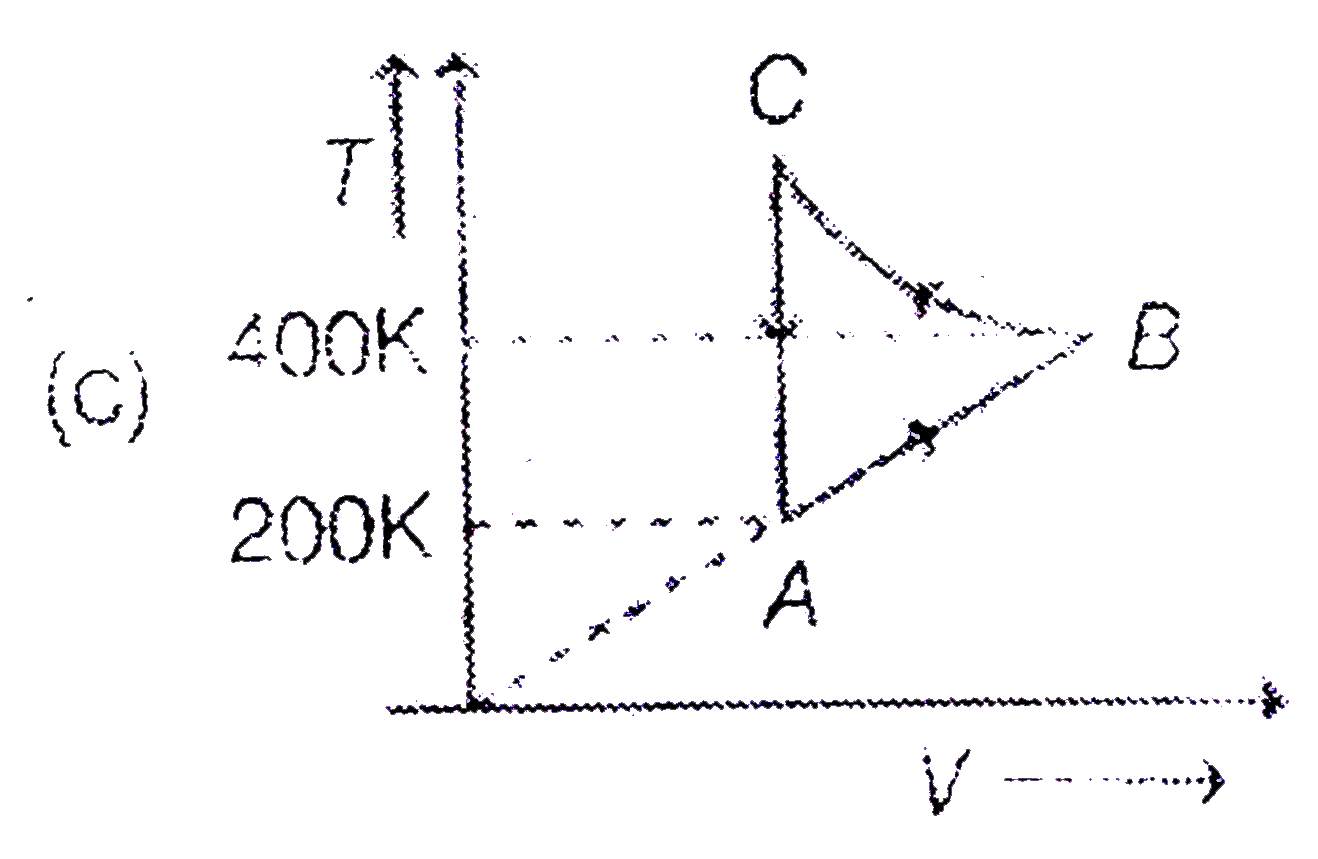
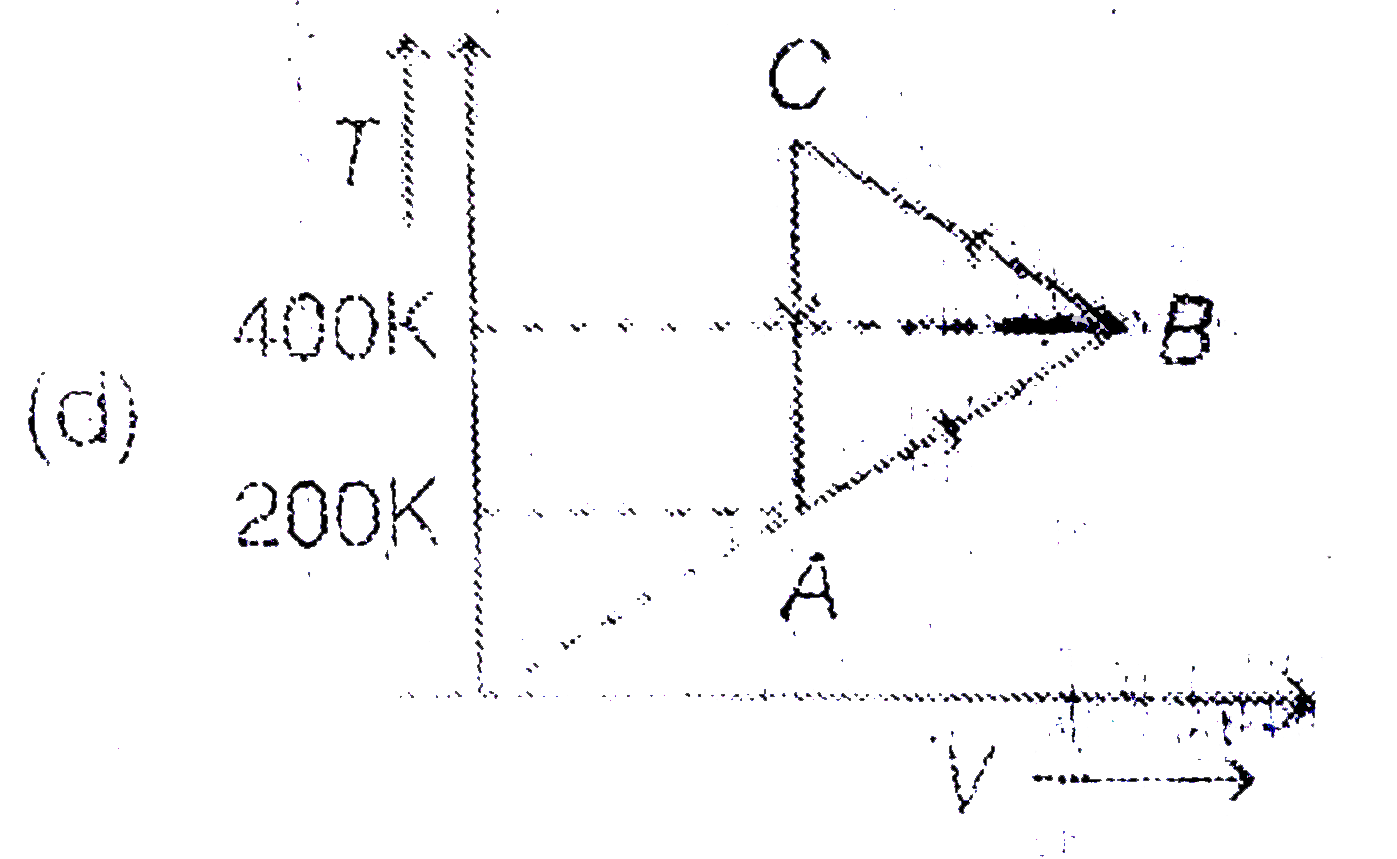
Four moles of an ideal gas is initially in a state A having pressure `2xx10^(5)N//m^(2)` and temperature 200 K . Keeping pressure constant the gas is taken to state B at temperature of 400K. The gas is then taken to a state C in such a way that its temperature increases and volume decreases. Also from B to C, the magnitude of `(dT)/(dV)` increases. The volume of gas at state C is eaual to its volume at state A. Now gas is taken is initial state A keeping volume constant. A total of 1000 J heat is rejected from the sample in the cyclic process. Take `R=8.3J//K//mol`.
Which graph between temperture T and volume V for the cyclic process is correct.

A

B

C

D

Text Solution

AI Generated Solution

The correct Answer is:

To solve the problem step by step, we will analyze the states of the gas and the relationships between pressure, volume, and temperature during the cyclic process. ### Step 1: Identify the initial conditions - The gas has 4 moles (n = 4). - Initial pressure (P_A) = \(2 \times 10^5 \, \text{N/m}^2\) - Initial temperature (T_A) = 200 K ### Step 2: Determine the volume at state A Using the ideal gas law, \(PV = nRT\): \[ V_A = \frac{nRT_A}{P_A} \] Substituting the values: \[ V_A = \frac{4 \times 8.3 \times 200}{2 \times 10^5} \] Calculating: \[ V_A = \frac{6640}{200000} = 0.0332 \, \text{m}^3 \] ### Step 3: Determine the state B conditions At state B, the pressure remains constant, and the temperature is increased to 400 K. Since pressure is constant: \[ V_B = \frac{nRT_B}{P_A} \] Substituting the values: \[ V_B = \frac{4 \times 8.3 \times 400}{2 \times 10^5} \] Calculating: \[ V_B = \frac{13280}{200000} = 0.0664 \, \text{m}^3 \] ### Step 4: Analyze the transition from state B to state C From state B to state C, the temperature increases while the volume decreases. The volume at state C is equal to the volume at state A (i.e., \(V_C = V_A\)). ### Step 5: Determine the conditions at state C Since \(V_C = V_A\), we have: \[ V_C = 0.0332 \, \text{m}^3 \] We need to find the temperature at state C (T_C). Using the ideal gas law again: \[ P_B V_C = nRT_C \] Substituting the values: \[ 2 \times 10^5 \times 0.0332 = 4 \times 8.3 \times T_C \] Calculating: \[ 6666 = 33.2 T_C \implies T_C = \frac{6666}{33.2} \approx 200 \, \text{K} \] ### Step 6: Analyze the final state A conditions At state A, the gas is kept at constant volume and a total of 1000 J of heat is rejected. The process is cyclic, so the net heat exchange must equal zero. ### Step 7: Determine the graph between T and V - From A to B: \(T\) increases while \(V\) increases (straight line). - From B to C: \(T\) increases while \(V\) decreases (curve). - From C back to A: \(T\) remains constant while \(V\) is constant (horizontal line). ### Conclusion The correct graph will show: - An initial increase in temperature with increasing volume from A to B. - A decrease in volume with an increase in temperature from B to C. - A constant temperature at state A.
Promotional Banner

Topper's Solved these Questions

  • COMMUNICATION SYSTEM

    DC PANDEY ENGLISH|Exercise Only One Option is Correct|27 Videos
  • ELASTICITY

    DC PANDEY ENGLISH|Exercise Medical entrances s gallery|21 Videos

Similar Questions

Explore conceptually related problems

Four moles of an ideal gas is initially in a state A having pressure 2xx10^(5)N//m^(2) and temperature 200 K . Keeping pressure constant the gas is taken to state B at temperature of 400K. The gas is then taken to a state C in such a way that its temperature increases and volume decreases. Also from B to C, the magnitude of (dT)/(dV) increases. The volume of gas at state C is eaual to its volume at state A. Now gas is taken is initial state A keeping volume constant. A total of 1000 J heat is rejected from the sample in the cyclic process. Take R=8.3J//K//mol . The work done by the gas along path B to C is

Four moles of an ideal gas is initially in state A having pressure 2 xx 10^(5) N//m^(2) and temperature 200 K . Keeping the pressure constant the gas is taken to state B at temperature of 400K . The gas is then taken to a state C in such a way that its temperature increases and volume decreases. Also from B to C , the magnitude of dT//dV increases. The volume of gas at state C is equal to its volume at state A . Now gas is taken to initial state A keeping volume constant. A total 1000 J of heat is withdrawn from the sample of the cyclic process . Take R=8.3 J// K// mol . The volume of gas at state C is

What is the effect on the pressure of a gas if its temperature is increased at constant volume ?

One mole of an ideal monoatomic gas is taken at a temperature of 300 K . Its volume is doubled keeping its pressure constant. Find the change in internal energy.

Can the temperature of a gas increased keeping its pressure and volume constant ?

The temperature of a given mass of a gas is increased from 19^(@)C to 20^(@)C at constant pressure. The volume V of the gas is

A sample of ideal gas is taken through the cyclic process shown in the figure. The temerauture of the gas in state A is T_(A) =200 K. In states B and C the temperature of the gas is the same. Net work done by the gas in the process is

At constant pressure, the ratio of increases in volume of an ideal gas per degree rise in kelvin temperature to its volume is

Four moles of an ideal gas at a pressure of 4 atm and at a temperature of 70^(@)C expands is othermally to four times its initial volume : What is (i) the final temperature and (ii) the final volume ?

A vessel is filled with an ideal gas at a pressure of 20 atm and is a temperature of 27^@ C One - half of the mass is removed from the vessel and the temperature of the remaining gas is increased to 87^@ C . At this temperature, Find the pressure of the gas.

DC PANDEY ENGLISH-CURRENT ELECTRICITY-All Questions
  1. A metal block is placed in a room which is at 10^(@)C for long time. N...

    Text Solution

    |

  2. A metal block is placed in a room which is at 10^(@)C for long time. N...

    Text Solution

    |

  3. Four moles of an ideal gas is initially in a state A having pressure 2...

    Text Solution

    |

  4. Four moles of an ideal gas is initially in a state A having pressure 2...

    Text Solution

    |

  5. Two moles of a diatomic gas are carried trhough the cycle ABCDA as sho...

    Text Solution

    |

  6. Two moles of a diatomic gas are carried trhough the cycle ABCDA as sho...

    Text Solution

    |

  7. Two moles of a diatomic gas are carried trhough the cycle ABCDA as sho...

    Text Solution

    |

  8. 2 moles of an ideal monoatomic gas undergoes a cyclic process ABCA as ...

    Text Solution

    |

  9. 2 moles of an ideal monoatomic gas undergoes a cyclic process ABCA as ...

    Text Solution

    |

  10. 2 moles of an ideal monoatomic gas undergoes a cyclic process ABCA as ...

    Text Solution

    |

  11. One mole of helium gas follows the cycle 1-2-3-1 shown in the diagram....

    Text Solution

    |

  12. One mole of helium gas follows the cycle 1-2-3-1 shown in the diagram....

    Text Solution

    |

  13. Match the following

    Text Solution

    |

  14. In the rho-T graph shown in figure, match the following.

    Text Solution

    |

  15. In process Tprop(1)/(V), pressure of the gas increases from p(0) to 4p...

    Text Solution

    |

  16. Three liquids A, B and C having same specific heat and mass , 2m and 3...

    Text Solution

    |

  17. For a monoatomic gas at temperature T, match the following.

    Text Solution

    |

  18. Three rods of equal length of same material are joined to form an equi...

    Text Solution

    |

  19. Match the following.

    Text Solution

    |

  20. Match the following.

    Text Solution

    |
