Home
Class 11
PHYSICS
An ideal monoatomic gas is taken through...

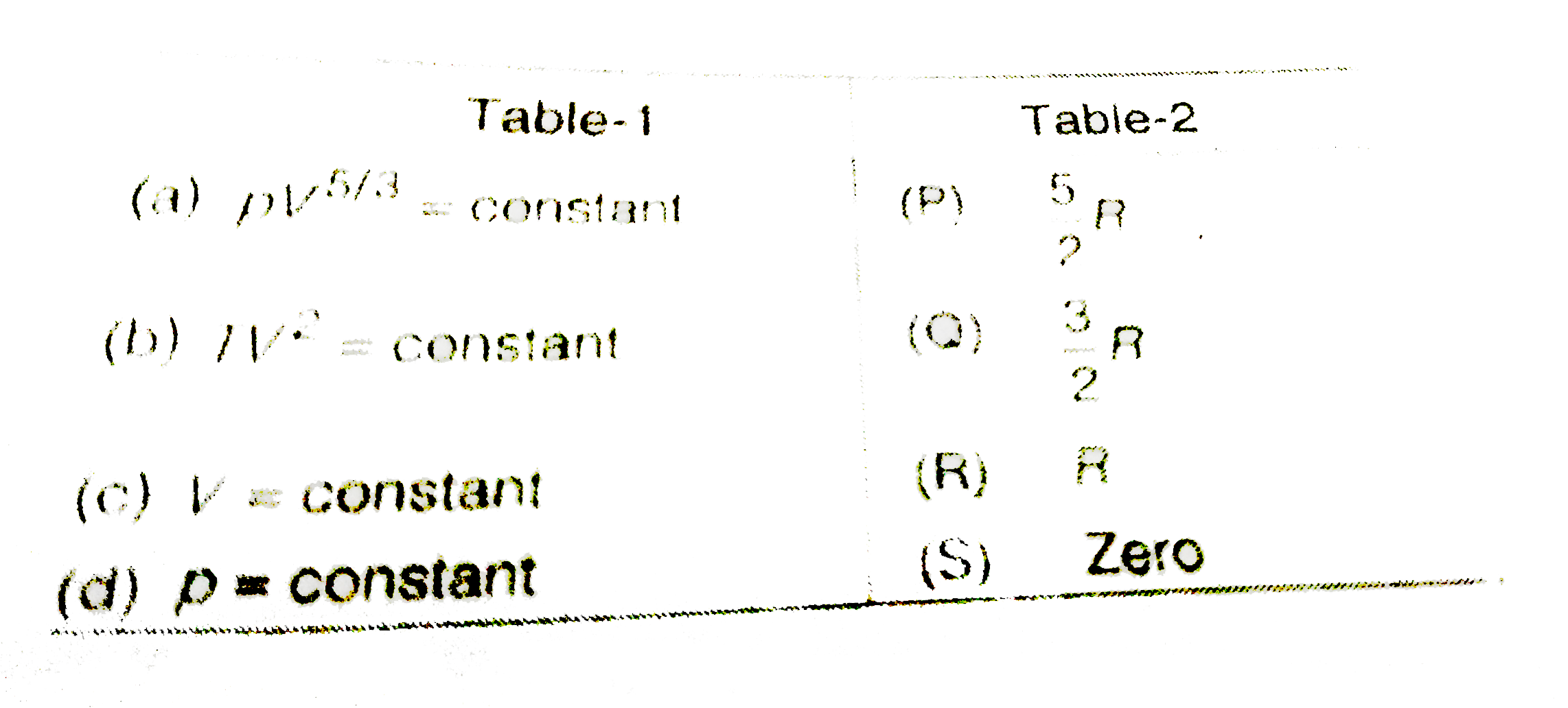
An ideal monoatomic gas is taken through one of the following reversible processes expressed by the equation in Table-1. Match the molar heat capacity of the gas, expressed in multiplies of R, in Table-2 with the appropriate process:

Text Solution

Verified by Experts

The correct Answer is:

(A) S, (B) R, (C) Q, (D)P
Promotional Banner

Topper's Solved these Questions

  • COMMUNICATION SYSTEM

    DC PANDEY ENGLISH|Exercise Only One Option is Correct|27 Videos
  • ELASTICITY

    DC PANDEY ENGLISH|Exercise Medical entrances s gallery|21 Videos

Similar Questions

Explore conceptually related problems

Ideal gas is taken through the process shown in the figure :

Ideal gas is taken through the process shown in the figure :

an ideal diatomic gas undergoes a polytropic process described by the equation P√V= constant . The molar heat capacity of the gas during this process is

One mole of an ideal monoatomic gas is taken through a cyclic process as shown. Choose the correct option(s).

One mole of an ideal monatomic gas undergoes a process described by the equation PV^(3) = constant. The heat capacity of the gas during this process is

An ideal gas is taken through a process in which the pressure and the volume are changed according to the equation p=kv . Show that the molar heat capacity of the gas for the process is given by (C=C_v + ( R)/(2)) .

An ideal gas is taken through a process in which the pressure and the volume are changed according to the equation p=kv . Show that the molar heat capacity of the gas for the process is given by (C=C_v + ( R)/(2)) .

One mole of an ideal monoatomic gas is taken through the thermodynamic process shown in the P-V diagram. The heat supplied to the system is

One mole of monoatomic gas is taken round the cyclic process. Heat absorbed by gas in process AB is

Ideal mono-atomic gas is taken through process such that dQ = 3dU. The molar heat capacity for process is:

DC PANDEY ENGLISH-CURRENT ELECTRICITY-All Questions
  1. Match the following two tables.

    Text Solution

    |

  2. A rod AB of uniform cross-section consists of 4 sections AC, CD, DE an...

    Text Solution

    |

  3. An ideal monoatomic gas is taken through one of the following reversib...

    Text Solution

    |

  4. There are two types of rods : Rod 1 : Length L, Thermal conductivity...

    Text Solution

    |

  5. The energy of the rotational motion of the molecules in n moles of nit...

    Text Solution

    |

  6. Two moles of a diatomic ideal gas is taken through pT= constant. Its t...

    Text Solution

    |

  7. Two idential container joined by a small pipe initially contain the sa...

    Text Solution

    |

  8. One mole of a monoatomic gas is carried along process ABCDEA as shown ...

    Text Solution

    |

  9. Corresponding to the process shown in figure, the heat given to the ga...

    Text Solution

    |

  10. The internal energy of a gas is given by U=2pV. It expands from V0 to ...

    Text Solution

    |

  11. An ideal monoatomic gas undergoes a process in which its internal ener...

    Text Solution

    |

  12. Rate of heat flow through a cylindrical rod is H(1). Temperatures of e...

    Text Solution

    |

  13. Choose the correct option: Two identical conducting rods are first c...

    Text Solution

    |

  14. One mole of a monatomic gas is involved in the cyclic process as shown...

    Text Solution

    |

  15. Figure shows a parabolic graph between T and (1)/(V) (T = temperature,...

    Text Solution

    |

  16. Consider the adjacent figure. A piston divides a cylindrical container...

    Text Solution

    |

  17. A black body emits maximum radiation of wavelength lambda(1) at a cert...

    Text Solution

    |

  18. Nine identical conducting rods are arranged as shown in the figure. T...

    Text Solution

    |

  19. In steady state, rate of heat flow through rod of variable thermal con...

    Text Solution

    |

  20. The pressure and volume of an ideal gas are related as P=(a)/(1+((V)/(...

    Text Solution

    |
