Home
Class 11
PHYSICS
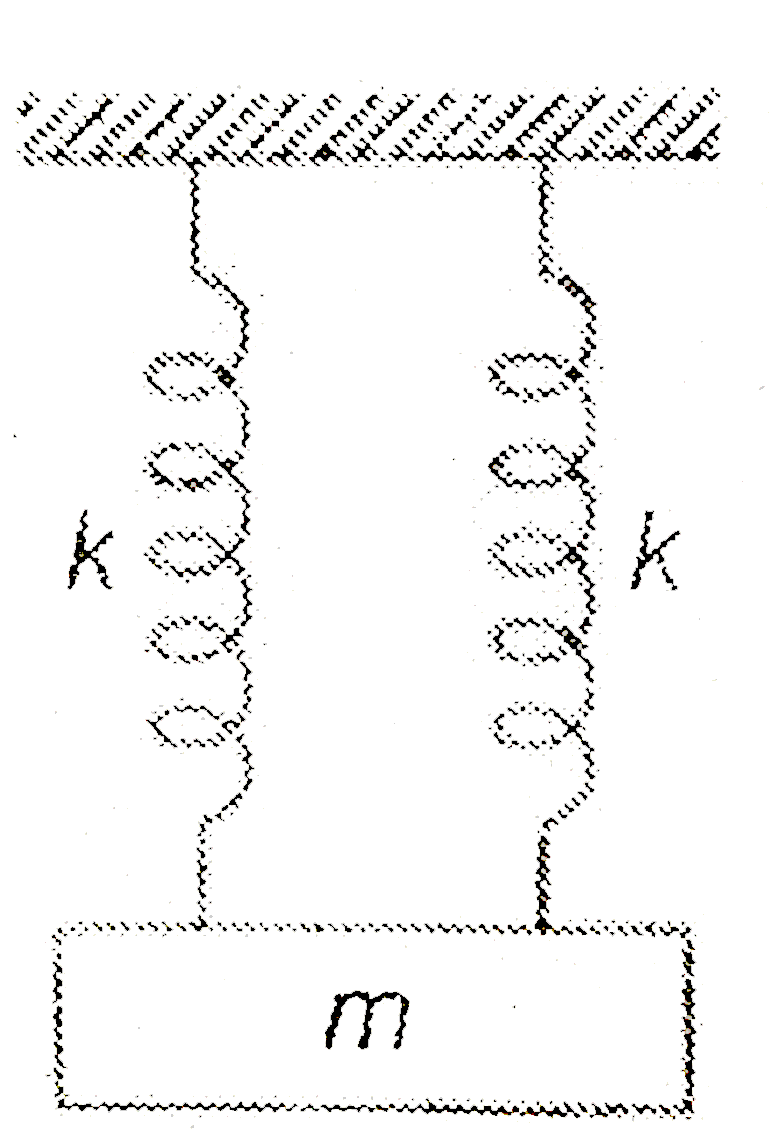
Passage III A block of mass m =1/2 kg is...

Passage III A block of mass m =1/2 kg is attached with two springs each of force contant k=10N/m as shown. The block is oscillating vertically up and down with amplitude A=25cm. When the block is at its mean position one of the spring breaks without changing momentum of block.

What is the new amplitude of osciallation of the block.

A

10.6cm

B

43.3 cm

C

25 cm

D

62.2 cm

Text Solution

Verified by Experts

The correct Answer is:

B
Promotional Banner

Topper's Solved these Questions

  • SIMPLE HARMONIC MOTION

    DC PANDEY ENGLISH|Exercise Matrix matching type questions|13 Videos
  • SIMPLE HARMONIC MOTION

    DC PANDEY ENGLISH|Exercise Integer type questions|14 Videos
  • SIMPLE HARMONIC MOTION

    DC PANDEY ENGLISH|Exercise More than one option is correct|50 Videos
  • SEMICONDUCTORS AND ELECTRONIC DEVICES

    DC PANDEY ENGLISH|Exercise More than One Option is Correct|3 Videos
  • SOLVD PAPERS 2017 NEET, AIIMS & JIPMER

    DC PANDEY ENGLISH|Exercise Solved paper 2018(JIPMER)|38 Videos

Similar Questions

Explore conceptually related problems

Passage III A block of mass m =1/2 kg is attached with two springs each of force contant k=10N/m as shown. The block is oscillating vertically up and down with amplitude A=25cm. When the block is at its mean position one of the spring breaks without changing momentum of block. If instead of breaking one spring m/2 mass would have fallen from the block, then what will be the new amplitude?

A block of mass 0.2 kg is attached to a mass less spring of force constant 80 N/m as shown in figure. Find the period of oscillation. Take g=10 m//s^(2) . Neglect friction

A block of mass 0.2 kg is attached to a mass less spring of force constant 80 N/m as shown in figure. Find the period of oscillation. Take g=10 m//s^(2) . Neglect friction

A block of mass m is attached to two unstretched springs of spring constant k , each as shown. The block is displaced towards right through a distance x and is released The speed of the block as it passes through the mean position will be

A block of mass 0.01 kg is attached to a spring of force constant 10^(-1)Nm^(-1) . If the energy of oscillation is 10^(-5) J, find the angular frequency and amplitude of oscillation.

A block of mass 2 kg is connected with a spring of natural length 40 cm of force constant K=200 N//m . The cofficient of friction is mu=0.5 . When released from the given position, acceleration of block will be

A block of mass m = 2 kg is attached to two unstretched spring of force constant k_(1)=100 N//m and k_(2)=125 N//m The block is displaced towards left through a distance of 10 cm and released. Find the speed of the block as it passes through the mean position.

A block of mass m is attached to two unstretched springs of spring constants k_1 and k_2 as shown in figure. The block is displaced towards right through a distance x and is released. Find the speed of the block as it passes through the mean position shown.

A block of mass m is attached with a spring in vertical plane as shown in the figure. If initially spring is in its natural length and the block is released from rest, then maximum extension in the spring will be

A block of mass m is attached to a spring of force constant k .Charges on the block is q . A horizontal electric field E is acting in the directions as shown.Block is released with the spring in unstretched position (a) block will execute SHM (b) time period of osciallation is 2pisqrt(m)/(k) (c) amplitude of oscillation is (qE)/(k) (d) Block will oscillate but not simple harmonically choose the correct answer

DC PANDEY ENGLISH-SIMPLE HARMONIC MOTION-Comprehension types
  1. Passage I) In simple harmonic motion force acting on a particle is giv...

    Text Solution

    |

  2. Passage I) In simple harmonic motion force acting on a particle is giv...

    Text Solution

    |

  3. Passage I) In simple harmonic motion force acting on a particle is giv...

    Text Solution

    |

  4. Passage II) Two identicla blocks P and Q have masses m each. They are ...

    Text Solution

    |

  5. Passage II) Two identicla blocks P and Q have masses m each. They are ...

    Text Solution

    |

  6. Passage II) Two identicla blocks P and Q have masses m each. They are ...

    Text Solution

    |

  7. Passage III A block of mass m =1/2 kg is attached with two springs eac...

    Text Solution

    |

  8. Passage III A block of mass m =1/2 kg is attached with two springs eac...

    Text Solution

    |

  9. Passage IV) Angular frequency in SHM is given by omega=sqrt(k/m). Maxi...

    Text Solution

    |

  10. Angular frequnecy in SHM is given by omega = sqrt((k)/(m)), Maximum ac...

    Text Solution

    |

  11. Passage V) In SHM displacement, velocity and acceleration all oscillat...

    Text Solution

    |

  12. Passage V) In SHM displacement, velocity and acceleration all oscillat...

    Text Solution

    |

  13. Passage VI Two particles collide when they are at same position at sam...

    Text Solution

    |

  14. Passage VI Two particles collide when they are at same position at sam...

    Text Solution

    |

  15. Passage VII There is a spring block system in a lift moving upwards wi...

    Text Solution

    |

  16. Passage VII There is a spring block system in a lift moving upwards wi...

    Text Solution

    |

  17. Passage VIII A disc of mass m and radius R is attached with a spring o...

    Text Solution

    |

  18. In the problem if k = 10 N/m, m=2kg, R=1m and A=2m. Find linear speed ...

    Text Solution

    |
