Home
Class 11
PHYSICS
A simple harmonic oscillator consists of...

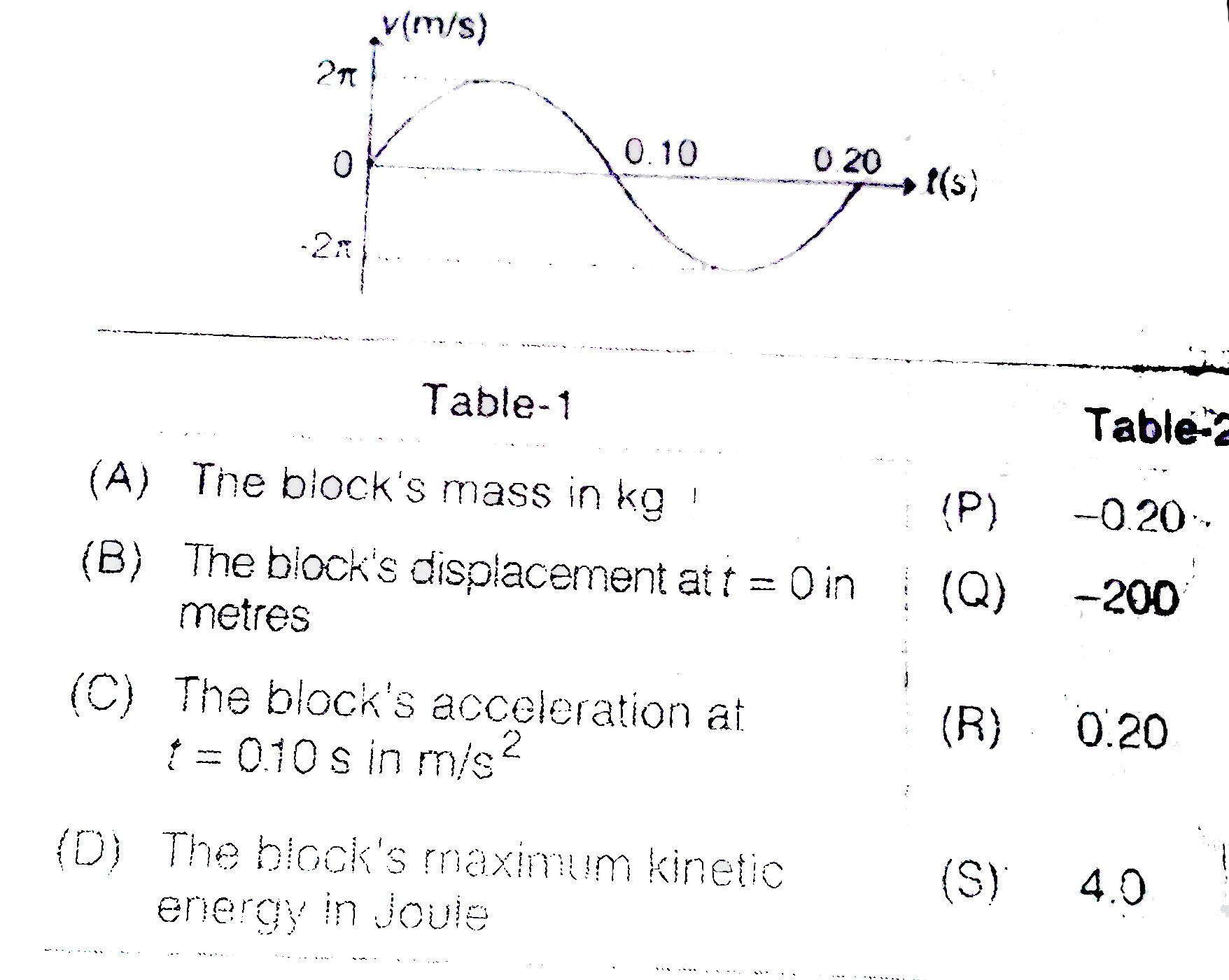
A simple harmonic oscillator consists of a block attached to a spring with k=200N/m. The block slides on a frictionless horizontal surface, with equilibrium point x=0. A graph of the block velocity v as a function of time t is shown. Correct match the required information in the left column with the values given in table.

Text Solution

Verified by Experts

The correct Answer is:

A, B, C, D
Promotional Banner

Topper's Solved these Questions

  • SIMPLE HARMONIC MOTION

    DC PANDEY ENGLISH|Exercise Integer type questions|14 Videos
  • SIMPLE HARMONIC MOTION

    DC PANDEY ENGLISH|Exercise Comprehension types|18 Videos
  • SEMICONDUCTORS AND ELECTRONIC DEVICES

    DC PANDEY ENGLISH|Exercise More than One Option is Correct|3 Videos
  • SOLVD PAPERS 2017 NEET, AIIMS & JIPMER

    DC PANDEY ENGLISH|Exercise Solved paper 2018(JIPMER)|38 Videos

Similar Questions

Explore conceptually related problems

A block performs simple harmonic motion with equilibrium point x = 0 . Graph of acceleration of the block as a function of time is shown. Which of the following statement is correct about the block ?

A 4.00 kg block carrying a charge Q = 50.0muC is connected to a spring for which k = 100 N/ m. The block lies on a frictionless horizontal track, and the system is immersed in a uniform electric field of magnitude E = 5.00 xx 10^5 V/m , directed as shown in figure. If the block is released from rest when the spring is unstretched (at x = 0). (a) By what maximum amount does the spring expand? (b) What is the equilibrium position of the block? (c) Show that the block's motion is simple harmonic and determine its period. (d) Repeat part (a) if the coefficient of kinetic friction between block and surface is 0.2.

A block of mass 2.0 kg is moving on a frictionless horizontal surface with a velocity of 1.0 m/s figure towards another block of equal mass kept at rest. The spring constant of the spring fixed at one end is 100 N/m. Find the maximum compression of the spring.

Two blocks of masses m_1 =1kg and m_2 = 2kg are connected by a spring of spring constant k = 24 N/m and placed on a frictionless horizontal surface. The block m_(1) is imparted an initial velocity v_(0) = 12cm/s to the right. The amplitude of oscillation is

A block of mass m is connected to a spring of spring constant k as shown in Fig. The block is found at its equilibrium position t=1s and it has a velocity of +0.25(m)/(s) at t=2s . The time period of oscillation is 6 s. Based on the given information answer the following question: Q. the amplitude of oscillation is

Two blocks of equal mass m are connected by an unstretched spring and the system is kept at rest on a frictionless horizontal surface. A constant force F is applied on the first block pulling away from the other as shown in Fig. If the extension of the spring is x_(0) at time t , then the displacement of the first block at this instant is

Two blocks of equal mass m are connected by an unstretched spring and the system is kept at rest on a frictionless horizontal surface. A constant force F is applied on the first block pulling away from the other as shown in Fig. If the extension of the spring is x_(0) at time t , then the displacement of the first block at this instant is

A block of mass m is connected to a spring of spring constant k as shown in Fig. The block is found at its equilibrium position t=1s and it has a velocity of +0.25(m)/(s) at t=2s . The time period of oscillation is 6 s. Based on the given information answer the following question: Q. Determine the velocity of particle at t=5s .

A block of mass 100 g attached to a spring of stiffness 100 N//m is lying on a frictionless floor as shown. The block is moved to compress the spring by 10 cm and released. If the collision with the wall is elastic then find the time period of oscillations.

A block of mass 0.1 kg is attached to a cord passing through a hole in a horizontal frictionless horizontal surface as shown in the figure. The block is originally revolving at a distance of 0.4 m from the hole, with an angular velocity of "2 rad s"^(-1) . The cord is then pulled from below, shortening the radius of the circle in which the block revolves to 0.2 m. Considering the block to be point mass, calculate the new angular velocity ("in rad s"^(-1))
