Home
Class 12
PHYSICS
q(1),q(2),q(3) and q(4) are point charge...

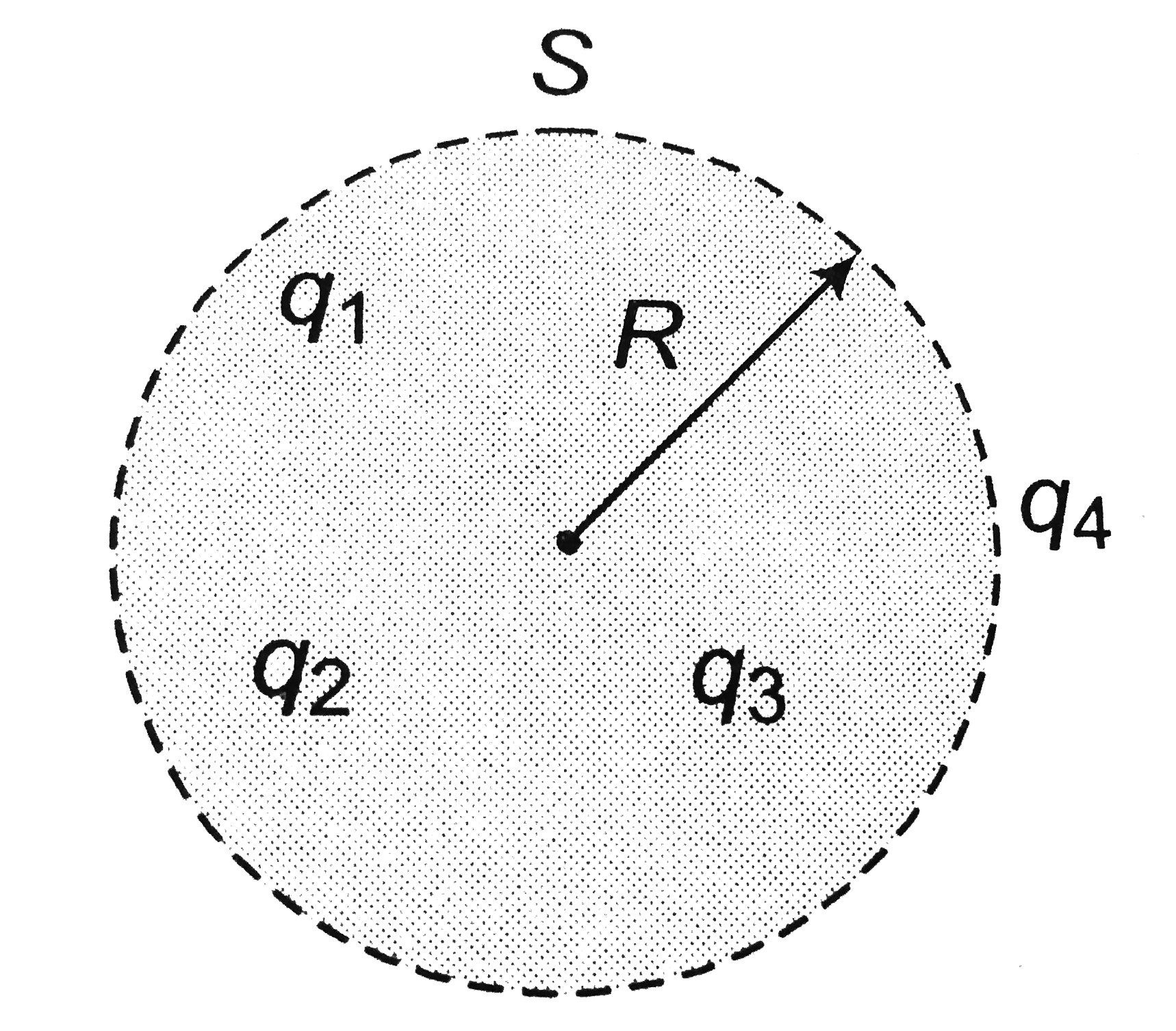
`q_(1),q_(2),q_(3)` and `q_(4)` are point charges located at point as shown in the figure and `s` is a spherical Gaussian surface of radius `R`. Which of the following is true according to the Gauss's law

A

`underset(s)oint (E_(1) + E_(2) + E_(3)) .dA = (q_(1) + q_(2) + q_(3))/(2 epsi_(0))`

B

`underset(S)oint (E_(1) + E_(2) + E_(3)).dA = ((q_(1) + q_(2) + q_(3)))/(epsi_(0))`

C

`underset(S)oint (E_(1) + E_(2) + E_(3)).dA = ((q_(1) + q_(2) + q_(3) + q_(4)))/(epsi_(0))`

D

None of the above

Text Solution

Verified by Experts

The correct Answer is:

D
Promotional Banner

Topper's Solved these Questions

  • ELECTROSTATICS

    DC PANDEY ENGLISH|Exercise Taking it together|105 Videos
  • ELECTROSTATICS

    DC PANDEY ENGLISH|Exercise Assertion and Reason|15 Videos
  • ELECTROSTATICS

    DC PANDEY ENGLISH|Exercise Check point 1.4|10 Videos
  • ELECTROSTATIC POTENTIAL AND CAPACITORS

    DC PANDEY ENGLISH|Exercise (C) Chapter exercises|50 Videos
  • GRAVITATION

    DC PANDEY ENGLISH|Exercise All Questions|135 Videos

Similar Questions

Explore conceptually related problems

A point charge +Q is place just outside an imaginary hemispherical surface of radius R as shown in the figure. Which of the following statements is/are correct ?

five charge q_(1),q_(2),q_(3),q_(4) and q_(5) are fixed at their positions as shown in figure . s is Gaussian surface .The Gauss's law is given by ointvec(E).vec(ds)=(q)/(epsilon_(0)) Which of the following statement is correct?

Refer to the arrangement of charges in Fig and a Gaussian surface of radius R with Q at the centre. Then

Five charges q_(1),q_(2),q_(3),q_(4)andq_(5) are fixed at their positions as shown in figure. S is Gaussian surface. The Gauss's law is given by ointundersetSvecE*vec(ds)=q/epsilon_(0) . Which of the following statements is correct?

A charge Q is enclosed by a Gaussian spherical surface of radius R . If the radius is doubled, then the outward electric flux will

Consider Gauss's law oint vecE * vecd s = q/epsilon_0 Then, for the situation shown in figure at the Gaussian surface

Three charges -q_(1), +q_(2) and -q_(3) are placed as shown in the figure. The x -component of the force on -q_(1) is proportional to

A solid insulating sphere of radius a carries a net positive charge 3Q , uniformly distributed throughout its volume. Concentric with this sphere is a conducting spherical shell with inner radius b and outer radius c and having a net charge -Q, as shown in figure a. Consider a spherical Gaussian surface of radius rgtc, the net charge enclosed by this surface is ............. b. The direction of the electric field rgtc is ............. c. The electric field at rgtc is ............... . d. The electric field in the region with radius r, which cgtrgtb, is ............... e. Consider a spherical Gaussian surface of radius r, where cgtrgtb , the net charge enclosed by this surface is ................ . f. Consider a spherical Gaussian surface of radius r, where bgtrgta , the net charge enclosed by this surface is ................. . g. The electric field in the region bgtrgta is ................ . h. Consider a spherical Gaussian surface of radius rlta . Find an expression for the net charge Q(r) enclosed by this surface as a function of r. Note that the charge inside the surface is less than 3Q. i. The electric field in the region rlta is ................. . j. The charge on the inner surface of the conducting shell is .......... . k. The charge on the outer surface of the conducting shell is .............. . l. Make a plot of the magnitude of the electric field versus r.

Gauss's law and Coulomb's law , although expressed in different forms , are equivalent ways of describing the relation between charge and electric field in static conditions . Gauss's law is epsilon_(0) phi = q_(encl) ,when q(encl) is the net charge inside an imaginary closed surface called Gaussian surface. The two equations hold only when the net charge is in vaccum or air . If the charge q_(3) and q_(4) are displaced (always remaining outside the Gaussian surface), then consider the following two statements : A : Electric field at each point on the Gaussian surface will remain same . B : The value of oint vec(E ) .d vec(A) for the Gaussian surface will remain same.

Consider a Gaussian spherical surface covering a dipole of charge q and -q, then

DC PANDEY ENGLISH-ELECTROSTATICS-Check point 1.5
  1. The law goverening electrostatics is coulomb's law.In priciple coulomb...

    Text Solution

    |

  2. A surface element vec(ds) = 5 hat(i) is placed in an electric field v...

    Text Solution

    |

  3. A cube of side a is placed in a uniform electric field E = E(0) hat(i)...

    Text Solution

    |

  4. Flux coming out from a positive unit charge placed in air, is

    Text Solution

    |

  5. If the electric flux entering and leaving an enclosed surface respecti...

    Text Solution

    |

  6. Charge of 2 C is placed at the centre of a cube. What is the electric ...

    Text Solution

    |

  7. For a given surface the Gauss's law is stated asoint vecE.dvecA=0. Fro...

    Text Solution

    |

  8. The total electric flux emanating from a closed surface enclosing an a...

    Text Solution

    |

  9. The inward and outward electric flux for a closed surface unit of N-m^...

    Text Solution

    |

  10. If the flux of the electric field through a closed surface is zero,

    Text Solution

    |

  11. Consider the charge configuration and a spherical Gaussian surface as ...

    Text Solution

    |

  12. q(1),q(2),q(3) and q(4) are point charges located at point as shown in...

    Text Solution

    |

  13. The Gaussian surface for calculating the electric field due to a charg...

    Text Solution

    |

  14. If Coulomb's law involved 1/r^3 instead of 1/r^2, would Gauss's law st...

    Text Solution

    |

  15. Two parallel infinite line charges with linear charge densities +lambd...

    Text Solution

    |

  16. An infinite line charge produces a field of 9xx10^(4) N/C at a distanc...

    Text Solution

    |

  17. A charge of 17.7 xx 10^(-4)C is distributed uniformly over a large she...

    Text Solution

    |

  18. From what distance should a 100 eV electron be fired towards a large m...

    Text Solution

    |

  19. If the field near the earth's surface is 300V m^(-1) directed downward...

    Text Solution

    |

  20. A thin spherical shell of metal has a radius of 0.25 m and carries a c...

    Text Solution

    |
