Home
Class 12
PHYSICS
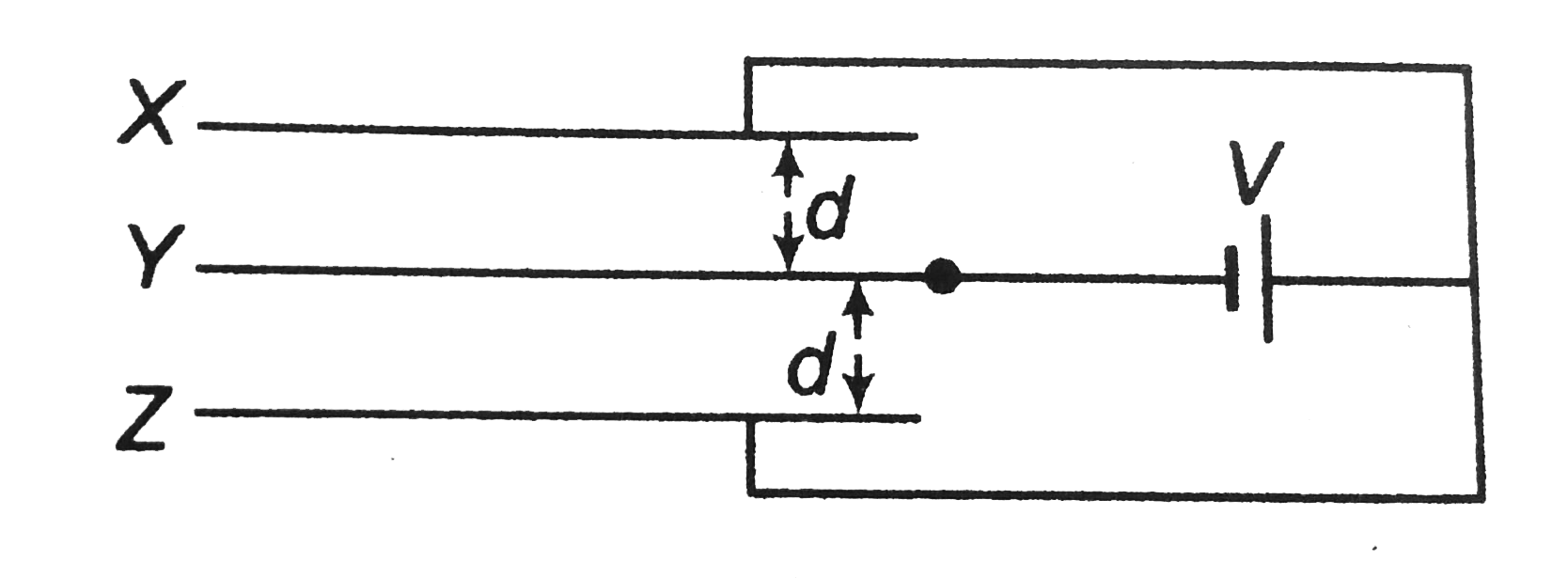
Consider the arrangement of three plates...

Consider the arrangement of three plates `X,Y` and `Z` each of the area `A` and separatioin `d`. The energy sotred when the plates are fully charged is

A

`(epsilon_(0)AV^(2))/(2d)`

B

`(epsilon_(0)AV^(2))/(d)`

C

`(2 epsilon_(0)AV^(2))/(d)`

D

`(3 epsilon_(0)AV^(2))/(2d)`

Text Solution

Verified by Experts

The correct Answer is:

B
Promotional Banner

Topper's Solved these Questions

  • ELECTROSTATIC POTENTIAL AND CAPACITORS

    DC PANDEY ENGLISH|Exercise (B) Chapter exercises|17 Videos
  • ELECTROSTATIC POTENTIAL AND CAPACITORS

    DC PANDEY ENGLISH|Exercise (C) Chapter exercises|50 Videos
  • ELECTROSTATIC POTENTIAL AND CAPACITORS

    DC PANDEY ENGLISH|Exercise Check point 2.5|20 Videos
  • ELECTROMAGNETIC WAVES

    DC PANDEY ENGLISH|Exercise Sec C|22 Videos
  • ELECTROSTATICS

    DC PANDEY ENGLISH|Exercise Medical entrances gallery|37 Videos

Similar Questions

Explore conceptually related problems

Consider the arrangement of three plates X,Y and Z each of the area A and separation d . Find the energy stored when the plates are fully charged.

Three plates A, B, C each of area 50 cm^(2) have separation 3 mm between A and 3 mm between B and C . The energy stored when the plates area fully charged is

A capacitor, made of two parallel plates each of plate area A and separation d, is being charged by an external ac socurce. Show that the displacement current inside the same as the current charging the capacitor.

A capacitor, made of two parallel plates each of plate area A and separation d, is being charged by an external ac socurce. Show that the displacement current inside the same as the current charging the capacitor.

Find the charge on each plate given area of each plate is A and separation between two consecutive plates is d.

In a parallel-plate capacitor of plate area A , plate separation d and charge Q the force of attraction between the plates is F .

Consider the arrangement of parallel plates of the previous problem. If 1.0 nC charge is given to the upper plate instead of the middle, what will be the potential difference (in V) between (a) the upper and the middle plates and (b) the middle and the lower plates ? If Capacitance of each plate is 50 nF .

The diagram shows an arrangement of identical metal plates placed parallel to each other and the variation of potential between the paltes by dotted lilne. Using the details given in diagram, the equivalent capacitance connected across the plate No. 2 and plate No. 4 is (Separation between the consecutive plates =L , area of each plate =A )

Consider a parallel plate capacitor is charged by a constant current I, with plate area A and separation between the plates d. Consider a plane surface of area A//4 parallel to the plates and drawn symmetrically between the plates. Find the displacement current through this area.

A parallel plate vacuum capacitor eith plate area A and separation x has charges +Q and -Q on its plates. The capacitor is disconnected from the source of charge, so the charge on each plate remains fixed. a. What is the total energy stored in the capacitor? b. The plates are pulled apart an additional distance each case. c. If F is the force with which the plates attract each other, the change in the stored energy must equal the work dW =F dx done in pulling the plates apart. Find an expression for F d. Energy storage in a capacitor can be limited by the maximum electric field between the plates. What is the ratio of the electric field for the series for parallel combinations?

DC PANDEY ENGLISH-ELECTROSTATIC POTENTIAL AND CAPACITORS-(A) Chapter exercises
  1. Two condensers, one of capacity C and the other of capacity C//2 are c...

    Text Solution

    |

  2. In the circuit shown here C(1) = 6muF, C2 = 3muF and battery B = 20V. ...

    Text Solution

    |

  3. Consider the arrangement of three plates X,Y and Z each of the area A ...

    Text Solution

    |

  4. A light bulb, a capacitor and a battery are connected together as show...

    Text Solution

    |

  5. Point charges +4q, -q and +4q are kept on the x-axis at points x=0,x=a...

    Text Solution

    |

  6. Two spherical conductors of radii 4 cm and 5 cm are charged to the sam...

    Text Solution

    |

  7. A hollow charged metal sphere has radius r. If the potential differenc...

    Text Solution

    |

  8. Charge Q on a capacitor varies with voltage V as shown in the figure, ...

    Text Solution

    |

  9. How many 1muF capacitors must be connected in parallel to store a char...

    Text Solution

    |

  10. In the figure below, the capacitance of each capacitor is 3 muF. The e...

    Text Solution

    |

  11. The 500 muF capacitor is charged at a steady rate of 100 mu C//s. The ...

    Text Solution

    |

  12. A ball of mass 1g and charge 10^(-8) C moves from a point A. Where pot...

    Text Solution

    |

  13. In the circuit shown in the figure, the potential difference across th...

    Text Solution

    |

  14. Three capacitors of capacitances 1muF,2muF and 4muF are connected firs...

    Text Solution

    |

  15. An electron moving with the speed 5xx10^(6) per sec is shot parallel t...

    Text Solution

    |

  16. The electirc potential at a point (x, y, z) is given by V = -x^(2)y ...

    Text Solution

    |

  17. Three charges -q,+Q and -q are placed in a straight line as shown ...

    Text Solution

    |

  18. The mutual electrostatic potential energy between two protons which ar...

    Text Solution

    |

  19. Three capacitor of capacitance C(mu F) are connected in parallel to wh...

    Text Solution

    |

  20. Figure shows some equipotential lines distributed in space. A charge...

    Text Solution

    |
