Home
Class 12
PHYSICS
The temperature (T) dependence of resist...

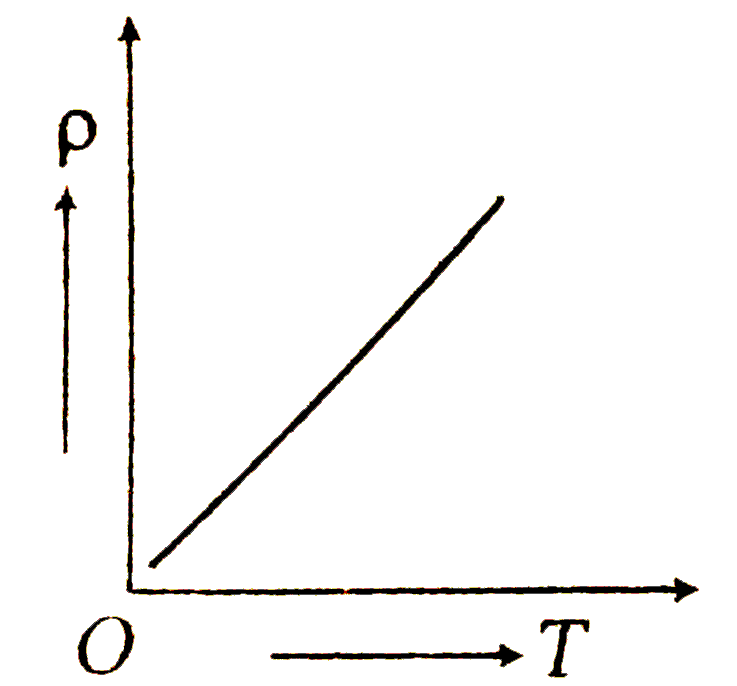
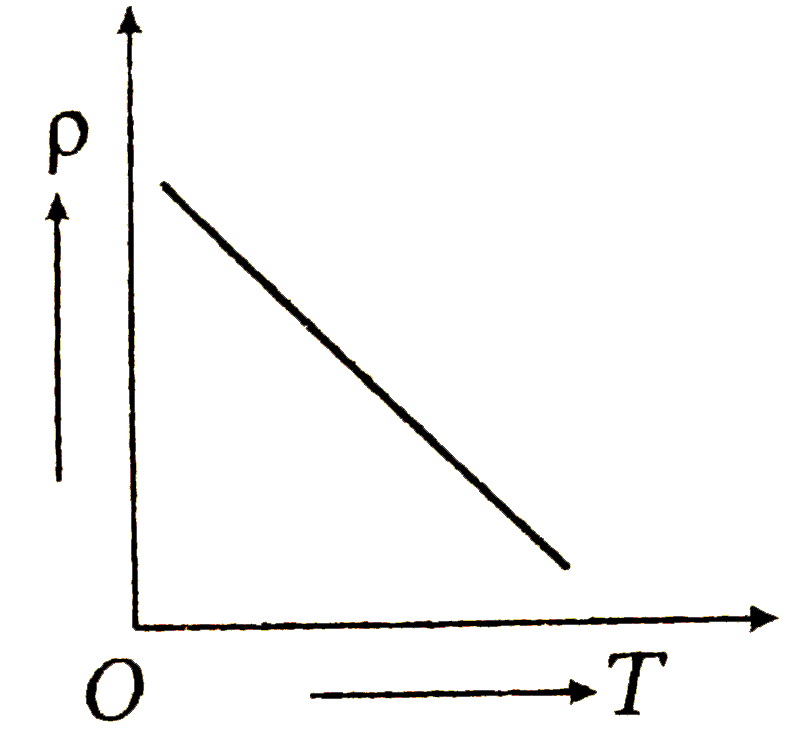
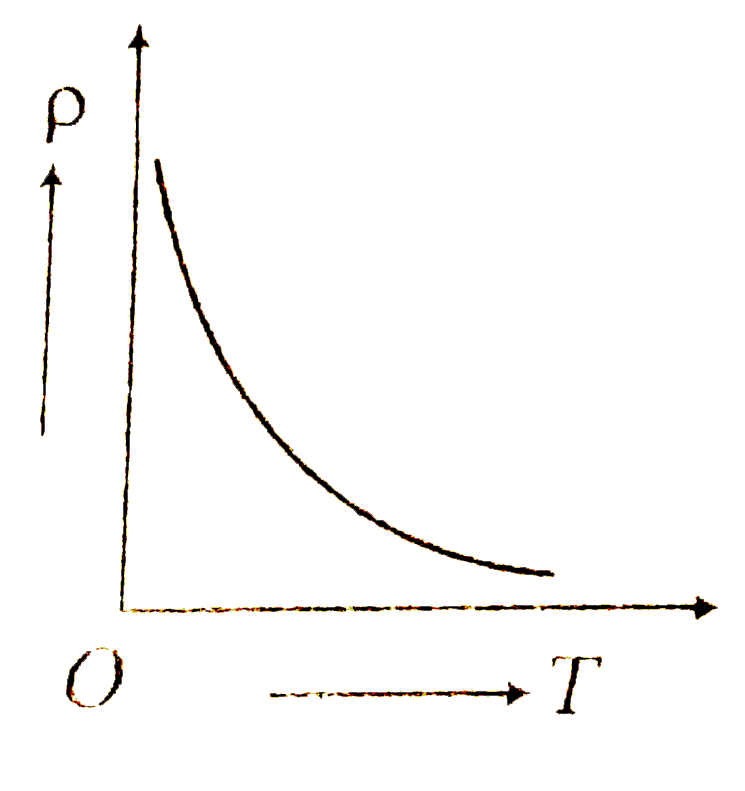
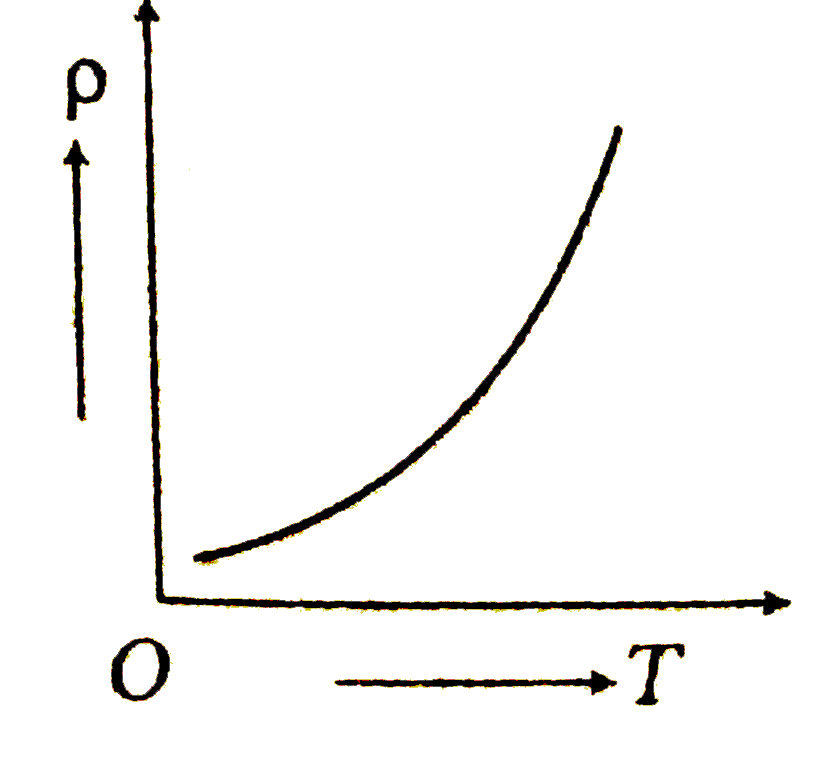
The temperature (T) dependence of resistivity (rho) of a semiconductor is represented by :

A

B

C

D

Text Solution

AI Generated Solution

The correct Answer is:

To understand the temperature dependence of resistivity (\(\rho\)) of a semiconductor, we can break down the problem step by step. ### Step-by-Step Solution: 1. **Understanding Resistivity and Temperature**: The resistivity of a semiconductor changes with temperature. The relationship can be expressed as: \[ \Delta \rho = \rho_0 \alpha \Delta T \] where: - \(\Delta \rho\) is the change in resistivity, - \(\rho_0\) is the initial resistivity, - \(\alpha\) is the temperature coefficient of resistivity, - \(\Delta T\) is the change in temperature. 2. **Expressing the Change in Resistivity**: We can express the change in resistivity in terms of initial and final temperatures: \[ \Delta \rho = \rho(T) - \rho_0 = \rho_0 \alpha (T - T_0) \] Rearranging gives: \[ \rho(T) = \rho_0 + \rho_0 \alpha (T - T_0) \] 3. **Identifying the Linear Relationship**: The equation can be rewritten as: \[ \rho(T) = \rho_0(1 + \alpha (T - T_0)) \] This shows that resistivity is a linear function of temperature, where: - The slope of the line is \(\rho_0 \alpha\), - The y-intercept is \(\rho_0\). 4. **Sign of the Temperature Coefficient**: For semiconductors, the temperature coefficient \(\alpha\) is typically negative. This means that as the temperature increases, the resistivity decreases, leading to a negative slope in the graph of resistivity versus temperature. 5. **Graphical Representation**: Since \(\alpha\) is negative, the graph of \(\rho\) versus \(T\) will have a negative slope. This indicates that the resistivity decreases with an increase in temperature. 6. **Conclusion**: Based on the analysis, the correct representation of the temperature dependence of resistivity for a semiconductor will show a downward slope in the graph. ### Final Answer: The correct option for the temperature dependence of resistivity of a semiconductor is the one that shows a negative slope.
Promotional Banner

Topper's Solved these Questions

  • CURRENT ELECTRICITY

    DC PANDEY ENGLISH|Exercise B. Assertion and reason|18 Videos
  • CURRENT ELECTRICITY

    DC PANDEY ENGLISH|Exercise Match the columns|4 Videos
  • CURRENT ELECTRICITY

    DC PANDEY ENGLISH|Exercise Check point|70 Videos
  • COMMUNICATION SYSTEM

    DC PANDEY ENGLISH|Exercise Subjective|11 Videos
  • ELECTROMAGNETIC INDUCTION

    DC PANDEY ENGLISH|Exercise Medical entrances gallery|25 Videos

Similar Questions

Explore conceptually related problems

Resistivity of a semiconductor depends on

Temperature dependence of resistivity p(T) of semiconductors, insulators and metals is significantly based on the following factors:

The electrical resistivity of a semiconductor :

The conductivity of a semiconductor depends upon

The temperature dependence of resistance of Cu and undoped Si in the temperature range 300 -400 K, is best described by :

State the order of specific resistance of a semiconductor

Temperature dependence of drift velocity depends on the following factors.

By increasing the temperature , the specific resistance of a conductor and a semiconductor

How does an increase in the temperature affect the specific resistance of a : Semiconductor ?

How does the conductivity of a semiconductor change if its temperature is raised ?

DC PANDEY ENGLISH-CURRENT ELECTRICITY-Taking it together
  1. The maximum power dissipated in an external resistance R, when connect...

    Text Solution

    |

  2. The resistance across A and B in the figure below will be

    Text Solution

    |

  3. The temperature (T) dependence of resistivity (rho) of a semiconductor...

    Text Solution

    |

  4. The current (I) and voltage (V) graphs for a given metallic wire at tw...

    Text Solution

    |

  5. Which of the follwing characteristies of electrons determines the curr...

    Text Solution

    |

  6. An ammeter and a voltmeter of resistance R connected in seires to an e...

    Text Solution

    |

  7. The resistance of a wire is 10 Omega. Its length is increased by 10% b...

    Text Solution

    |

  8. Four resistances are connected in a circuit in the given figure. The e...

    Text Solution

    |

  9. Current through the 5Omega resistor is

    Text Solution

    |

  10. A cell which has an emf 1.5 V is connectedin series with an external r...

    Text Solution

    |

  11. A piece of wire of resistance 4 ohm s is bent through 180^(@) at its...

    Text Solution

    |

  12. A wire of resistance R is divided in 10 equal parts. These parts are c...

    Text Solution

    |

  13. Three resistors each of 2 ohm are connected together in a triangular s...

    Text Solution

    |

  14. The effective resistance between the points A and B in the figure is

    Text Solution

    |

  15. Two resistances are joined in parallel whose resultant is 6//8 ohm. On...

    Text Solution

    |

  16. A wire of resistanc e9Omega is broken in two parts. The length ratio b...

    Text Solution

    |

  17. In the network shown, the equivalent resistance between A and B is

    Text Solution

    |

  18. In the circuit shown, the currents i(1) and i(2) are

    Text Solution

    |

  19. Consider the following statements regarding the network shown in the f...

    Text Solution

    |

  20. To send 10% of the main current through a moving coil galvanometer of ...

    Text Solution

    |
