Home
Class 11
PHYSICS
Assertion : Two identical spherical ball...

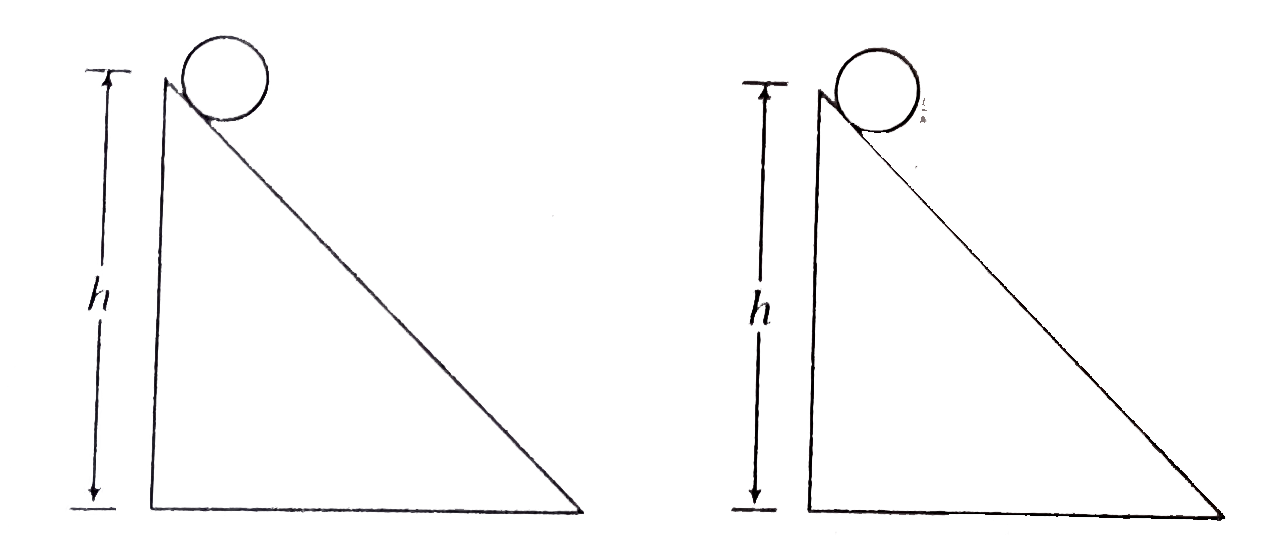
Assertion : Two identical spherical balls are released from two inclined plane. First is sufficiently rough and second is smooth. Both the balls will have same kinetic energy on reaching the bottom

Reason : Linear velocity of second ball will be more.

A

If both Assertion and Reason are correct and Reason is the correct explanation of Assertion

B

If both Assertion and Reason are true but Reason is not the correct explanation of Assertion

C

If Assertion is true but Reason is fasle

D

If Assertion is false but Reason is true

Text Solution

Verified by Experts

The correct Answer is:

B

In first case, work done by friction will be zero. That's why mechanical energy will remain conserved. Further, in second case, linear velocity will be more because this ball has only translation kinetic energy.
Promotional Banner

Topper's Solved these Questions

  • ROTATION

    DC PANDEY ENGLISH|Exercise (C) Chapter Exercises|39 Videos
  • ROTATION

    DC PANDEY ENGLISH|Exercise (A) Chapter Exercises|83 Videos
  • RAY OPTICS

    DC PANDEY ENGLISH|Exercise Integer type q.|14 Videos
  • ROTATIONAL MECHANICS

    DC PANDEY ENGLISH|Exercise Subjective Questions|2 Videos

Similar Questions

Explore conceptually related problems

A small ball is released from rest from point A as shown. if bowl is smooth, than ball will exert more pressure at point B, compared to the situation if bowl is rough. Reason: Linear velocity and hence, centripetal force in smooth situation is more.

In both the figures, all other factors are same, except that in figure (i) AB is sufficiently rough and BC is smooth while in figure (ii) AB is smooth and BC is sufficiently rough. Kinetic energy of the ball on reaching the bottom:

A uniform solid spherical ball is rolling down a smooth inclined plane from a height h. The velocity attained by the ball when it reaches the bottom of the inclined plane is v. If ball when it reaches the bottom of the inclined plane is v. If the ball is now thrown vertically upwards with the same velocity v , the maximum height to which the ball will rise is

A solid ball of mass 'm' is released on a rough fixed inclined plane from height H . The ball will perform pure rolling on the inclined plane. Then

A ball is released from point A. During its motion ball takes two seconds from B to C Find the time taken by ball from A to C. .

A solid spherical ball of mass m is released from the topmost point of the shown semi - spherical shell. The track is sufficiently rough to enablle to enable pure rolling motion. The normal force between the ball and the shell at the lowest position is

A solid spherical ball is rolling without slipping down an inclined plane. The fraction of its total kinetic energy associated with rotation is

Assertion : A solid sphere and a ring of same mass and radius are released simultaneously from the top of an inclined surface. The two objects roll down the plane without slipping. They reach the bottom of the incline with equal linear speeds Reason : Decrease in potential enery for both is the same.

A solid spherical ball is released from rest on an incline of inclination angle theta (which can be varied ) but through a fixed vertical height h . The coefficient of static and kinetic friction are both equal to mu . If E represents the total kinetic energy of the ball at the bottom of the incline as a function of the angle of inclination theta . W represents the work done by friction for the whole time of motion as a function of the angle of inclination theta . Choose of correct graph (s)

A curved suface is shown in figure. The portion BCD is free of friction. There are three spherical balls of identical radii and masses. Balls are released from rest one by one from A which is at a slightly greater height than C. Wioth the surface AB, ball 1 has large enough friction to cause rolling down without slipping, ball 2 has a small friction and ball 3 has a negligible friction. (a) For which ball is total mechanical energy conserved? (b) Which ball(s) can reach D? (c )For ball which do not reach D, which of the balls can reach back A?

DC PANDEY ENGLISH-ROTATION-(B) Chapter Exercises
  1. Assertion : The condition of equilibrium for a rigid body is Transla...

    Text Solution

    |

  2. Assertion : Two axes AB and CD are as shown in figure. Given figure is...

    Text Solution

    |

  3. Assertion : If a particle moves with a constant velocity, then angular...

    Text Solution

    |

  4. Assertion : Two identical solid spheres are rotated frm rest to same a...

    Text Solution

    |

  5. Assertion : A ring and a disc of same mass and radius begin to roll wi...

    Text Solution

    |

  6. Assertion : A sphere is placed in pure rolling condition over a rough ...

    Text Solution

    |

  7. Assertion : In rotational plus translational motion of a rigid body, d...

    Text Solution

    |

  8. Assertion : Angular momentum of sun and planet system about any point ...

    Text Solution

    |

  9. Assertion : Moment of inertia about an axis passing throught centre of...

    Text Solution

    |

  10. Assertion : A solid sphere cannot roll without slipping on smooth hori...

    Text Solution

    |

  11. Assertion : Speed of any point on rigid body executing rolling motion...

    Text Solution

    |

  12. Assertion : A solid sphere and a ring of same mass and radius are rele...

    Text Solution

    |

  13. Assertion : A uniform disc of radius R is performing impure rolling mo...

    Text Solution

    |

  14. Assertion : Two identical spherical balls are released from two inclin...

    Text Solution

    |

  15. Assertion : A solid and a hollow sphere both of equal masses and radii...

    Text Solution

    |

  16. If radius if earth is reduced to half without changing its mass, then ...

    Text Solution

    |

  17. A disc rolls on ground without slipping. Velocity of centre of mass is...

    Text Solution

    |

  18. A solid sphere is rotating about an axis shown in figure. An insect fo...

    Text Solution

    |

  19. Four rods of equal length l and mass m each forms a square as shown in...

    Text Solution

    |

  20. A semi-circular ring has mass m and radius R as shown in figure. Let I...

    Text Solution

    |
