Home
Class 12
PHYSICS
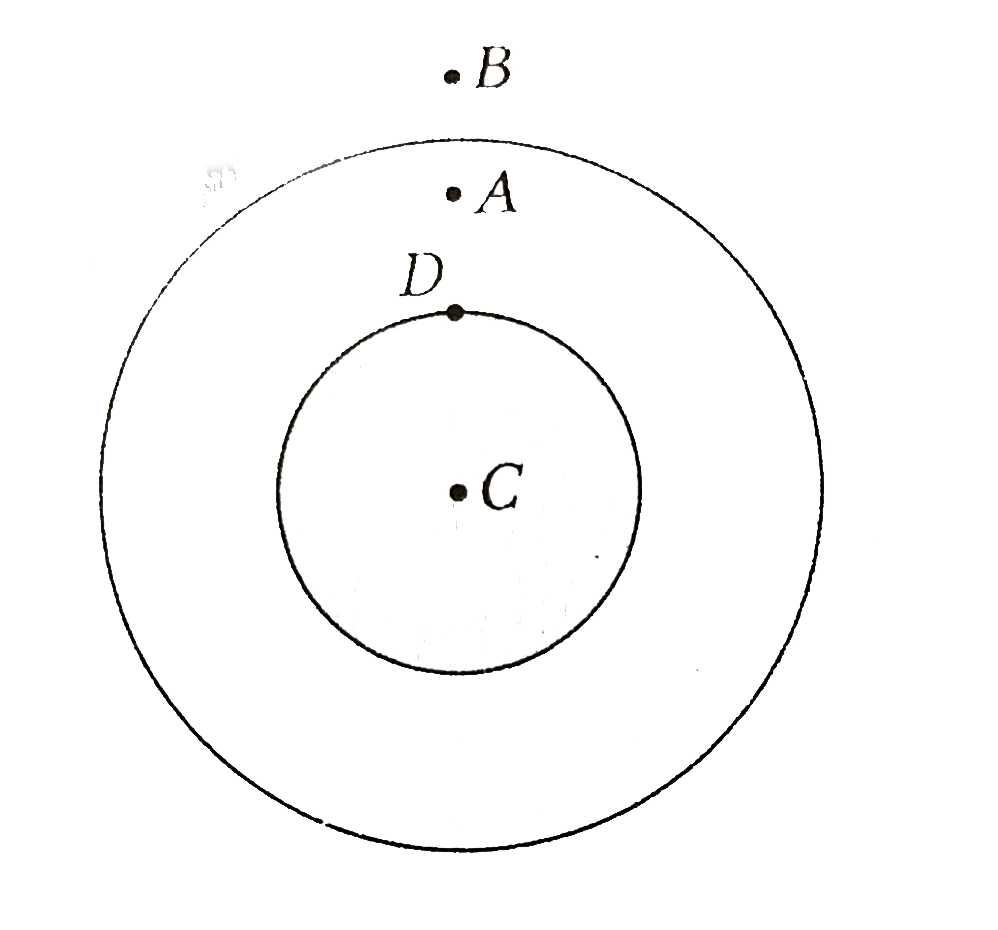
Two concentric spherical shells are as s...

Two concentric spherical shells are as shown in figure. Match the following columns

`{:(,"Column-I",,"Column-II"),("(A)","Potential at A","(p)","greater than B"),("(B)","Gravitational field at A","(q)","less than B"),("(C)","As one moves from C to D","(r)","Potential remains constant"),("(D)","As one moves from D to A","(s)","Gravitational field decreases"),(,,"(t)","None"):}`

Text Solution

Verified by Experts

The correct Answer is:

A, B, C, D
Promotional Banner

Topper's Solved these Questions

  • ELECTROSTATICS

    DC PANDEY ENGLISH|Exercise Medical entrances gallery|37 Videos
  • INTERFERENCE AND DIFFRACTION OF LIGHT

    DC PANDEY ENGLISH|Exercise Level 2 Subjective|5 Videos

Similar Questions

Explore conceptually related problems

If earth decreases its rotational speed. Match the following columns {:(,"Column-I",,"Column-II"),("(A)","Value of g at pole","(p)","Will remain same"),("(B)","Value of g at equator","(q)","Will increase"),("(C)","Distance of geostationary","(r)","Will decrease"),("(D)","Energy of geostationary satellite","(s)","Cannot say"):}

Density of a planet is two times the density of earth. Radius of this planet is half. Match the following (as compared to earth) {:(,"Column-I",,"Column-II"),("(A)","Accleration due to gravity on this planet's surface","(p)","Half"),("(B)","Gravitational potential on the surface","(q)","Same"),("(C)","Gravitational potential at centre","(r)","Two times"),("(D)","Gravitational field strength at centre","(s)","Four times"):}

Let V and E denote the gravitational potential and gravitational field at a point. Then, match the following columns {:(,"Column-I",,"Column-II"),("(A)",E = 0","V = 0,"(p)","At centre of spherical shell"),("(B)",E ne0","V=0,"(q)","At centre of solid sphere"),("(C)",V ne0","E=0,"(r)","At centre of circular ring"),("(D)",V ne0","E ne0,"(s)","At cetre of two point masses of equal magnitude"),(,,"(t)","None"):}

In elliptical orbit of a planet, as the planet moves from apogee position to perigee position to perigee position, match the following columns {:(,"Column-I",,"Column-II"),("(A)","Speed of planet","(p)","Remains same"),("(B)","Distance of planet from centre of sun","(q)","Decreases"),("(C)","Potential energy","(r)","Increase"),("(D)","Angular momentum about centre of sun","(s)","Cannot say"):}

Match the Column-I with Column-II : {:(,"Column-I",,"Column-II"),("(a)","Mole fraction","(p)","mol kg"^(-1)),("(b)","Molality","(q)","Depends on temperature"),("(c)","Molarity","(r)","Unitless"),("(d)","Normality","(s)","Independent of temperature"):}

Match the following : {:(,"Column -I",,"Column -II"),((A),"Acceleration due to gravity",(p),"Kepler's law"),((B),"Law of periods",(q),"Vector quantity"),((C ),"Orbital speed",(r ),"Uniform near earth surface"),((D),"Gravitational potential",(s),"Is nearly zero at infinity"):}

Match the following {:(,"Column-I",,"Column-II"),((A),"Enthalpy",(p),"Extensive property"),((B),"Entropy",(q),"H - TS"),((C),"Free energy",(r),"E + PV"),((D),"Pressure",(s),"Intensive property"):}

{:(,"Column I",,"Column II"),((A),"Dimensional variable",(p),pi),((B),"Dimensionless variable",(q),"Force"),((C),"Dimensional constant",(r),"Angle"),((D),"Dimensionless constant",(s),"Gravitational constant"):}

On the surface of earth acceleration due gravity is g and gravitational potential is V. Match of following columns {:(,"Column-I",,"Column-II"),("(A)","At height h=R, value of g","(p)","Decreases by a factor" (1)/(4)),("(B)","At depth " h =(R)/(2)"," "value of g","(q)","Decrease by a factor" (1)/(2)),("(C)","At height "h=R",""value of V","(r)","Increase by a factor" (11)/(8)),("(D)","At height "h=(R)/(2)"," "value of V","(s)","Increase by a factor 2"),(,,"(t)","None"):}

Match the following columns. (for a satellite in circular orbit) {:(,"Column-I",,"Column-II"),("(A)","Kinetic energy","(p)",-(GMm)/(2r)),("(B)","Potential energy","(q)",sqrt((GM)/(r))),("(C)","Total energy","(r)",-(GMm)/(r)),("(D)","Orbital speed","(s)",(GMm)/(2r)):}

DC PANDEY ENGLISH-GRAVITATION-All Questions
  1. A particle is projected from the surface of earth of mass M and radius...

    Text Solution

    |

  2. In elliptical orbit of a planet, as the planet moves from apogee posit...

    Text Solution

    |

  3. Match the following

    Text Solution

    |

  4. Let V and E denote the gravitational potential and gravitational field...

    Text Solution

    |

  5. Two concentric spherical shells are as shown in figure. Match the foll...

    Text Solution

    |

  6. Match the following

    Text Solution

    |

  7. Match the following

    Text Solution

    |

  8. If earth decreases its rotational speed without changing other factors...

    Text Solution

    |

  9. Match the following columns. (for a satellite in circular orbit) {:(...

    Text Solution

    |

  10. The orbital angular momentum of a satellite revolving at a distance r ...

    Text Solution

    |

  11. The diameters of two planets are in the ratio 4:1 and their mean densi...

    Text Solution

    |

  12. A mass is taken to a height R from the surface of earth and then is gi...

    Text Solution

    |

  13. The density of the core of a planet is x and that of outer shell is y....

    Text Solution

    |

  14. Energy required to launch a satellite of mass m from earth's surface i...

    Text Solution

    |

  15. A body is projected vertically upwards from the surface of earth with ...

    Text Solution

    |

  16. Pertaining to two planets, the ratio of escape velocities from respect...

    Text Solution

    |

  17. Two particles of equal masses m go round a circle of radius R under th...

    Text Solution

    |

  18. Energy of a satellite in circular orbit is E(0). The energy required ...

    Text Solution

    |

  19. An artificial satellite is moving in a circular orbit around the earth...

    Text Solution

    |

  20. A solid sphere of radius R and mass density rho is surrounded by anoth...

    Text Solution

    |
