Home
Class 12
PHYSICS
AB and CD are fixed conducting smooth ra...

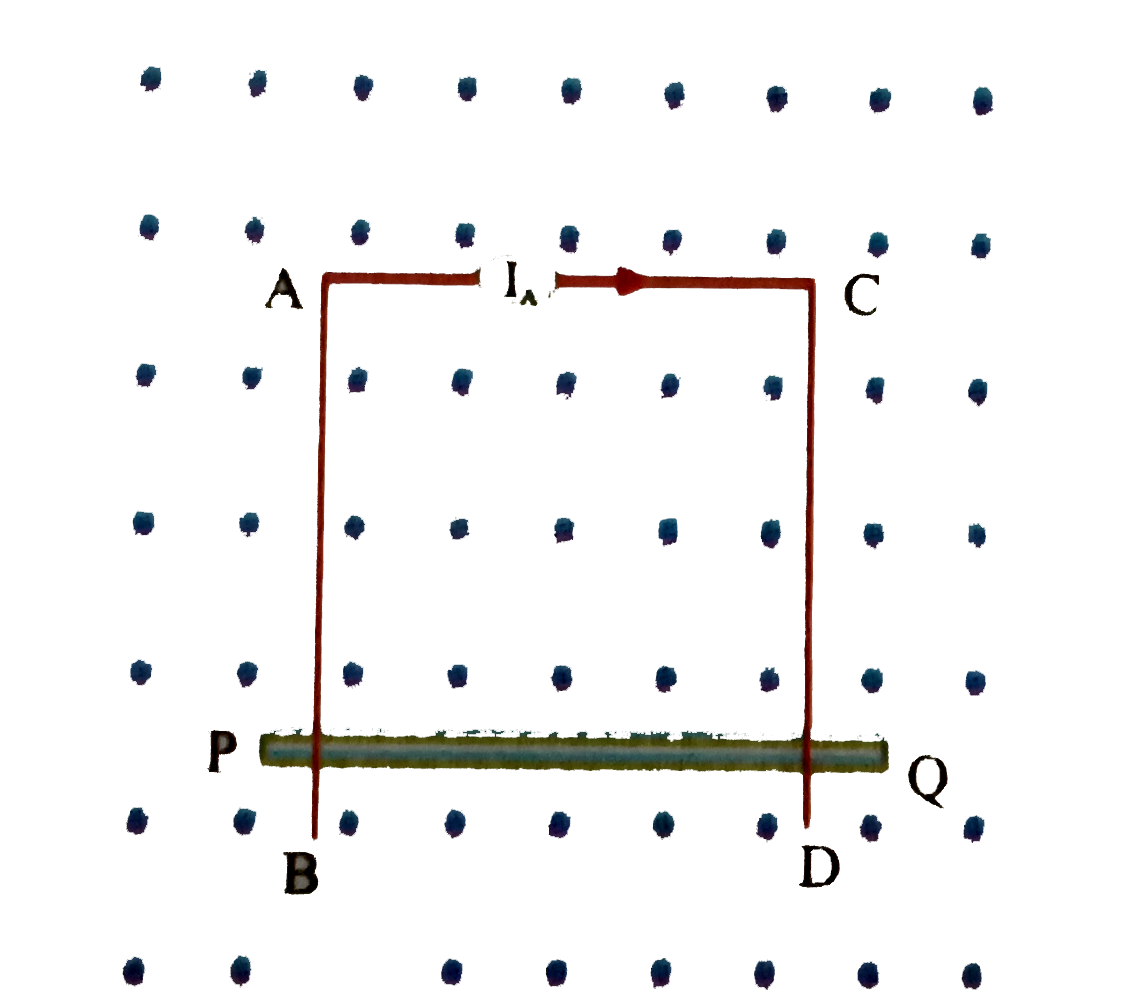
`AB` and `CD` are fixed conducting smooth rails placed in a vertical plane and joined by a constant current source at its upper end. `PQ` is a conducting rod which is free to slide on the rails. A horizontal uniform magnetic field exists in space as shown in figure. If the rod `PQ` is released from rest then,

A

The rod PQ may move downward with ocnstant acceleration

B

The rod PQ may move upward with constant acceleration

C

The rod wil move downward with decreasing acceleration and finally acquire a constant velocity

D

either a or b

Text Solution

Verified by Experts

The correct Answer is:

D
Promotional Banner

Similar Questions

Explore conceptually related problems

A uniform conducting rod of length I is moving with speed v_0 in a uniform transverse magnetic field B_0 as shown in figure. The emf developed across the two ends of the rod will be

A metal rod moves at a constant velocity in a direction perpendicular to its length. A constant, uniform magnetic field exists in space in a direction perpendicular to the rod as well as its velocity. Select the correct statements(s) from the following

Two long parallel horizontal rails a, a distance d aprt and each having a risistance lambda per unit length are joing at one end by a resistance R. A perfectly conduction rod MN of mass m is free to slide along the rails without friction (see figure). There is a uniform magnetic field of induction B normal to the plane of the paper and directed into the paper. A variable force F is applied to the rod MN such that, as the rod moves a constant current flows through R. (i) Find the velocity of the rod and the applied force F as function of the distance x of the rod from R. (ii) What fraction of the work done per second by F is converted into heat?

A conducting bar is pulled with a constant speed v on a smooth conducting rail. The region has a steady magnetic field of induction B as shown in the figure. If the speed of the bar is doubled then the rate of heat dissipation will

Statement I: A resistance R is connected between the two ends of the parallel smooth conducting rails. A conducting rod lies on these fixed horizontal rails and a uniform constant magnetic field B exists perpendicular to the plane of the rails as shown in Fig. if the rod is given a velocity upsilon and released as shown in Fig. 3.188, it will stop after some time. the total work done by magnetic field negative. Statement II: If force acts opposite to direction of velocity its work done is negative.

A resistance R is connected between the two ends of the parallel smooth conducting rails.A conducting rod lies on these fixed horizontal rails and a uniform constant magnetic field B exists perpendicular to the plane of the rails as shown in the figure.If the rod is given a velocity v and released as shown in figure, it will stop after some time, which option are correct:

On an inclined plane, two conducting rails are fixed along the line of greatest slope. A conducting rod AB is placed on the radils so that it is horizontal. A vertically upward uniform magnetic field is present in the region. A current i flows through AB from B to A. The mass of AB is m and the coefficient of friction between the rod and rails is mu . Find the minimum and maximum value of B, so that the rod can stay in equilibrium. Assume that mu lt tan theta

Two identical conductors P and Q are placed on two friction less rails R and S in a uniform magnetic field directed into the plane. If P is moved in the direction shown in figure with a constant speed, then rod Q

A wire is bent in the form of a V shape and placed in a horizontal plane.There exists a uniform magnetic field B perpendicular to the plane of the wire. A uniform conducting rod starts sliding over the V shaped wire with a constant speed v as shown in the figure. If the wire no resistance, the current in rod wil

A conductor bar with mass m and length L slides over horizontal rails that are connected to a voltage source. The voltage source maintains a constant current I in the rails and bar, and constant, uniform, vertical magnetic field vecB fills the region between the rails (as shown in Fig.) If the bar has mass m, find the distance d that the bar must move along the rails from rest to attain speed v.
