Home
Class 12
PHYSICS
A conducting rod with resistance r per u...

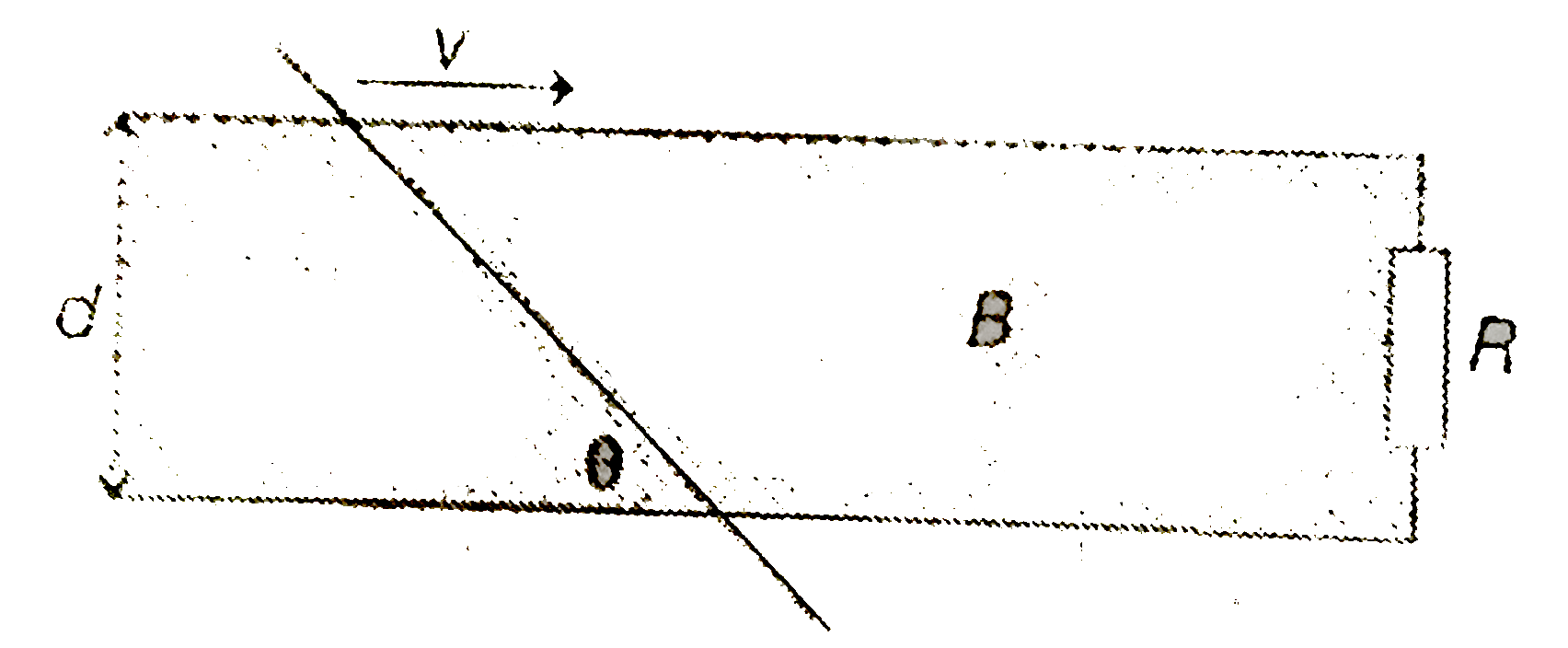
A conducting rod with resistance r per unit length is moving inside a vertical magnetic field B with speed v on two smooth horizontal parallel ideal conducting rails. The end of the rails are connected to a resistor R. the separation between the rails is d. The rod maintains a tilted angle `theta` to the rail. Find the external force F required to keep the rod moving

A

`F=(B^(2)d^(2)v)/(R+dr)`

B

`F=(B^(2)d^(2)v)/((R+dr//sin theta)`

C

`F=(B^(2)d^(2)vsin theta)/((R+dr)//sin theta)`

D

`F=(B^(2)d^(2)vcos theta)/((R+dr)//costheta)`

Text Solution

Verified by Experts

The correct Answer is:

C
Promotional Banner

Similar Questions

Explore conceptually related problems

A conducting rod of length l is moving in a transverse magnetic field of strength B with veocity v. The resistance of the rod is R. The current in the rod is

Two smooth horizontal parallel conducting rails are connected with a capacitor and a resistor at the two ends as shown. A uniform conducting rod PQ of mass 'm' and length 'l' is dragged with a constant horizontal force 'F'. The terminal velocity aquired by the conducting rod is

A conducting rod of resistance r moves uniformly with a constant speed v in a uniform magnetic field. If the rod keeps moving uniformly, then the amount of force required is

A conducting rod of length L=0.1 m is moving with a uniform sped v=0.2m//s on conducting raisli a magnetic field B=0.5T as shown. On one side, the end of the rails is connected to a capacitor of capacitance C=20muF . Then, the charge on the capacitor's plates are

A metal rod of length l cuts across a uniform magnetic field B with a velocity v. If the resistance of the circuit of which the rod forms a part is r, then the force required to move the rod is

A wire of mass m and length I can freely slide on a pair of parallel, smooth, horizontal rails placed in a vertical magnetic field B . The rails are connected by a capacitor of capacitance C. The electric resistance of the rails and the wire is zero. If a constant force F acts on the wire as shown in the figure, find the acceleration of the wire.

A conducting rod of length is moved at constant velocity v_(0) on two parallel, conducting, smooth, fixed rails, that are placed in a uniform constant magnetic field B perpendicular to the plane for the rails as shown in Fig. A resistance R is connected between the two ends of the rails. Then which of the following is/are correct:

A conducting rod of length is moved at constant velocity v_(0) on two parallel, conducting, smooth, fixed rails, that are placed in a uniform constant magnetic field B perpendicular to the plane for the rails as shown in Fig. A resistance R is connected between the two ends of the rails. Then which of the following is/are correct:

A copper rod of mass m slides under gravity on two smooth parallel rails l distance apart set at an angle theta to the horizontal. At the bottom, the rails are joined by a resistance R . There is a uniform magnetic field perpendicular to the plane of the rails. the terminal valocity of the rod is

Two long parallel conducting horizontal rails are connected by a conducting wire at one end. A uniform magnetic field B (directed vertically downwards) exists in the region of space. A light uniform ring of diameter d which is practically equal to separation between the rails is placed over the rails as shown in Fig. If resistance of ring be (lambda) per unit length The force required to pull the ring with uniform velocity v is
