Home
Class 12
PHYSICS
A capacitor of capacitnace C is charged ...

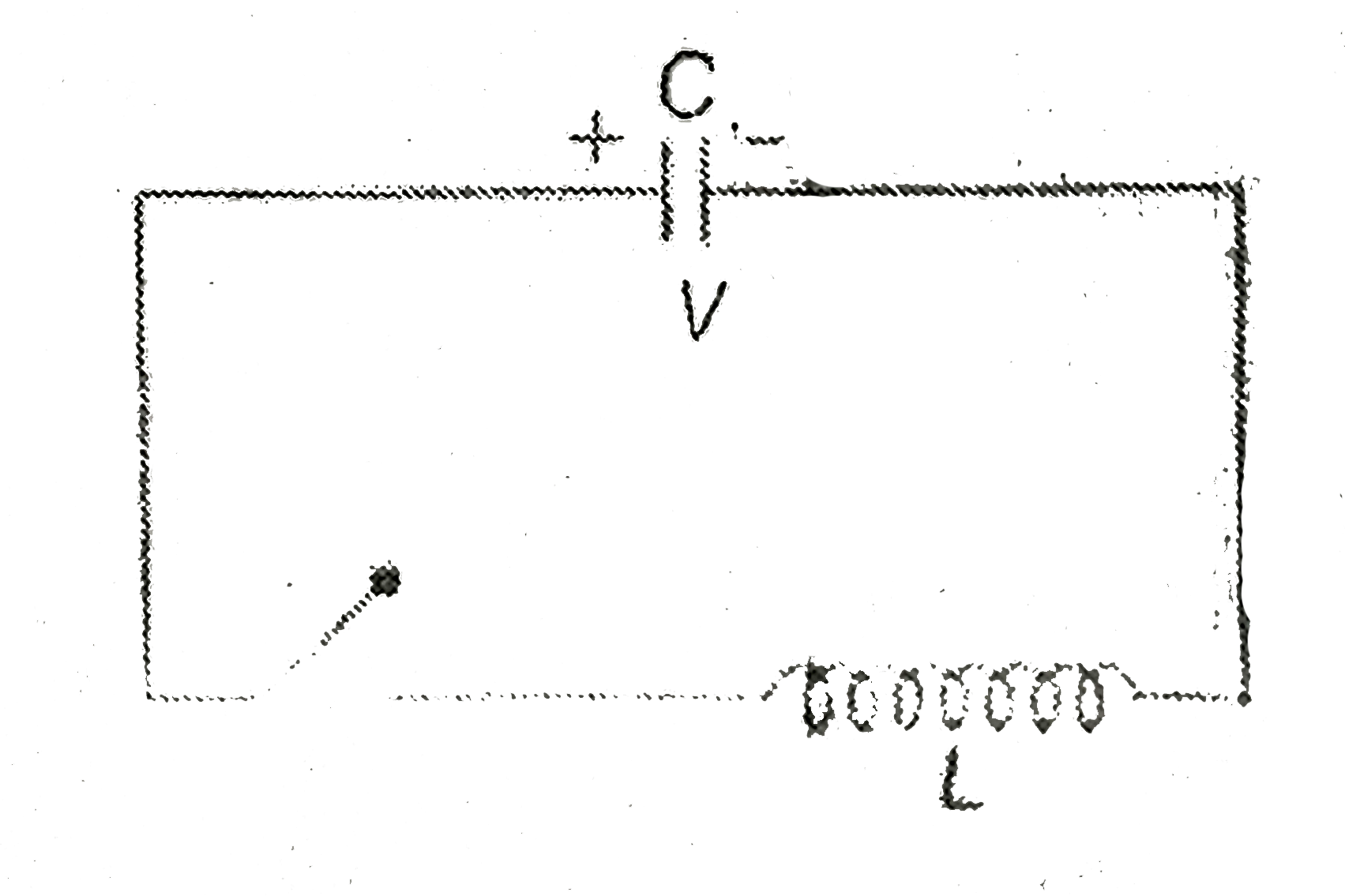
A capacitor of capacitnace C is charged to a potential difference V and then disconnected from the battery. Now it is connected to an inductor of inductance L at t=0. Then

A

Energy stored in capacitor and inductor will be equal at time `t=(pi)/(2)sqrtLC`

B

Potential difference across inductor will be `(V)/(2)` at time `t=(pi)/(3)sqrtLC`

C

The rate of increase of energy in magnetic field will be maximum at `(pi)/(4)sqrtLC`

D

When the potentail difference across the capacitor `sqrt(((3C)/(L)))`

Text Solution

Verified by Experts

The correct Answer is:

B, C, D
Promotional Banner

Similar Questions

Explore conceptually related problems

A capacitor of capacitance C is charged to a potential difference V_(0) . The charged battery is disconnected and the capacitor is connected to a capacitor of unknown capacitance C_(x) . The potential difference across the combination is V. The value of C_(x) should be

A condenser of capacity C is charged to a potential difference of V_(1) . The plates of the condenser are then connected to an ideal inductor of inductance L . The current through the inductor when the potential difference across the condenser reduces to V_(2) is

A condenser of capacity C is charged to a potential difference of V_(1) . The plates of the condenser are then connected to an ideal inductor of inductance L . The current through the inductor wehnn the potential difference across the condenser reduces to V_(2) is

A capacitor of capacitance C is charged to a potential difference V from a cell and then disconncted from it. A charge +Q is now given to its positive plate. The potential difference across the capacitor is now

A capacitor of capacitance C is charged to a potential difference V from a cell and then disconncted from it. A charge +Q is now given to its positive plate. The potential difference across the capacitor is now

A parallel plate capacitor 'A' of capacitance 1 muF is charged to a potential drop 100 volt and then disconnected form the battery. Now the capacitor 'A' is completely filled with a dielectric slap of dielectric constant k = 4 . Another parallel plate capacitor 'B' of capacitance 2 muF is charged to a potential drop 20 volt and then disconnected from the battery. Now the two capacitors 'A' and 'B' are connected with each other with opposite polarities. Then the heat dissipated after connecting the capacitors is

A capacitor of capacitance C_(1) is charged to a potential difference V and then connected with an uncharged capacitor of capacitance C_(2) a resistance R. The switch is closed at t = 0. Choose the correct option(s):

Two capacitors of capacitance C and 3C are charged to potential difference V_(0) and 2V_(0) , respectively, and connected to an inductor of inductance L as shows in Fig. Initially, the current in the inductor is zero. Now, switch S is closed. Potential difference across capacitor of capacitance C when the current in the circuit is maximum is

Two capacitors of capacitance C and 3C are charged to potential difference V_(0) and 2V_(0) , respectively, and connected to an inductor of inductance L as shows in Fig. Initially, the current in the inductor is zero. Now, switch S is closed. Potential difference across capacitor of capacitance 3C when the current in the circuit is maximum is

Two capacitors of capacitance C and 3C are charged to potential difference V_(0) and 2V_(0) , respectively, and connected to an inductor of inductance L as shows in Fig. Initially, the current in the inductor is zero. Now, switch S is closed. The maximum current in the inductor is
