Home
Class 11
PHYSICS
A cyclist starts from the centre O of a ...

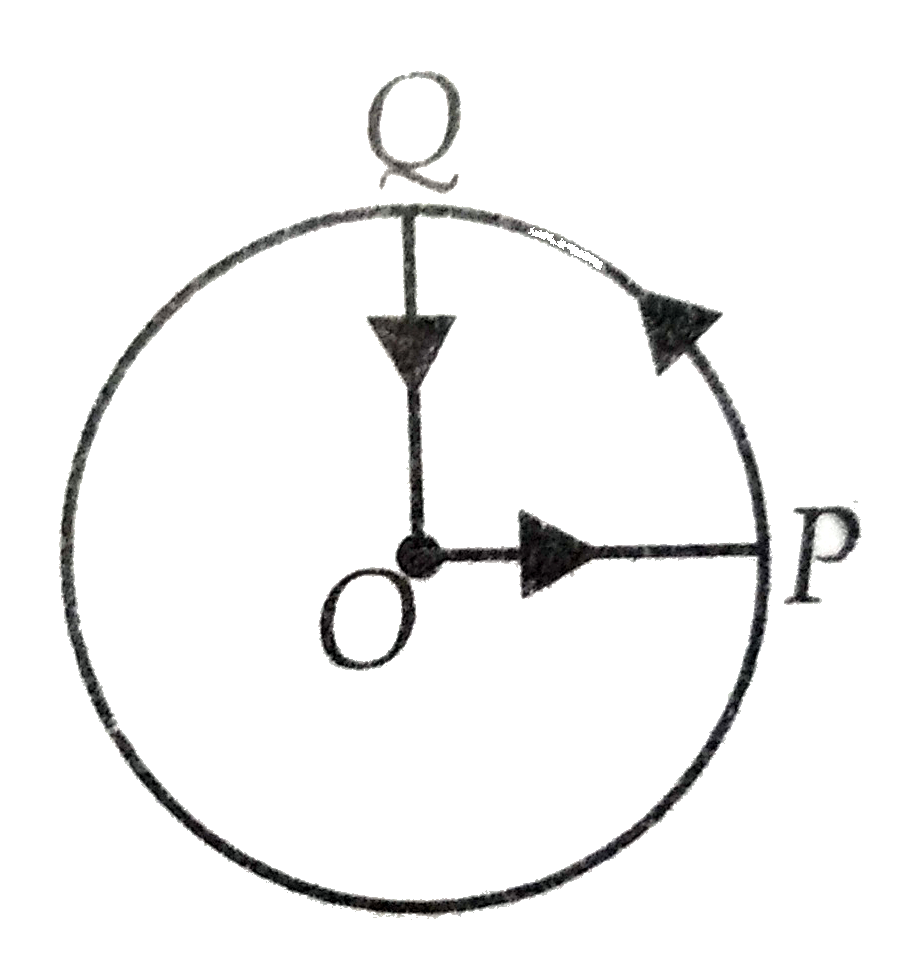
A cyclist starts from the centre O of a circular park of radius 1 km. reaches the edge P of the park, then cycles along the circumference and returns to the centre along QO as shown in the figure.
IF the rounds trip takes ten minutes, the net displacement and average speed of the cyclist ( in metre and kilometre per hour) is

A

0, 1

B

`(pi+4)/(2),0`

C

`21.4, (pi+4)/(2)`

D

`0, 21.4`

Text Solution

Verified by Experts

The correct Answer is:

D

Net displacement = 0 and total distance = OP + PQ + QO
`=1+(2pixx1)/(4)+1=(14.28)/(4)km`
Averagespeed `= (14.28)/(4xx10//60)=(6xx14.28)/(4)=21.42 km//h`
Promotional Banner

Topper's Solved these Questions

  • MOTION IN A PLANE

    DC PANDEY ENGLISH|Exercise (B) Meical entrance special format questions (Assertion and reason)|19 Videos
  • MOTION IN A PLANE

    DC PANDEY ENGLISH|Exercise (B) Meical entrance special format questions (Mathch the columns)|6 Videos
  • MOTION IN A PLANE

    DC PANDEY ENGLISH|Exercise Check point 3.7|15 Videos
  • MOTION

    DC PANDEY ENGLISH|Exercise Medical entrances gallery|19 Videos
  • PROJECTILE MOTION

    DC PANDEY ENGLISH|Exercise Level - 2 Subjective|10 Videos

Similar Questions

Explore conceptually related problems

A cyclist starts from the centre O of a circular park of radius 1km, reaches the edge P of the park, then cycles along the PQ cicumference and returns to the centre along OQ as shown in fig. If the round trip taken ten minute, the net displacement and average speed of the cylists (in kilometer and kinetic per hour) is

A cyclist starts from the center O of a circular park of radius 1km, reaches the edge P of the park, then cycles along the PQ circumference and returns to the center along OQ as shown in fig. If the round trip taken ten minute, the (a) net displacement, (b) average velocity and (c) average speed of the cyclists (in kilometer per hour) is

A cyclist starts from the centre O of circular path of radius 10 m, covers the radius of circular path and reaches at point X on circumference, then cycles along the semi-circular path and reaches the point Y. If he takes 10 minutes to go from O to Y via X, then the net displacement and average speed of the cyclist would be

A vehicle starts from centre O of a circular park of radius 1 km and reaches point A. After travelling 1//4^("th") of the circumference along AB, he returns to the centre of the park. If the total time taken is 10 minute. (i) Net displacement (ii) Average velocity (iii) Average speed in the round trip (iv) Magnitude of average velocity in the interval when vehicle moves from A to B, considering motion of the vehicle uniform.

A cyclist starts form centre O of a circular park of radius 1 km and moves along the path OPRQO as shown in the figure . If he maintains constant speed of 10 ms^(-1) , what is his acceleration at point (R )in magnitude and direction ? .

A cyclist starts form centre O of a circular park of radius 1 km and moves along the path OPRQO as shown Fig. 2 (EP).15. If he maintains constant speed of 10 ms^(-1) , what is his acceleration at point (R )in magnitude and direction ? .

A small, electrically charged bead can slide on a circular, frictioless, insulating rod. A point - like electric dipole (vec(P)) is fixed at the centre of the circle with the dipole.s axis lying in the plane of the circle. Intially the bead is on the plane of symmetry of the dipole, as shown in the figure. The bead is slightly displaced along ring, tangentially with intial speed very close to zero. (Ignore the effect of gravity, assuming that the electric forces are much greater than the gravitational ones). The normal force exerted by rod on the bead is (q = angle between an radius vector of bead, (considering dipole as origin)

A cyclist rides along the circumference of a circular horizontal plane of radius R , with the friction coefficient mu=mu_(0)(1-(r )/(R )) , where mu_(0) is constant and r is distance from centre of plane O . Find the radius of the circle along which the cyclist can ride with the maximum velocity, what is this valocity?

A uniform circular disc has radius R and mass m . A particle, also of mass m , if fixed at a point A on the edge of the disc as shown in the figure. The disc can rotate freely about a horizontal chord PQ that is at a distance R//4 from the centre C of the disc. The line AC is perpendicular to PQ . Initially the disc is held vertical with the point A at its highest position. it is then allowed to fall, so that it starts rotation about PQ. Find the linear speed of the particle as it reaches its lowest position.

A track consists of two circular pars ABC and CDE of equal radius 100 m and joined smoothly as shown in figure.Each part subtends a right angle at its centre. A cycle weighing 100 kg together with rider travels at a constant speed of 18 km/h on the track. A. Find the normal contact force by the road on the cycle when it is at B and at D. b.Find the force of friction exerted by the track on the tyres when the cycle is at B,C and D. c. Find the normal force between the road and the cycle just before and just after the cycle crosses C. d. What should be the minimum friction coefficient between the road and the tyre, which will ensure that the cyclist can move with constant speed? Take g=10 m/s^2

DC PANDEY ENGLISH-MOTION IN A PLANE-(A) Taking it together
  1. At a metro station, a girl walks up a stationary escalator in time t1....

    Text Solution

    |

  2. The displacement of a body along X-axis depends on time as sqrt(x)=t+1...

    Text Solution

    |

  3. A cyclist starts from the centre O of a circular park of radius 1 km. ...

    Text Solution

    |

  4. A particle moves along a straight line OX. At a time t(in second), the...

    Text Solution

    |

  5. Two boys are standing at the ends A and B of a ground where AB = a. Th...

    Text Solution

    |

  6. A bullet emerges from a barrel of length 1.2 m with a speed of 640 ms^...

    Text Solution

    |

  7. From the top of a tower, 80m high from the ground a stone is thrown in...

    Text Solution

    |

  8. A boggy of uniformly moving train is suddenly detached from train and ...

    Text Solution

    |

  9. A man is 45 m behind the bus when the bus starts acceleration from res...

    Text Solution

    |

  10. A body moves for a total of nine second starting from rest with unifor...

    Text Solution

    |

  11. A point initially at rest moves along x-axis. Its acceleration varies ...

    Text Solution

    |

  12. The time taken by a block of wood (initially at rest) to slide down a ...

    Text Solution

    |

  13. A particle move a distance x in time t according to equation x = (t + ...

    Text Solution

    |

  14. A ball is thrown upwards with a speed u from a height h above the grou...

    Text Solution

    |

  15. The position of a particle along X-axis at time t is given by x=2+t-3t...

    Text Solution

    |

  16. A ball falls freely from rest. The ratio of the distance travelled in ...

    Text Solution

    |

  17. What is nature of trajectory of a particle having a uniformly accelera...

    Text Solution

    |

  18. A particle moves along a straight line. Its position at any instant is...

    Text Solution

    |

  19. A point moves in a straight line so its displacement x meter at time t...

    Text Solution

    |

  20. The displacement x of a particle varies with time t as x = ae^(-alpha ...

    Text Solution

    |
