Home
Class 11
PHYSICS
An explosion blows a rock into three par...

An explosion blows a rock into three parts. Two parts go off at right angles to each other . These two are `1 kg` first part moving with a velocity of `12 ms^(-1) and 2 kg` second part moving with a velocity of `8 ms^(-1)`. If the third part flies off with a velocity of `4 ms^(-1)`. Its mass would be

Text Solution

Verified by Experts
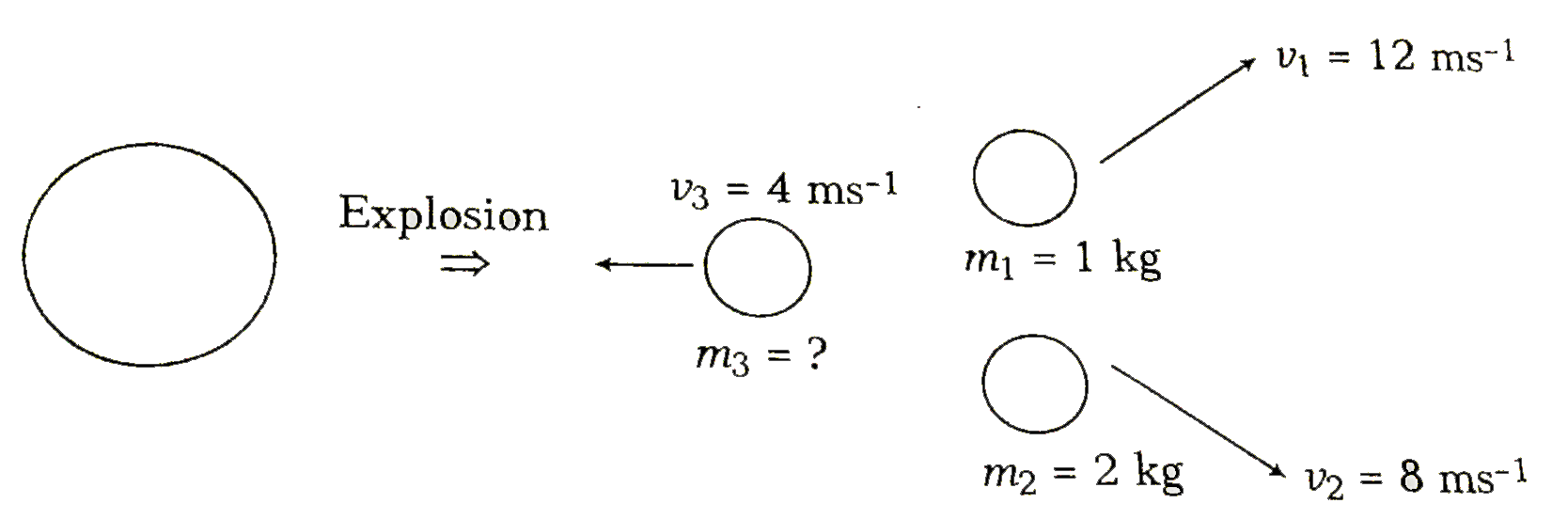

From the law of conservation of momentum,
`p_(3)=sqrt(p_(1)^(2)+p_(2)^(2))`
`implies m_(3)xx4=sqrt((1xx12)^(2)+(2xx8)^(2))=20 implies m_(3)=5 kg`
Promotional Banner

Similar Questions

Explore conceptually related problems

An explosion blows a rock into three parts. Two pieces go off at right angles to each other, 1.0 kg piece with velocity of 12 m//s and other , 1.0 kg piece with a velocity of 12 m//s and other 2.0 kg piece with a velocity of 8 m//s . If the third piece flies off with a velocity of 40 m//s compute the mass of the third piece.

The wavelength of an electron moving with velocity of 10^(7)ms^(-1) is

A ball of mass 0.5 kg is moving with a velocity of 2 ms^(-1) . It if subjected to a force of x Newton for 2s. Because of this force, the ball moves with a velocity of 3ms^(-1) . The value of x is :

A cricket ball of 0.5 kg is moving with a velocity of 100ms^(-1) . The wavelength associated with its motion is :

A particle moves in the direction of east for 2s with velocity of 15 ms^(-1). Then it moves towards north for 8s with a a velocity of 5 ms^(-1). The average velocity of the particle is

A body covers first one-third of the distance with a velocity 10 ms^(-1) in same direction, the second one-third with a velocity 20 ms^(-l) and last one-third with a velocity of 30 ms^(-1) . The average velocity of body is

In a reference frame a man A is moving with velocity (3hati-4hatj)ms^(-1) and another man B is moving with velocity (hati+hatj)ms^(-1) relative to A. Find the actual velocity of B.

A body of mass 10 mg is moving with a velocity of 100 ms^(-1) . The wavelength of the de Broglie wave associated with it would be

What will be de Broglie's wavelength of an electron moving with a velocity of 1.2 xx 10^(5) ms^(-1) ?

The de-Broglie wavelength associated with a particle of mass 10^-6 kg moving with a velocity of 10 ms^-1 , is

