Home
Class 11
PHYSICS
A riding ball of mass m strikes a rigid ...

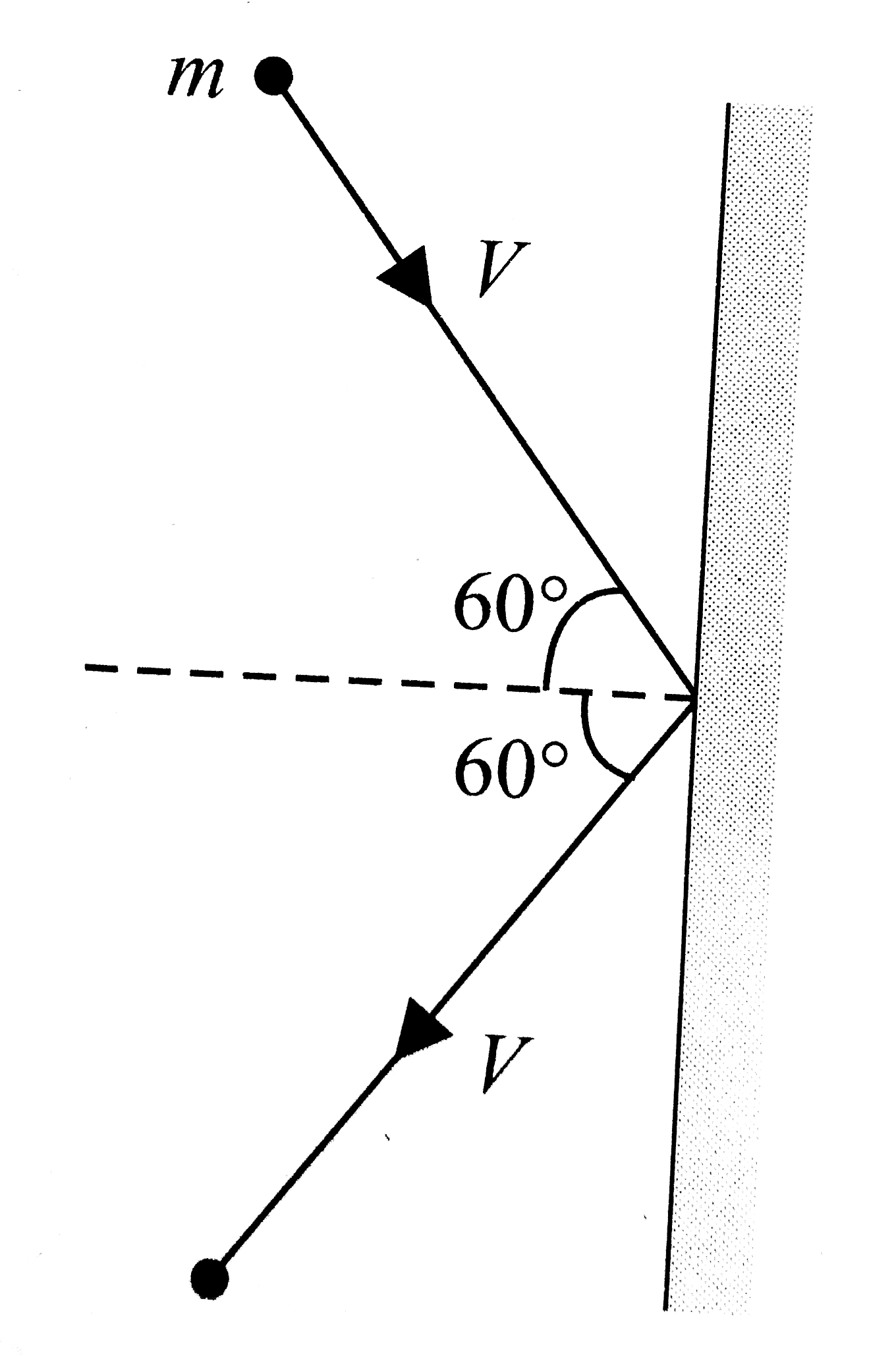
A riding ball of mass `m` strikes a rigid wall at `60^(@)` and gets reflected without loss of speed as shown in the figure below. The value of impulse imparted by the wall on the ball will be.

Text Solution

Verified by Experts
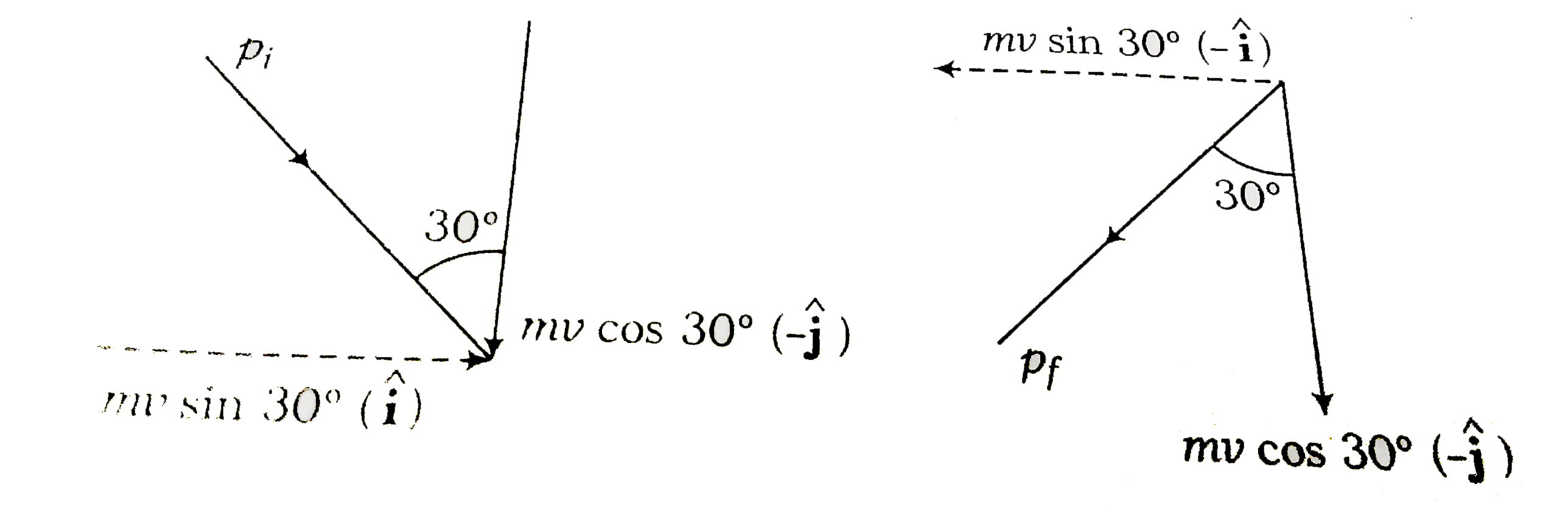

According to the question ,
(i) `p_(i)=mv sin 30^(@)hati-mv cos 30^(@)hatj`
`p_(f)=-mv sin 30^(@)hati-mv cos 30 ^(@) hatj`
`therefore Deltap=p_(f)-p_(i)=-2mv sin 30^(@)hati=-mvhati`
`abs(Deltap)=mv`
(ii) Negative sign of the impulse shows that it is along negativ x-direction. Since impulse and force are in the same direction, the force on the ball is along the negative direction of x-axis. Hence the force on the wall will be along positive x-axis.
Promotional Banner

Similar Questions

Explore conceptually related problems

A rigid ball of mass m strikes a rigid wall at 60^(@) and gets reflected without loss of speed as shown in the figure. The value of impulse imparted by the wll on the ball will be

A ball of mass m strikes a rigid wall with speed v and gets reflected without any loss of speed, as shown in the figure. (a) What is the magnitude of the impulse imparted to the ball by the wall? (b) What is the direction of the force on the wall due to the ball?

A particle of mass m strikes a wall with speed v at an angle 30^(@) with the wall elastically as shown in the figure. The magnitude of impulse imparted to the ball by the wall is

A ball of mass m strikes a rigid walJ with speed u and rebounds with the same speed. The impulse imparted to the ball by the wall is

A ball of mass m strikes a rigid walJ with speed u and rebounds with the same speed. The impulse imparted to the ball by the wall is

Two identical billiard balls striks a rigid wall with the same speed but at different angles , and get reflected without any change in speed , as shown in Fig . What is (i) the direction of the force on the wall due to each ball ? (ii) the ratio of the magnitudes of impulses imparted to the balls by the wall ?

A ball of mass M moving with speed v collides perfectly inelastically with another ball of mass m at rest. The magnitude of impulse imparted to the first ball is

A ball of mass M moving with speed v collides perfectly inelastically with another ball of mass m at rest. The magnitude of impulse imparted to the first ball is

A ball of mass M moving with speed v collides perfectly inelastically with another ball of mass m at rest. The magnitude of impulse imparted to the first ball is

A 0.5 kg ball moving with a speed of 12 m//s strikes a hard wall at an angle of 30^(@) with the wall. It is reflected with the same speed and at the same angle . If the ball is in contact with the wall for 0.25 s , the average force acting on the wall is

