Home
Class 11
PHYSICS
An object is in equilibrium under four c...

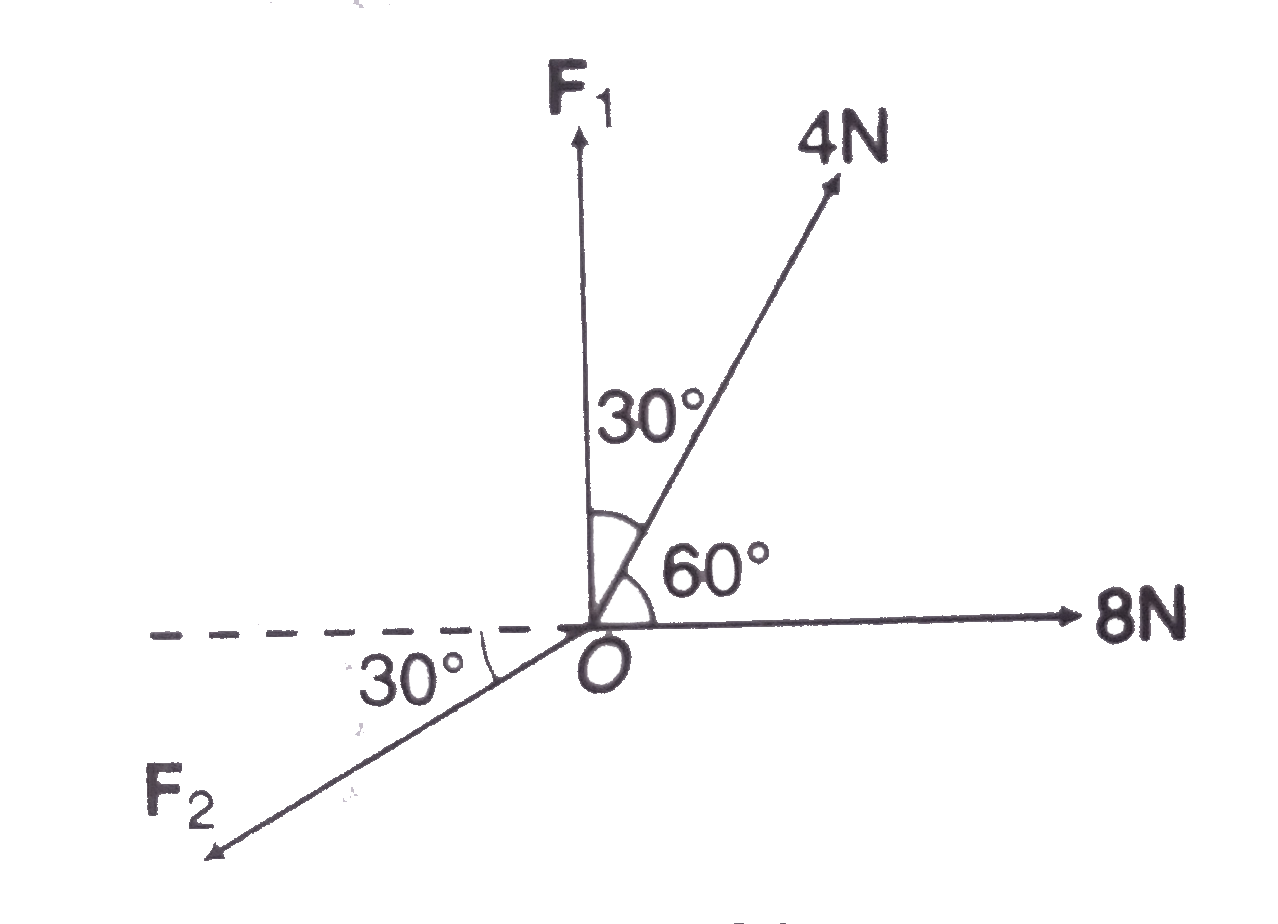
An object is in equilibrium under four concurrent forces in the direction shown in figure. Find the magnitudes of `F_(1)` and `F_(2)`

Text Solution

Verified by Experts

The object is in equilibrium. Hence,
(i) `sumF_(x)=0`
`therefore 8+4 cos 60^(@)-F_(2) cos 30^(@)=0`
or `8+2-F_(2)(sqrt3)/(2)=0 " or " F_(2)=(20)/(sqrt(3))N`
(ii) `sumF_(y)=0 therefore F_(1)+4sin 60^(@)-F_(2) sin 30^(@)=0`
or `F_(1)(4sqrt(3))/(2)-(F_(2))/(2)=0" or "F_(1)=(F_(2))/(2)-2 sqrt(3) =(10)/(sqrt3)-2sqrt(3)`
or `F_(1)=(4)/(sqrt3)N`
Promotional Banner

Similar Questions

Explore conceptually related problems

A homogeneous block rests against a vertical wall for which the coefficient of friction is 1//2 . A force 'F' is applied to the block in the direction as shown in figure. Find the maximum magnitude of applied force 'F' such that block remains in rest.

For the circuit shown in figure the direction and magnitude of the force on PQR is :

Four forces are acting on a body as shown in figure. The magnitude of resultant of the forces is

A bob of weight 3N is in equilibrium under the action of two string 1 and 2 (figure) . Find the tension forces in the string.

A body is in equilibrium under the action of three coplanar forces P,Q and R as shown in figure. Select the correct statement.

There are four force acting at a point p produced by strings as shown in figure, which is at rest. The force F_(1) and F_(2) are .

There are four force acting at a point p produced by strings as shown in figure, which is at rest. The force F_(1) and F_(2) are .

According to Newton.s second law of motion, resultant force on a particle is in the direction of acceleration of the particle. Two forcce F_(1) and F_(2) are acting on a particle as shown in the figure. The acceleration of the particle is along X-axis. FInd the value of F_(1) (in newton)

Three infinetely long wires 1 , 2 and 3 carry equal currents in the directions shown in fiugre. They are placed on the vertices of an equilateral triangle. Let F be the magnitude of force between any two wires. F_(1) is the magnitude of force on wire 1 and F_(2) the magnitude of force on wire 2. Then

What is the maximum value of the force F such that the block shown in the figure does not move?
