Home
Class 11
PHYSICS
A block of mass m is at rest on a rough ...

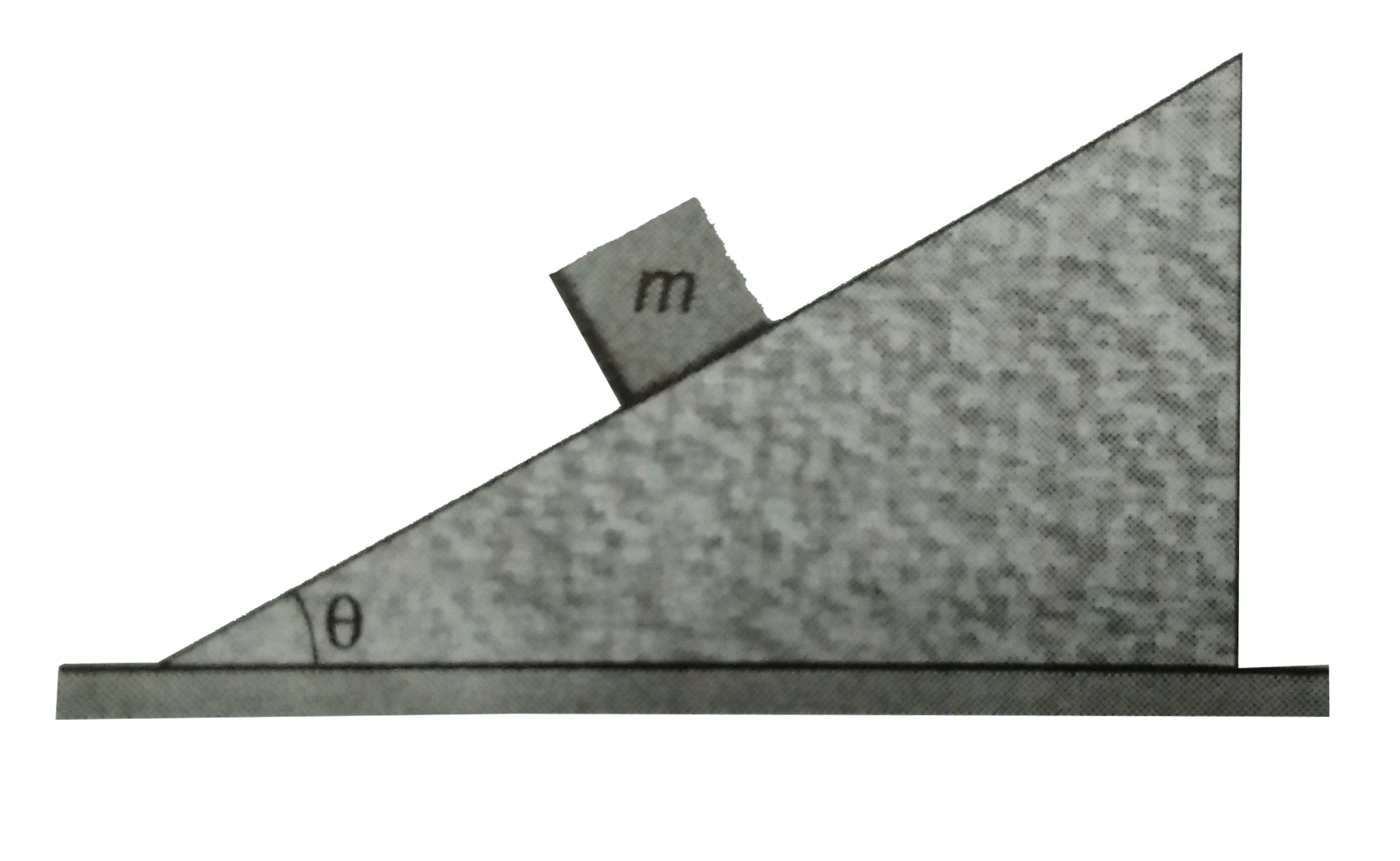
A block of mass `m` is at rest on a rough wedge as shown in figure. What is the force exerted by the wedge on the block?

Text Solution

Verified by Experts
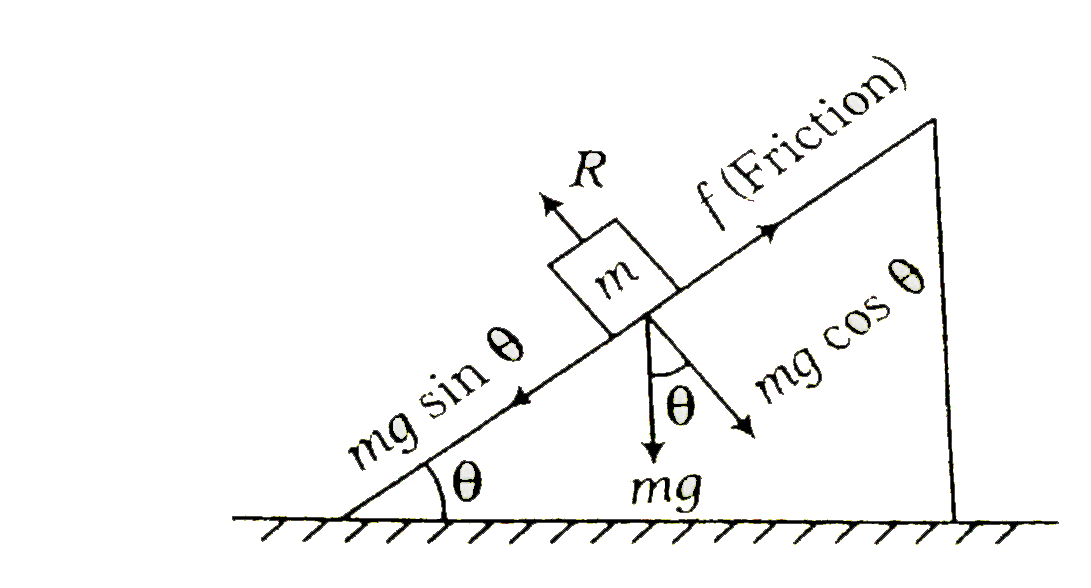

Since, the block is permanently at rest, it is in equilibrium . Net force on it should be zero. In this case only two forces are acting on the block.
(i) Weight=mg( downward)
(ii) Contact force (resultant of normal reaction and friction force) applied by the wedge on the block.
For the block to be in equilibrium these two forces should be equal and opposite. Therefore, force exerted by the wedge on the bock is mg (upward).
Note From Newton's third law of motion- force exerted by the block on the wedge is also mg but downwards. The result can also be obtained in a different manner. The normal force on the block is `N=mg cos theta` and the friction force on the block is `f= mg sin theta`( not `mu mg cos theta`) because it is not the case of limiting friction.
These two forces are mutually perpendicular.
`therefore` Net contact force would be `sqrt(N^(2)+f^(2))" or " sqrt((mg cos theta)^(2)+(mg sin theta)^(2))` which is equal to mg.
Promotional Banner

Similar Questions

Explore conceptually related problems

A block of mass m is at rest on a rought wedge as shown in figure. What is the force exerted by the wedge on the block?

A block of mass 3kg is at rest on a rough inclined plan as shown in the Figure. The magnitude of net force exerted by the surface on the block will be

A block of mass m is at rest on wedge as shown in figure. Let N be the normal reaction between two and f the force of friction, then choose the wrong option.

In the following figure, the object of mass m is held at rest by a horizontal force as shown. The force exerted by the string on the block is -

A block of mass m is stationary with respect to a rough wedge as shown in figure. Starting from rest in time t, (m = 1 kg, theta=30^(@), a = 2 m//s^(2) , t = 4 s) work done on block :

A block of mass m is released from a wedge of mass m as shown in figure . Find the time taken by the block to reach the end of the wedge.

A block of mass m is released from the top of a wedge of mass M as shown in figure. Find the displacement of wedges on the horizontal ground when the block reaches the bottom of the wedges. Neglect friction everywhere.

A block of mass m is arranged on the wedge as shown in figure . The wedge angle is theta . If the masses of pulley and thread and negligible and friction is absent , find the acceleration of the wedge

A block of mass m lies on wedge of mass. Mas shown in figure. With what minimum acceleration must the wedge be moved towared right horizontally so that block m falls freely.

A block of mass m is placed on the inclined sufrace of a wedge as shown in fig. Calculate the acceleration of the wedge and the block when the block is released. Assume all surfaces are frictionless.

