Home
Class 11
PHYSICS
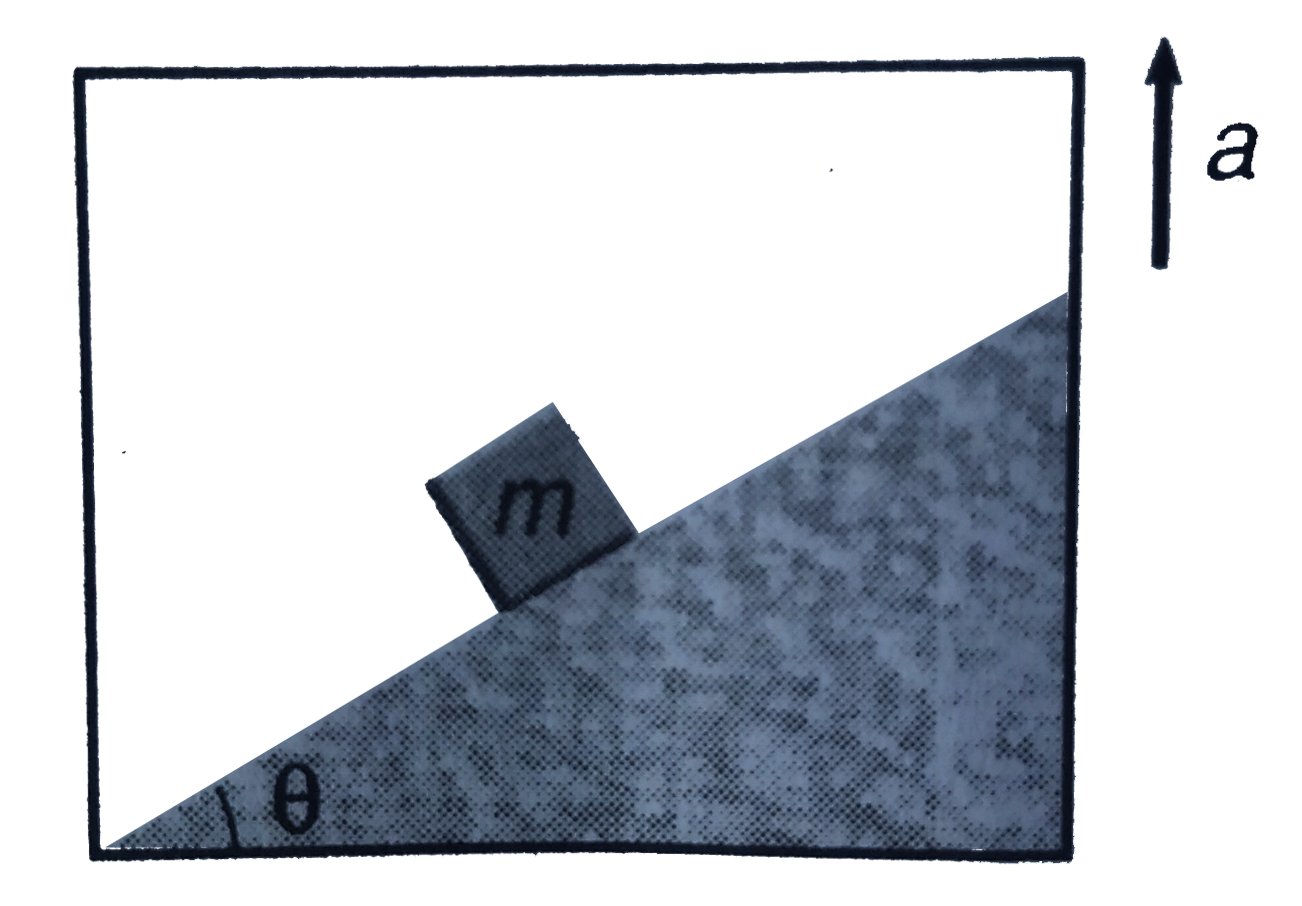
In the adjoining figure a wedge is fixed...

In the adjoining figure a wedge is fixed to an elevator moving upwards with an acceleration `a`. A block of mass `m` is placed over the wedge.Find the acceleration of the block with respect to wedge. Neglect friction

Text Solution

Verified by Experts
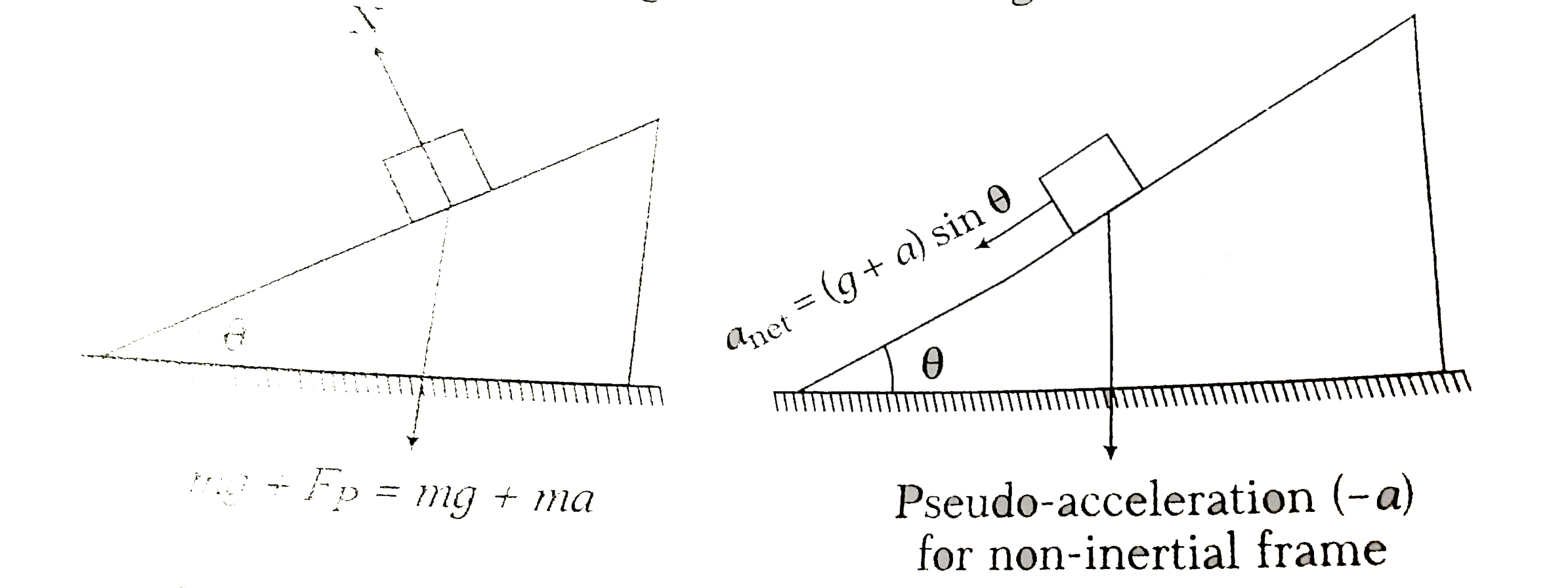
Since, acceleration of block w.r.t. wedge ( an accelerating or non-inertial frame of reference) is to be find out.
FBD of block w.r.t . Wedge is shown in fig.

The acceleration would had been g `sin theta` (down the plane) if the lift were stationery or when only weight (i.e.,mg) acts downwards.
Here, downward force is m(g+a)
`therefore` Acceleration of the block ( of course w.r.t. wedge) will be (g+a) `sin theta` down the plane.
Promotional Banner

Similar Questions

Explore conceptually related problems

A block of mass 'm' is kept on a smooth moving wedge. If the acceleration of the wedge is 'a'

Figure shows a block A constrained to slide along the inclined plane of the wedge B shown. Block A is attached with a string which passes through three ideal pulleys and connected to the wedge B. If wedge is pulled toward right with an acceleration a, find (a) the acceleration of the block with respect to wedge (b) the acceleration of the block with respect to ground.

A block of mass 2kg released from the top of a smooth fixed wedge inside the elevator which is moving downward with an acceleration a = 5 m/s^2 as shown in the figure.The value of acceleration of the block w.r.t wedge will be (g = 10 m/s^2)

A lift is moving upwards as shown in figure in figure A block of mass m s placed on a wedge inside the left and it is statioary with to lift Net force acting on m is

A block of mass m=5kg is placed on the wedge of mass M=32kg as shown in the figure. Find the acceleration of wedge with respect to ground. (Neglect any type of friction. Spring and pulley are ideal)

All surface are smooth. Find the acceleration of mass m relative to wedge when wedge is moving with acceleration 'a'

In the adjoining figure, the coefficient of friction between wedge (of mass M ) and block (of mass m ) is mu . Find the minimum horizontal force F required to keep the block stationary with respect to wedge.

As shown in the figure a block of mass 'm' is placed on a smooth wedge moving with constant acceleration such that block does not move with respect to the wedge. Find work done by the net force on the block in time t. (Initial speed is 0)

A smooth wedge of mass M is pushed with an acceleration a=gtantheta and a block of mass m is projected down the slant with a velocity v relative to the wedge. The horizontal force applied on the wedge is:

A smooth wedge of mass M is pushed with an acceleration a=gtantheta and a block of mass m is projected down the slant with a velocity v relative to the wedge. Q. The time taken by the block to reach the ground is:

